Introduction: The Rise of Digital Dollar Accounts
For millions of freelancers, remote workers, content creators, and small business owners around the world, access to a stable, U.S.-dollar-denominated bank account used to be a privilege reserved for people living in the United States or Europe. That’s changing fast. A new generation of fintech platforms has emerged to give people in Latin America, and increasingly other regions, the ability to open a dollar account from their phone, get paid by international clients and platforms, and hold their savings in a currency that isn’t losing value to local inflation.
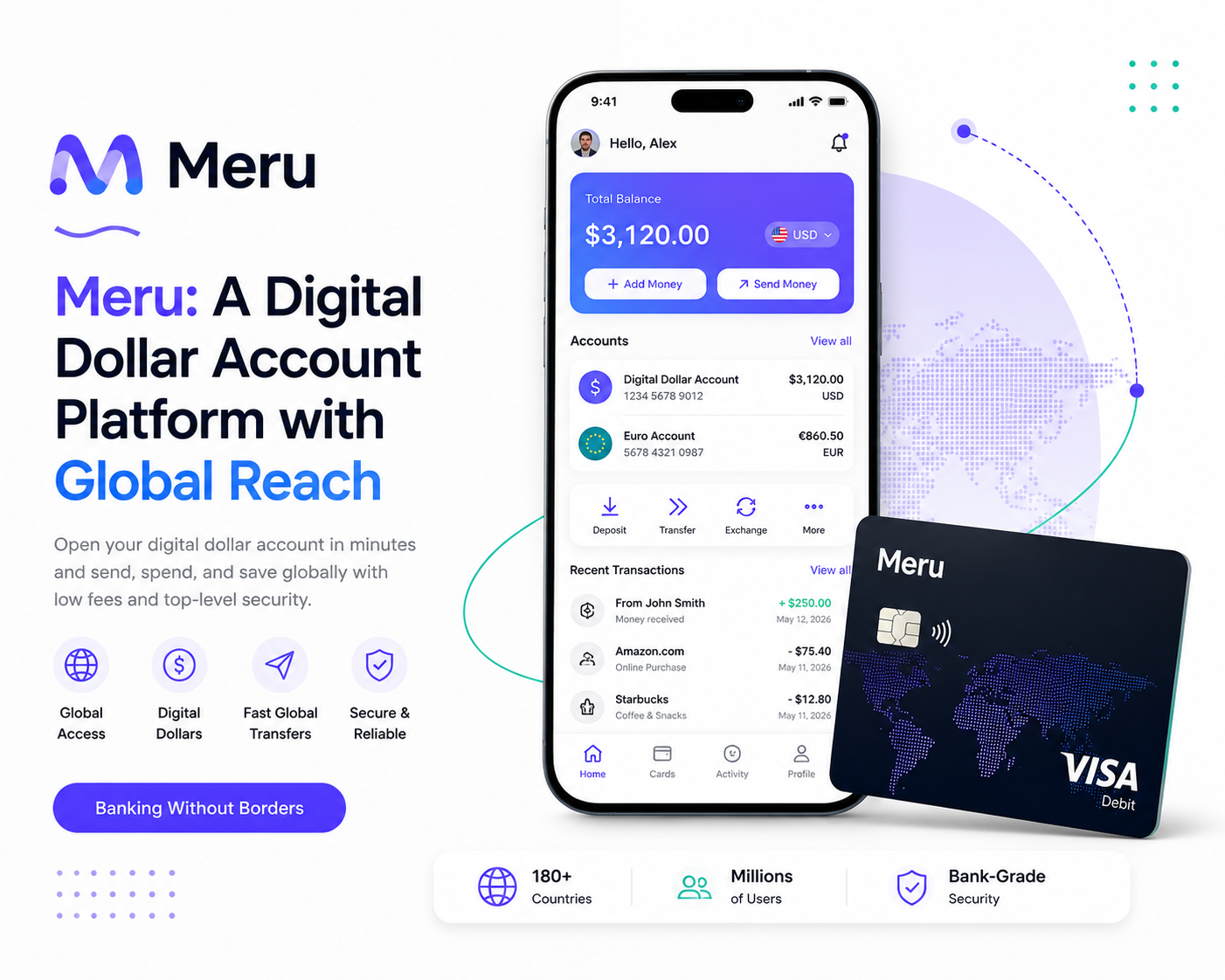
One of the platforms leading this movement is Meru, a digital banking app built by R3mit Solutions Inc. that combines a U.S. dollar account, a European IBAN, a Visa card, and crypto/DeFi access into a single mobile experience. In this guide, we’ll walk through what Meru is, how it works, who it’s built for, its core features, its fee structure, its strengths, and the concerns you should be aware of before opening an account.
As with any financial product, this article is meant to inform your research — not to replace it. Always check the platform’s current terms, regulatory status, and fee schedule directly before moving your money.
What Is Meru?
Meru is a neobank and digital wallet platform focused primarily on Latin America, designed to give freelancers, remote workers, content creators, and small businesses a way to receive, hold, and spend money in U.S. dollars — without needing a traditional U.S. bank account or a Social Security number.
At its core, Meru offers:
- A personal U.S. dollar account with its own account and routing number
- A European IBAN account for receiving SEPA transfers
- Virtual and physical Visa cards for spending online and in stores
- The ability to receive payments from platforms like Upwork, Payoneer, PayPal, Stripe, Deel, YouTube, and Amazon
- Cash withdrawal in local currency through MoneyGram in more than 200 countries and territories
- Crypto and stablecoin support (USDC/USDT) built on networks like Stellar, Polygon, Base, and Tron
- A savings feature that lets users earn yield on their dollar balance
- A unified personal and business account experience within the same app
Meru was founded in 2022–2023 and is headquartered in Orlando, Florida. Beyond its consumer app, the company has also built out a developer-facing stablecoin API infrastructure, allowing other fintech and crypto companies to integrate dollar accounts, KYC/onboarding, payouts, and wallets into their own products — positioning Meru as both a consumer neobank and a backend financial infrastructure provider.
Who Is Meru Built For?
Meru’s target audience is fairly specific, and understanding it helps clarify whether the platform is the right fit for you.
1. Freelancers and Remote Workers
If you work for international clients or platforms — Upwork, Fiverr, Deel, or a U.S.-based employer — and you live in a country where opening a U.S. dollar account is difficult or impossible, Meru gives you a way to receive that income directly in dollars.
2. Content Creators
YouTube, TikTok, and other platforms often pay creators in USD. Meru is built to receive these payouts directly, letting creators avoid unfavorable currency conversion from local banks.
3. Small Businesses and SMEs
Meru’s business accounts extend the same dollar/euro infrastructure to small companies that need to invoice international clients, pay international vendors, or hold reserves in a stable currency.
4. People Facing Local Currency Instability
In countries like Venezuela, Argentina, and Bolivia, where local currencies have experienced severe inflation, holding savings in digital dollars is one of the primary reasons users cite for adopting platforms like Meru.
5. Developers and Fintech Companies
Through its API product, Meru also serves businesses that want to embed dollar accounts, stablecoin rails, or payout infrastructure into their own apps, without building banking relationships from scratch.
Core Features Breakdown
U.S. Dollar Account With Real Account Numbers
Unlike some apps that only offer a virtual balance, Meru issues users a real U.S. account and routing number, allowing them to receive ACH and wire transfers as if they had a U.S. bank account — without ever setting foot in the country.
European IBAN
For users who need to receive euros or work with European clients, Meru also provides a personal IBAN, enabling SEPA transfers directly into the same app.
Visa Debit Card (Virtual and Physical)
Meru issues Visa-branded cards backed by the user’s dollar balance. These can be used for online purchases, subscriptions (Netflix, Spotify, Airbnb), and in-person payments anywhere Visa is accepted. Card controls — freezing, spending limits, and real-time notifications — are managed directly from the app.
Local Cash Withdrawals via MoneyGram
One of Meru’s more distinctive features is the ability to withdraw funds as physical cash through MoneyGram’s network, which spans more than 200 countries and territories. This is particularly useful in regions where ATM access, card acceptance, or banking infrastructure is inconsistent.
Crypto and DeFi Access
Meru integrates cryptocurrency functionality directly into the app, giving users access to buy, hold, and trade a wide range of tokens, along with the option to explore DeFi-based yield opportunities. This dual fiat/crypto approach differentiates Meru from more traditional neobanks that stick strictly to fiat rails.
Peer-to-Peer Transfers
Transfers between Meru users are typically instant and free, making the platform attractive for families or business partners who frequently move money between each other across borders.
Business and Personal Accounts in One App
Users who run a side business or freelance operation alongside personal finances can manage both account types without needing separate apps or logins.
Meru’s Fee Structure
Transparency around fees is one of the most important things to evaluate in any digital banking platform. According to Meru’s published fee schedule, the personal account structure generally looks like this:
| Service | Fee |
|---|---|
| Account opening | Free |
| Monthly maintenance | Free |
| U.S. account opening | Free |
| IBAN account opening | Free |
| Mexico account opening | Free |
| Transfers between Meru users | Free |
| Virtual card | Free |
| Physical card | ~$5 USD |
| Card shipping | Varies by destination country |
| International purchases | 0%* |
| ATM withdrawals | $0** |
*Card network conversion fees may still apply depending on the currency involved. **Local ATM operators may charge their own independent fee, separate from Meru’s.
This fee structure is competitive with many international neobanks, particularly for users who would otherwise face high international wire fees or unfavorable currency conversion rates through traditional local banks. That said, fee schedules in fintech change frequently — always confirm current rates directly in the app before initiating a transaction, since Meru states that final costs are displayed at the point of confirmation.
How to Open a Meru Account
Opening an account is designed to be fast and fully digital:
- Download the app (available on iOS and Android)
- Verify your identity using a government-issued ID and a selfie, processed through Veriff’s identity verification technology to meet KYC/AML requirements
- Choose your account type — personal or business
- Get your account details — a U.S. account/routing number and, if needed, a European IBAN
- Fund your account via bank transfer, instant PIX (in supported countries), cash deposit, or cryptocurrency
- Order your card — virtual immediately, physical shipped to your location
- Start receiving and sending funds internationally
Meru currently supports users across more than a dozen Latin American countries, including Colombia, Venezuela, Argentina, Mexico, and Brazil, with country-specific features (like PIX in Brazil) tailored to local payment rails.
Strengths of the Meru Platform
1. Genuine Access to U.S. Banking Infrastructure
For users in countries where opening a traditional U.S. account is nearly impossible without residency or a Social Security number, Meru’s ability to issue real account and routing numbers is a significant value proposition.
2. Multi-Currency Flexibility
Holding both USD and EUR balances, alongside crypto assets, in a single account gives users more flexibility than a typical single-currency neobank.
3. Wide Payment Platform Compatibility
Support for receiving payments from Upwork, Payoneer, PayPal, Stripe, Deel, YouTube, and Amazon makes Meru particularly convenient for freelancers and creators who already work across multiple international platforms.
4. Cash Access Through MoneyGram
The ability to convert a digital dollar balance into physical local currency cash addresses a real gap for users in regions where digital payment infrastructure isn’t universally accepted.
5. Competitive, Transparent Fee Structure
Free account opening, free maintenance, and $0 stated ATM withdrawal fees (subject to third-party ATM charges) make Meru relatively low-cost compared to legacy cross-border banking options.
6. Built-In Crypto Access
For users who already hold or want exposure to stablecoins and other crypto assets, having this functionality inside the same app as a fiat dollar account is a meaningful convenience.
Concerns and Criticism to Weigh Carefully
No fair review of a financial platform would be complete without addressing user feedback, and Meru has drawn a mix of very positive and very negative reviews across app stores and review platforms.
Customer Support Response Times
A recurring theme in user reviews on both the App Store and Trustpilot is dissatisfaction with customer support speed and helpfulness. Multiple users report waiting a full day or longer for a response, and some describe support as dismissive or unable to resolve account access issues in a timely manner.
Account Lockouts and Access Issues
Some reviewers describe being locked out of their accounts for extended periods — in a few cases, weeks — due to verification code delivery issues or other technical problems, with limited recourse through support channels.
Disputed Withdrawal Experiences
A small number of reviews describe disputes over withdrawal transactions, including cases where users say funds were debited without the withdrawal being completed as expected. These are serious claims, and while individual anecdotal reviews shouldn’t be taken as representative of every user’s experience, they are worth factoring into your risk assessment — especially before moving large sums.
App Stability
Several reviews mention occasional outages or slower-than-expected internal transfer speeds compared to competing apps, though most describe the core functionality as working well day-to-day.
A Note on Similarly Named Services
It’s worth flagging that there are unrelated entities using similar names in adjacent spaces — including at least one flagged as a likely scam operation using a “Meru Capital” branding for investment schemes, and separate, unrelated organizations using “MERU” as a name in entirely different industries (such as wellness and education). Before sending funds anywhere, double-check that you’re using Meru’s official app and the correct official domain, since name confusion is a common vector for fraud in the fintech space.
Bottom line: Meru’s feature set is genuinely useful and addresses a real problem for its target users, but the volume and consistency of customer service complaints in public reviews suggest it’s wise to start with a smaller balance, test withdrawals early, and avoid relying on the platform as your sole financial safety net until you’ve built confidence in its reliability for your specific use case.
Meru vs. Other Digital Dollar Platforms
To put Meru in context, here’s how it generally compares to some of the better-known alternatives in the cross-border digital banking space:
| Platform | Core Focus | Standout Feature | Consideration |
|---|---|---|---|
| Meru | LATAM freelancers/creators | Cash withdrawal via MoneyGram + crypto access | Mixed customer support reviews |
| Wise | Global multi-currency transfers | Wide country/ATM network, transparent FX | Not primarily built for freelancer payment receiving |
| Payoneer | Freelancer/marketplace payouts | Deep integration with freelance platforms | Can carry withdrawal/conversion fees |
| Deel | Global payroll for employers/contractors | Strong for formal contractor payments | Primarily tied to Deel-managed contracts |
Each of these platforms has a different core focus, so the “best” choice depends heavily on whether your priority is receiving freelance income, transferring money at low FX cost, formal payroll compliance, or — in Meru’s case — a combination of dollar banking, local cash access, and crypto in a single app.
Security and Compliance
Meru uses Veriff, a recognized identity verification provider, to handle KYC (Know Your Customer) and AML (Anti-Money Laundering) compliance during onboarding. The platform states that funds are protected and that all transaction costs are disclosed within the app before a user confirms a transaction. As with any financial app handling cross-border transfers and crypto assets, users should:
- Enable any available two-factor authentication
- Avoid reusing passwords from other accounts
- Be cautious of phishing attempts referencing “Meru” support
- Regularly review account activity and set card spending limits
- Keep withdrawal habits conservative until you’ve verified reliability firsthand
Frequently Asked Questions (FAQ)
Is Meru a licensed bank? Meru operates as a fintech platform that partners with banking infrastructure providers to issue account numbers and cards, rather than being a chartered bank itself. This is a common structure among neobanks. Always review the platform’s current terms and licensing disclosures for the most accurate and up-to-date regulatory information.
Which countries can use Meru? Meru is primarily focused on Latin America, with availability across 14+ countries including Colombia, Venezuela, Argentina, Mexico, Bolivia, and Brazil, alongside broader international withdrawal access through MoneyGram’s global network.
Can I receive payments from Upwork or PayPal through Meru? Yes. Meru is built to receive payments from a range of platforms including Upwork, Payoneer, PayPal, Stripe, Deel, YouTube, and Amazon.
Does Meru charge monthly fees? According to Meru’s published fee schedule, account opening and monthly maintenance are free. Fees apply to specific services like physical card issuance and shipping.
Can I hold crypto and fiat dollars in the same account? Yes, Meru integrates both fiat USD/EUR balances and cryptocurrency holdings within the same app, including access to a wide range of tokens.
Is customer support reliable? This is an area of concern based on user reviews. Multiple users report slow response times and difficulty resolving account issues. It’s advisable to test the platform with smaller amounts first and read recent reviews before relying on it heavily.
What happens if I need to close my account? Some user reviews describe friction when trying to close an account, so it’s worth reviewing the current in-app process and terms of service before opening an account, particularly if you may need to exit the platform in the future.
Conclusion
Meru fills a genuine gap in the financial lives of freelancers, remote workers, content creators, and small businesses across Latin America — people who need dollar-denominated banking, international payment compatibility, and local cash access, but who have historically been locked out of traditional U.S. banking. Its combination of a real U.S. account and routing number, a European IBAN, a Visa card, MoneyGram cash-out access, and built-in crypto functionality makes it one of the more feature-rich platforms in its category.
At the same time, the pattern of customer service complaints and account access issues reported by users is a legitimate factor to weigh before making Meru your primary financial account. As with any fintech platform handling cross-border money movement, the smart approach is to start small, verify that deposits and withdrawals work smoothly for your specific situation, keep your security settings tight, and only scale up your usage once you’ve built confidence in the platform’s day-to-day reliability.
For the right user — someone who needs dollar income access from a country with limited banking options and is comfortable navigating a newer fintech platform — Meru can be a genuinely useful tool. For anyone planning to move large sums or who needs guaranteed, fast customer support, it’s worth weighing Meru against more established alternatives and reading the latest user feedback before committing.