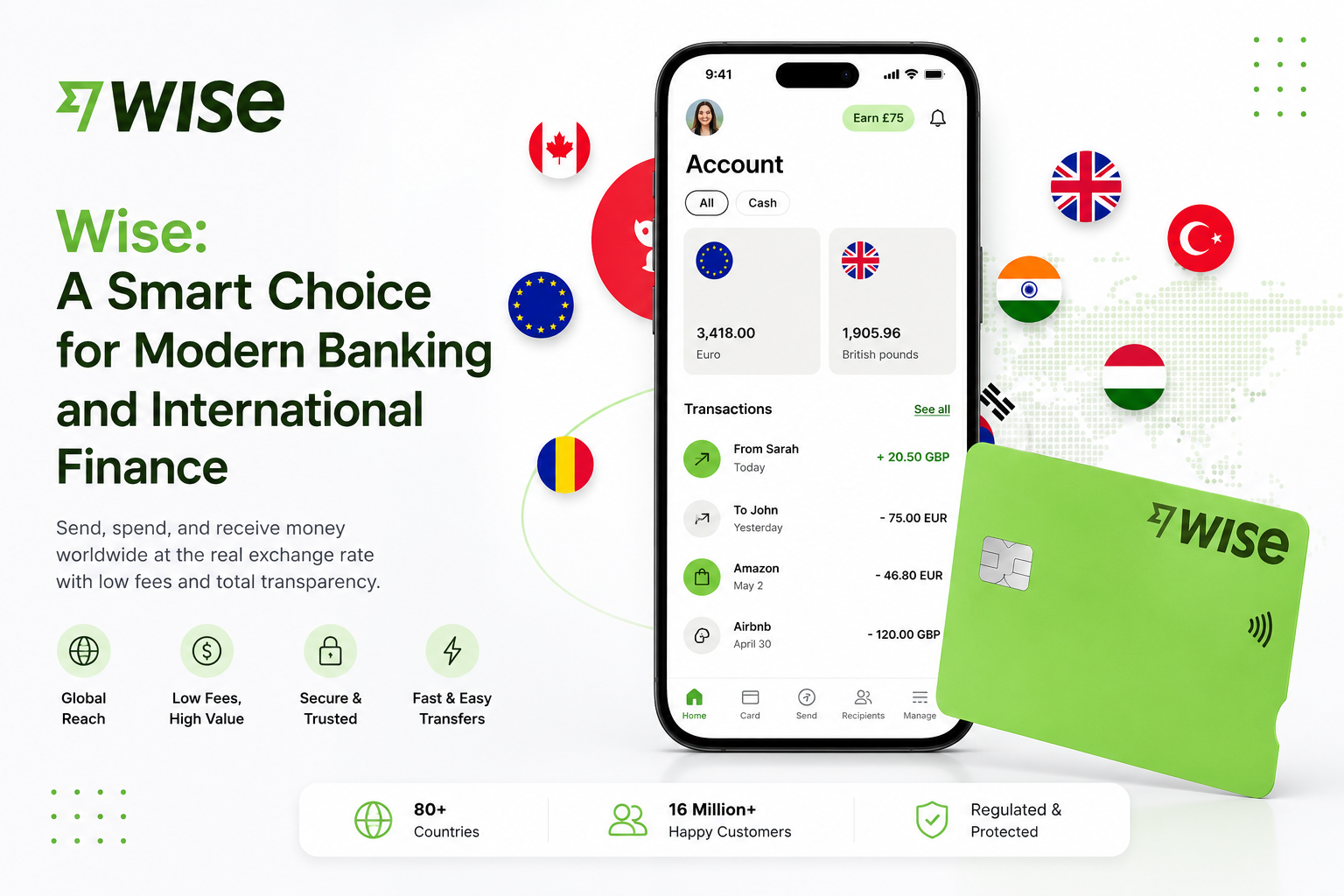
Introduction: Rethinking How the World Moves Money
Money has always crossed borders slower than people, ideas, and goods do. For decades, sending funds from one country to another meant accepting hidden exchange rate markups, unpredictable fees, and transfers that could take anywhere from two days to two weeks. Traditional banks built entire business models around this friction, quietly profiting from the gap between the “real” exchange rate and the one customers actually received.
Wise emerged to challenge that model. Founded in London in 2011 (originally under the name TransferWise), the company set out with a simple but disruptive idea: what if international money transfers used the same exchange rate you could see on Google, with a single transparent fee and nothing hidden in the fine print? More than a decade later, Wise has grown from a niche remittance app into a global financial platform used by tens of millions of people, freelancers, small businesses, and multinational companies who need to move money across currencies quickly, affordably, and without surprises.
This article takes a deep, practical look at what Wise is, how it works, what it costs, who it serves best, and how it stacks up against banks and other money transfer services. Whether you are an expat sending money home, a freelancer billing international clients, a digital nomad juggling multiple currencies, or a small business owner paying overseas suppliers, understanding how Wise fits into modern banking and international finance can help you make a smarter decision about where your money goes.
What Is Wise, Exactly?
Wise is a financial technology company, not a traditional bank. It operates as a licensed Electronic Money Institution (EMI) in the UK and Europe, and it holds money transmitter licenses across all fifty US states, along with registrations in dozens of other countries. This distinction matters: because Wise is not a chartered bank, it cannot offer certain products that banks provide, such as loans, mortgages, overdrafts, or traditional interest-bearing savings accounts protected by deposit insurance schemes like the FDIC or the FSCS. What Wise does offer is a lean, purpose-built platform for moving, holding, and spending money across more than 40 currencies in over 160 countries.
At its core, Wise operates on a model that avoids the traditional correspondent banking network wherever possible. Instead of physically wiring money across borders through a chain of intermediary banks (each of which may take a cut), Wise uses local bank transfers on each side of a transaction, matching a currency exchange internally between its liquidity pools. This “local-to-local” mechanism is a major reason Wise transfers tend to be faster and cheaper than a traditional international wire.
The company has expanded well beyond peer-to-peer money transfers. Today, the platform includes:
- International money transfers between individuals and businesses
- A multi-currency account that can hold balances in 40+ currencies simultaneously
- A debit card linked to that multi-currency balance, usable for spending and ATM withdrawals abroad
- Local account details (routing numbers, IBANs, sort codes) in multiple countries, allowing users to receive payments like a local
- A business account with invoicing, batch payments, and accounting software integrations
- An API and platform-banking service that other financial companies build on top of
How Wise Pricing Works
One of the most consistently praised aspects of Wise is the clarity of its pricing. Rather than folding a hidden margin into the exchange rate the way many banks and traditional transfer services do, Wise shows customers the mid-market exchange rate, then charges a separate, visible fee for the transfer itself.
That fee structure generally combines two elements: a small fixed fee, and a variable percentage that depends on the currency pair, the transfer amount, and the funding method chosen. Bank transfers and direct debit tend to be the cheapest way to fund a transfer, while paying by credit card is usually the most expensive option because card networks charge processing fees that Wise passes along. Depending on the corridor, variable fees can range from well under half a percent for major currency pairs like USD to EUR, up to two percent or more for less liquid or higher-risk corridors.
This transparency is often the single biggest differentiator between Wise and a conventional bank wire. A typical international bank transfer might advertise itself as “free” or low-cost, while actually building a two to four percent markup into the exchange rate you receive. On a transfer of a thousand dollars, that invisible markup can quietly cost twenty to forty dollars more than a transparent alternative would, even though no explicit “fee” ever appears on the statement. Because Wise fees are calculated and displayed before you confirm a transfer, users can compare the total cost against other providers in seconds, which has pushed much of the money transfer industry toward greater transparency generally.
It’s worth noting that Wise is not automatically the cheapest option for every single corridor or transfer type. Competing services occasionally run promotional rates for specific currency pairs, and for very large or unusual transfers, comparing a few providers before committing is generally sound financial practice. Still, because the fee structure is disclosed clearly and calculated the same way every time, Wise makes that kind of comparison shopping much easier than it would be with an opaque bank margin.
Speed: How Fast Does Money Actually Move?
Speed is one of the areas where digital-first companies like Wise have made the clearest improvements over legacy banking. Because Wise avoids routing money through multiple correspondent banks whenever it can settle a transfer using its own local currency balances, a large share of transfers complete far faster than a traditional international wire would. Many transfers between major currencies and well-connected countries complete within minutes to a few hours, and a majority of all transfers on the platform are reported to settle same-day or instantly, depending on the currency pair and payment method used to fund the transfer.
Naturally, transfer speed still depends on several factors: the currency corridor, whether the sender is paying by bank transfer or card, local banking hours and holidays in the destination country, and any compliance checks that Wise’s systems flag for review. A transfer between two well-established currencies funded by an instant payment method will typically be much faster than a transfer to a currency corridor with fewer banking partners or heavier regulatory requirements.
The Multi-Currency Account: A Digital Alternative to Multiple Bank Accounts
For freelancers, remote workers, and small business owners who regularly deal with more than one currency, the Wise multi-currency account is arguably the platform’s most practical feature. Instead of opening separate bank accounts in different countries, a user can hold balances in dozens of currencies within a single Wise account and convert between them only when the exchange rate is favorable.
This is especially useful for a few common scenarios:
Freelancers and contractors who invoice international clients in US dollars, euros, or British pounds can receive payments using local account details in each of those currencies, effectively appearing to their clients as a local recipient rather than requiring an expensive international wire on the client’s end. This alone can save both parties transfer fees, since the sender pays a much smaller domestic transfer fee (or none at all) rather than an outbound international wire fee.
Digital nomads and expats who earn in one currency but spend in another can hold their income currency in the account and convert small amounts as needed, rather than accepting a bank’s exchange rate every time a paycheck lands.
Small businesses with international suppliers can hold a working balance in the supplier’s currency, converting when rates are advantageous and paying invoices directly from that balance, which reduces the number of conversions (and therefore fees) involved in each transaction.
Wise’s multi-currency account is not itself a bank account in the traditional sense and does not typically earn meaningful interest the way a savings account might, though in certain regions Wise has introduced ways to invest idle balances. The core value proposition is convenience and cost savings on currency conversion and cross-border payments, not wealth accumulation through interest.
The Wise Card: Spending Abroad Without the Bank Markup
Linked to the multi-currency account, the Wise debit card allows users to spend directly from their balance while traveling or shopping internationally. When a purchase is made in a currency the user already holds a balance in, no conversion fee applies at all, since the transaction settles directly from the matching currency balance. When a purchase is made in a currency the user does not hold, the card automatically converts at the mid-market rate plus a small, disclosed conversion fee, which is typically far lower than the two to three percent (or more) foreign transaction fee that a conventional bank debit or credit card would charge.
This makes the Wise card a popular choice for travelers who want to avoid the classic “dynamic currency conversion” trap, where a foreign merchant terminal offers to charge in the cardholder’s home currency at an inflated exchange rate. Because the Wise card converts at a transparent rate behind the scenes, travelers can decline dynamic conversion offers at the point of sale and let Wise handle the currency math instead.
ATM withdrawals are also supported internationally, generally with a monthly allowance of fee-free withdrawals up to a certain limit, after which a small percentage fee applies. As with transfer fees, exact ATM withdrawal allowances and fees vary by country and can change over time, so checking current terms before relying on the card as a primary travel companion is a sensible habit.
Wise for Business: Beyond Personal Transfers
While Wise began as a consumer-focused remittance service, its business account has become a significant part of the platform, particularly for small and medium-sized enterprises with international operations. A Wise Business account offers many of the same core features as the personal account, scaled for commercial use:
- Holding and converting balances across 40+ currencies
- Local receiving account details in multiple countries, useful for businesses that invoice clients internationally without needing a local legal entity
- Batch payments, allowing a business to pay dozens or hundreds of invoices, contractors, or suppliers in a single upload
- Integration with accounting platforms such as Xero and QuickBooks, reducing manual reconciliation work
- Multiple user permissions, so finance teams can control who has access to send payments versus who can only view balances
- A business debit card for online subscriptions and travel expenses billed in foreign currency
For companies with international payroll, freelance contractor networks, or overseas suppliers, this combination of features can meaningfully reduce both the direct cost of currency conversion and the administrative overhead of reconciling multiple bank accounts in different countries.
Is Wise Safe? Regulation and Fund Protection
Trust is a legitimate concern for anyone considering moving money through a fintech company rather than a traditional bank, and it is a fair question to ask before committing to any financial platform. Wise operates under regulatory oversight in every major market it serves. In the UK, it is authorized by the Financial Conduct Authority. In the European Union, it operates through licenses obtained via its Belgian entity. In the United States, Wise is registered with FinCEN as a Money Services Business and holds individual state money transmitter licenses across all fifty states. In Australia, it is regulated by ASIC, and it holds additional licenses and registrations across Asia and other regions where it operates.
Because Wise is an EMI or MSB rather than a chartered bank, customer funds are not typically covered by deposit insurance schemes like the FDIC in the US or the FSCS in the UK, which insure deposits at licensed banks up to certain limits. Instead, regulated e-money and payment institutions like Wise are generally required to safeguard customer funds by keeping them in segregated accounts, separate from the company’s own operating capital, often held at partner banks or in low-risk instruments like government money market funds. This safeguarding requirement is designed to protect customer balances even if the company itself were to face financial difficulty, though it is a structurally different protection than deposit insurance and worth understanding clearly before holding large balances on the platform long-term.
Wise has processed hundreds of billions of dollars in transfers since its founding and serves well over ten million customers worldwide, a scale that reflects a long operating history without major security incidents affecting customer funds. Independent customer review platforms consistently rate the company highly, with hundreds of thousands of reviews averaging a strong overall score, reflecting broad satisfaction with transparency, though as with any large platform, individual experiences with support or edge-case transfers can vary.
Wise vs. Traditional Banks
To understand why Wise resonates with such a large global user base, it helps to compare it directly against the traditional bank alternative for a cross-border transfer.
A conventional international wire transfer through a bank typically involves an outbound wire fee charged by the sending bank, an inbound receiving fee sometimes charged on the other end, and one or more correspondent bank fees deducted along the way as the payment passes through intermediary institutions. On top of those explicit fees, the exchange rate applied is usually marked up by several percentage points above the mid-market rate, a margin the bank keeps as additional, undisclosed profit. For a transfer of a few thousand dollars, these combined costs can easily run into fifty to one hundred dollars or more, and the transfer itself might take several business days to arrive.
Wise’s alternative, by comparison, applies the real mid-market exchange rate and a single, visible fee calculated as a small percentage of the transfer amount. There are no correspondent bank deductions, because Wise generally does not route the payment through that legacy network. The net effect for most consumer and small business transfers is a lower total cost and a faster arrival time, particularly for major currency corridors with high transfer volumes.
Where traditional banks retain an advantage is in the breadth of products offered under one roof. A bank can provide a mortgage, an auto loan, a business line of credit, and a savings account with deposit insurance, none of which Wise offers directly. For customers who want a single relationship covering both everyday international payments and traditional lending or interest-bearing deposit products, a hybrid approach, using a bank for lending and long-term savings while using Wise for international transfers and multi-currency spending, is a common and practical strategy.
Wise vs. Other Money Transfer Services
Wise competes in a crowded field that includes Remitly, Western Union, PayPal, Revolut, WorldRemit, and a growing number of newer fintech challengers. Each competitor has carved out a slightly different niche.
Western Union remains a dominant player for cash pickup transfers, particularly in regions where the recipient may not have a formal bank account. This is one clear gap in Wise’s offering: Wise does not support cash pickup as a delivery method, focusing exclusively on direct bank deposits, mobile wallets in some corridors, and card-linked accounts. For remittance corridors where the recipient needs physical cash rather than a bank deposit, competitors with dedicated cash pickup networks are often the more practical choice.
Remitly and WorldRemit similarly focus heavily on remittance corridors to developing markets, often bundling cash pickup and mobile money integrations that Wise does not prioritize.
PayPal, by contrast, offers broad merchant and peer-to-peer payment acceptance but has historically applied less competitive exchange rates and higher fees for currency conversion compared to Wise’s transparent mid-market pricing.
Revolut competes most directly with Wise in the multi-currency account and travel card space, offering a broader suite of consumer banking-adjacent features, including budgeting tools, cryptocurrency trading, and stock trading in some markets, alongside its multi-currency capabilities. Wise, by comparison, keeps a narrower focus specifically on international transfers and currency management, which some users find results in a simpler, more predictable product, while others prefer Revolut’s broader all-in-one app.
Ultimately, the “best” service depends heavily on the specific transfer: the currency corridor, the delivery method the recipient needs, the amount being sent, and how frequently transfers are made. For anyone sending money regularly, it is worth checking a live quote across two or three providers for the specific transfer in question, since promotional rates and fee structures can shift.
Who Benefits Most From Using Wise?
Several groups of users tend to get the most value out of the platform:
Expats and immigrants sending remittances home benefit from the combination of transparent fees and a real exchange rate, which can add up to meaningful annual savings compared to a bank transfer, especially for recurring monthly transfers to family.
Freelancers and remote contractors working with international clients benefit from local receiving account details, which let clients pay as if sending a domestic payment, avoiding costly international wire fees on the client’s side.
Frequent international travelers benefit from the debit card’s fee structure, which avoids both foreign transaction fees and the dynamic currency conversion markup that many travelers unknowingly accept at point-of-sale terminals abroad.
Small and medium-sized businesses with international suppliers, contractors, or customers benefit from batch payments, multi-currency holding, and accounting software integration, which collectively reduce both the direct cost and the administrative burden of cross-border commerce.
Digital nomads who move between countries and need to receive income in one currency while spending in another benefit from the flexibility of holding multiple balances without needing to open a new bank account every time they relocate.
Conversely, Wise is generally not the right tool for customers who need cash pickup delivery, who want an interest-bearing savings account with deposit insurance, who need access to loans or credit products, or who are sending money to one of the small number of countries and territories that Wise does not support due to sanctions or regulatory restrictions.
Practical Tips for Getting the Most Out of Wise
For anyone setting up an account, a few practical habits can help maximize savings and avoid unnecessary costs.
Funding a transfer via bank transfer or direct debit, rather than a credit card, generally results in the lowest total fee, since card network processing costs are avoided. For occasional urgent transfers where speed matters more than the marginal cost difference, paying by card can still be a reasonable trade-off.
Before sending a large transfer, checking a live quote is worthwhile even for repeat corridors, since fees and exchange rate spreads can shift slightly over time based on currency volatility and payment method.
For freelancers, setting up local receiving account details in the currencies of your primary clients can meaningfully reduce the fees your clients pay to send you money, which can be a subtle but appreciated professional courtesy, especially for long-term client relationships.
For frequent travelers, loading the Wise card with a small buffer balance in the local currency of an upcoming trip, ahead of departure, allows conversions to be done at a convenient moment rather than in the middle of an unfamiliar checkout line.
For businesses, connecting the account to existing accounting software early can save significant reconciliation time later, particularly for companies processing dozens of international invoices per month.
Common Questions About Wise
Is Wise a bank? No. Wise is a licensed Electronic Money Institution and Money Services Business, not a chartered bank. It cannot offer loans, mortgages, or FDIC/FSCS-insured deposit accounts, but it is regulated in every major market where it operates and is required to safeguard customer funds separately from its own operating capital.
Is my money safe with Wise? Wise is regulated across all its major operating markets and has a long operating history moving very large transfer volumes without major incidents affecting customer funds. That said, because it is not a bank, its fund protection model differs structurally from deposit insurance, and understanding that distinction is worthwhile before holding significant balances long-term.
How long do Wise transfers take? Many transfers complete within minutes to a few hours, and a large share settle same-day, though the exact time depends on the currency corridor, funding method, and any compliance review a specific transfer might trigger.
Does Wise offer cash pickup? No. Wise focuses on direct bank deposits, local mobile wallets in some corridors, and card-linked accounts rather than cash pickup locations.
Is Wise cheaper than my bank? In most cases, yes, particularly because Wise applies the real mid-market exchange rate rather than embedding a hidden markup the way many banks do. However, it is still worth comparing a live quote for your specific transfer against alternatives, since exact savings vary by corridor and amount.
Can I use Wise for business payments? Yes. Wise Business supports batch payments, multi-currency holding, local receiving accounts in multiple countries, and integration with popular accounting software, making it suitable for companies with international suppliers, contractors, or customers.
The Origin Story: Why Wise Was Built in the First Place
Understanding Wise’s design choices today is easier once you know the problem its founders originally set out to solve. Two Estonian entrepreneurs living in London found themselves frustrated by a familiar cross-border headache: one was paid in euros but living in the UK, the other was paid in pounds but had bills to cover back in the Eurozone. Rather than each paying a bank’s inflated exchange rate and transfer fee to move money between their own accounts, they realized they could simply match their two transfers against each other, each depositing money into the other’s local account, and settling the exchange between themselves at the real market rate. No cross-border wire ever needed to happen at all.
That peer-matching idea, scaled up across millions of users and currency pairs, became the operating principle behind Wise’s entire infrastructure. Instead of physically moving money across a border every time a customer requests a transfer, Wise nets transfers against each other internally wherever possible, only moving larger batches of money between its own currency pools when necessary to keep balances topped up. This is part of why the company has historically been able to offer significantly lower fees than the traditional correspondent banking model, which by contrast requires a chain of intermediary banks to each take a cut every time money physically crosses a border.
Over the following decade, the company expanded steadily from this single use case, first adding support for more currency corridors, then building out the multi-currency account, followed by the debit card, business accounts, and eventually an API platform that other banks and fintech companies could build their own products on top of. The company’s 2021 direct listing on the London Stock Exchange, and its rebrand from TransferWise to the simpler “Wise,” marked its transition from a scrappy remittance startup into a publicly traded, globally regulated financial infrastructure company.
Understanding the Mid-Market Rate
A recurring theme throughout any honest discussion of Wise is the concept of the mid-market exchange rate, so it’s worth explaining clearly what that actually means and why it matters so much to the total cost of an international transfer.
The mid-market rate is the midpoint between the buy and sell price of a currency pair on global currency markets at any given moment, essentially the “real” exchange rate quoted by financial data providers and visible on tools like Google’s currency converter. Banks and many money transfer services do not give customers this rate directly. Instead, they apply their own, less favorable rate, keeping the difference between the real rate and the customer’s rate as an additional, often unstated, profit margin layered on top of any explicit transfer fee.
This matters enormously in practice, because a marked-up exchange rate is a cost that never appears as a line-item fee on a receipt. A bank might advertise a transfer as costing “no fee,” while quietly applying an exchange rate two to four percent worse than the real market rate, a cost that is functionally identical to a fee but far less visible to the average customer. Wise’s core pricing promise is to strip that hidden margin out entirely, applying the mid-market rate and then charging its fee as a single, separately visible number. This is the central reason financial comparison sites and personal finance writers so consistently highlight Wise’s pricing transparency as a genuine structural advantage rather than just clever marketing.
Supported Currencies and Countries
Wise supports transfers in more than 40 currencies to over 160 countries, covering the vast majority of major global economies, including the US dollar, euro, British pound, Australian and Canadian dollars, Indian rupee, Mexican peso, Philippine peso, Nigerian naira, and many others. The multi-currency account itself can hold balances across that same broad currency list, giving users considerable flexibility for both receiving international income and paying international expenses.
That said, coverage is not universal. Certain countries are excluded from Wise’s service entirely due to international sanctions regimes, most notably transfers to Cuba, which are prohibited for any US-registered money services business under regulations administered by the Office of Foreign Assets Control. Coverage and supported payment corridors can also shift over time as regulatory relationships change, so anyone planning a transfer to a less common corridor should verify current support directly within the app or on Wise’s official site before assuming a route is available.
Comparing the Total Cost of a Sample Transfer
To make the abstract cost comparison more concrete, consider a simple illustrative example (using approximate, non-guaranteed figures for illustration purposes only, since actual rates and fees fluctuate constantly). Imagine sending the equivalent of one thousand British pounds converted into euros.
A traditional bank wire might advertise a flat wire fee, commonly somewhere in the range of twenty-five to forty-five units of currency, while also applying an exchange rate that sits two to three percent below the real mid-market rate. Combined, the recipient on the other end might receive noticeably less than the equivalent mid-market conversion would produce, often a shortfall large enough to be worth a hundred units of currency or more on a transfer of this size, even though the bank’s advertised fee looked modest.
A transparent, mid-market-rate provider like Wise, by contrast, would apply the real exchange rate and a small percentage-based fee, typically well under one percent for a major currency pair like this one, resulting in a recipient balance considerably closer to the full mid-market conversion value. The exact gap varies by the currency pair, the date, and the specific bank or provider being compared, but the structural pattern, hidden exchange rate markups quietly costing more than visible fees suggest, holds true across the vast majority of real-world international transfer comparisons.
This is precisely why financial advisors and consumer finance publications so often recommend running the same transfer amount through two or three providers’ live calculators before committing to a large international payment: the visible “fee” advertised by a provider is frequently not the whole story, and the only reliable way to compare true cost is to check the actual amount the recipient would receive at the end of the transaction.
The Broader Shift Toward Transparent Cross-Border Finance
Wise’s rise is not happening in isolation. It reflects a broader shift in consumer expectations around financial transparency that has reshaped much of the fintech industry over the past decade. Younger consumers and small business owners, in particular, have grown accustomed to comparing prices instantly online for nearly everything they buy, and they have increasingly demanded the same transparency from financial services that were historically opaque by design.
This pressure has pushed even traditional banks to slowly improve their own cross-border transfer disclosures, and it has spurred an entire ecosystem of comparison tools, calculators, and review sites dedicated specifically to helping consumers see through marked-up exchange rates. Wise, alongside a handful of similarly transparent competitors, effectively helped set a new baseline expectation across the whole remittance and international banking industry: that customers deserve to see the real exchange rate and the real fee, every time, before they commit to a transfer.
For anyone managing money across borders today, whether occasionally or as a core part of running an international business, this shift matters well beyond any single provider. It means that comparison shopping for cross-border transfers is now both possible and relatively fast, and that choosing a transparent, well-regulated platform like Wise as at least one option in your financial toolkit is a genuinely practical way to keep more of your own money in your pocket, rather than quietly funding a bank’s hidden currency margin.
Final Thoughts
Wise represents a broader shift in how international finance is being reimagined for a digital, globally connected economy. By replacing opaque bank margins with a transparent fee structure, and by building a genuine alternative to the traditional correspondent banking network, the company has made cross-border money movement faster and considerably more predictable for millions of individuals and businesses.
It is not a complete replacement for a traditional bank; anyone who needs loans, insured savings accounts, or cash pickup delivery will still need a bank or a different specialized provider alongside it. But as a dedicated tool for international transfers, multi-currency management, and fee-free-ish international spending, Wise has earned its reputation as one of the more practical, transparent options available in modern banking. For anyone regularly moving money across borders, whether as an expat supporting family, a freelancer billing clients abroad, or a business managing international suppliers, taking the time to understand how Wise’s fee structure and account features work is a small effort that can lead to real, recurring savings over time.