Introduction
Decentralized finance has come a long way since the early days of Ethereum-based automated market makers, but nowhere has the pace of innovation been more visible than on Solana. Among the protocols that have shaped the Solana DeFi landscape, one name consistently rises to the top of every conversation: Raydium. Launched in February 2021, Raydium has grown from a modest automated market maker into the largest decentralized exchange and liquidity protocol on Solana, routing a significant share of the network’s trading volume and anchoring liquidity for thousands of tokens.
This article takes a deep, comprehensive look at what Raydium is, how it works, why it has become indispensable to the Solana ecosystem, and what sets it apart from competing decentralized exchanges. Whether you are a trader looking for fast and low-cost swaps, a liquidity provider searching for yield opportunities, or a developer curious about the mechanics of on-chain market making, this guide will walk you through everything you need to know about Raydium and its role in powering Solana’s DeFi economy.
What Is Raydium?
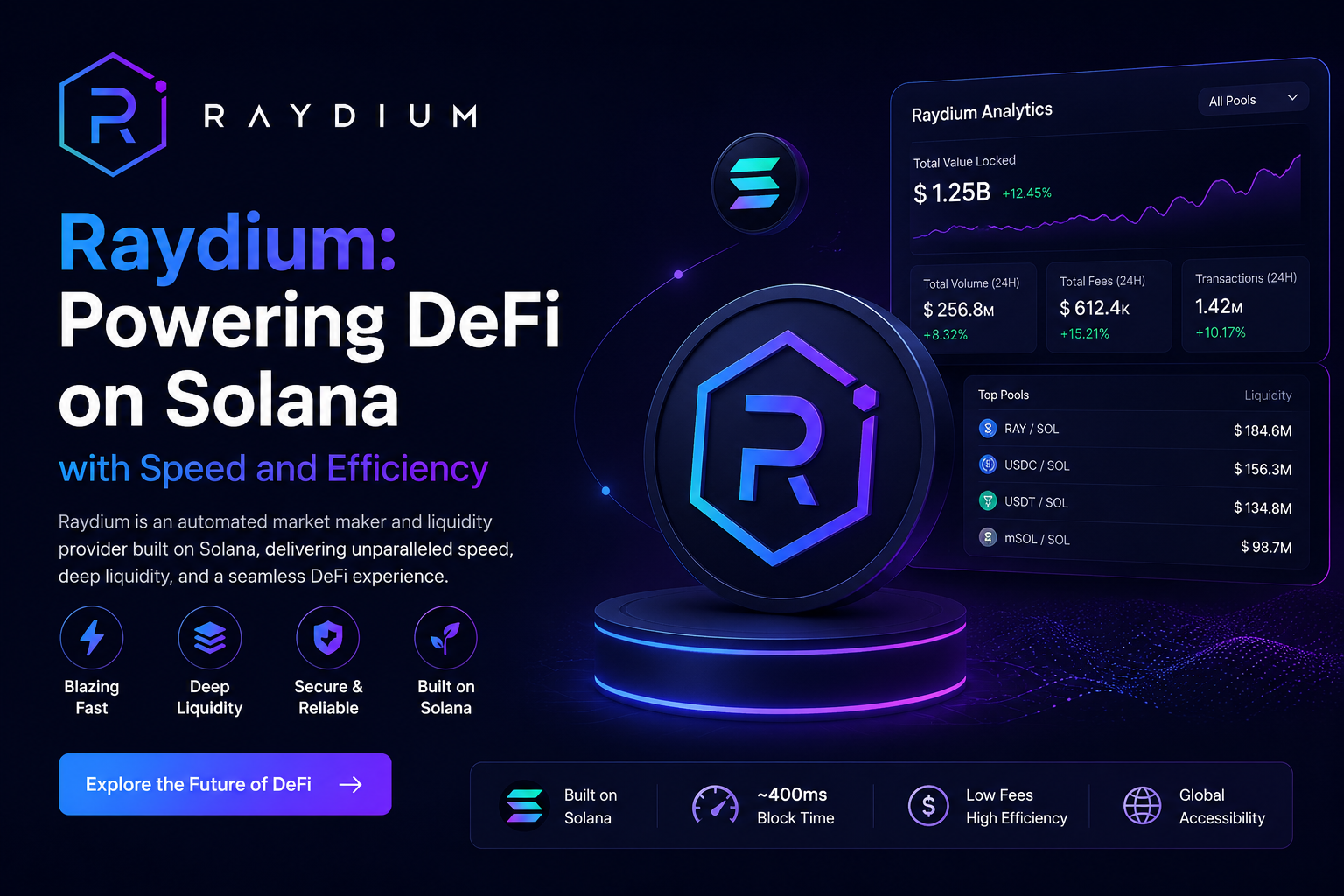
Raydium is a decentralized exchange and automated market maker built natively on the Solana blockchain. Unlike many earlier AMMs that operated as isolated liquidity silos, Raydium was designed from the outset to be an integrated liquidity layer for the broader Solana ecosystem. It combines the efficiency of an automated market maker with connectivity to on-chain order book infrastructure, allowing liquidity provided to Raydium pools to also be accessible to other applications and traders across Solana.
At its core, Raydium is a set of permissionless, non-custodial smart contracts. This means that anyone can create a liquidity pool, anyone can trade against that pool, and anyone can provide liquidity to earn a share of trading fees, all without needing permission from a centralized authority and without ever handing custody of their assets to a third party. The Raydium web application, raydium.io, serves as the primary interface through which users interact with these smart contracts: swapping tokens, supplying liquidity, launching new tokens, staking the platform’s native token, and more recently, trading perpetual futures.
Since its founding, Raydium has grown into what is widely regarded as Solana’s most-used decentralized exchange by trading volume and total value locked. It has weathered multiple market cycles, a significant security incident, explosive memecoin trading seasons, and the general maturation of the Solana DeFi stack, emerging each time as a central pillar of the ecosystem’s liquidity infrastructure.
The Origins of Raydium: Built for Solana’s Speed
To understand why Raydium exists and why it looks the way it does, it helps to understand the environment it was built for. Solana was designed as a high-throughput blockchain capable of processing thousands of transactions per second with sub-second finality and transaction costs measured in fractions of a cent. This stands in sharp contrast to blockchains like Ethereum, where network congestion can push gas fees into the tens or hundreds of dollars during periods of high demand.
Early automated market makers on Ethereum, such as Uniswap, proved that a constant-product formula could replace traditional order books for on-chain trading. But those designs were shaped by Ethereum’s constraints: expensive transactions meant that most AMMs tried to minimize the number of on-chain interactions, and liquidity tended to be fragmented across many isolated pools.
Solana’s architecture opened up different possibilities. With transaction costs low enough that even small trades remain economical, and with block times fast enough to support near-instant order matching, Solana provided fertile ground for a new generation of decentralized exchanges. Raydium was one of the first projects to fully capitalize on this by building an AMM that could also plug directly into Solana’s central limit order book infrastructure, originally through the Serum protocol and later through its successor, OpenBook.
This hybrid design was significant. Rather than forcing liquidity providers to choose between a simple AMM pool and an order book market, Raydium allowed liquidity supplied to its pools to also appear on the shared order book, giving traders access to deeper markets and giving liquidity providers exposure to a wider range of order flow. This approach helped Raydium avoid the liquidity fragmentation problem that has historically plagued newer DEXs trying to compete with more established venues.
How Raydium Works: The Mechanics of On-Chain Trading
Raydium’s trading infrastructure has evolved considerably since its initial launch, and today it operates multiple distinct pool types, each suited to different kinds of assets and trading strategies.
Constant Product Market Maker (CPMM) Pools
The foundation of Raydium’s original design is the constant product automated market maker, the same mathematical model popularized by Uniswap. In a CPMM pool, two tokens are deposited into a shared reserve, and the product of their quantities is kept constant according to the formula x multiplied by y equals k. When a trader swaps one token for another, they add to one side of the pool and remove from the other, shifting the price along a curve determined by that constant.
This model is simple, predictable, and permissionless. Anyone can create a new pool for any pair of tokens, seed it with initial liquidity, and immediately enable trading. This simplicity is part of why CPMM pools remain popular for newer or more volatile tokens, including many of the memecoins that have found a home on Solana. Liquidity providers deposit both tokens in a pool at the current market ratio and receive LP tokens representing their share of the pool, which can later be redeemed for the underlying assets plus any accumulated trading fees.
Concentrated Liquidity Market Maker (CLMM) Pools
As Raydium matured, it introduced concentrated liquidity pools modeled after the innovations pioneered by Uniswap V3. In a traditional constant product pool, liquidity is spread evenly across the entire price curve, from zero to infinity, even though most trading activity for a given pair typically happens within a much narrower band of prices. Concentrated liquidity allows liquidity providers to allocate their capital to a specific price range where they expect trading to occur, rather than spreading it thin across the full curve.
The benefit of this design is capital efficiency. A liquidity provider who concentrates their capital around the current market price can offer the same depth of liquidity, and therefore the same quality of trade execution, with a fraction of the capital that a traditional pool would require. This translates into tighter spreads and lower price impact for traders, and potentially higher fee income for liquidity providers, though it comes with the added responsibility of actively managing a price range. If the market price moves outside a liquidity provider’s chosen range, their position stops earning fees until the price returns or the range is adjusted.
By 2026, concentrated liquidity pools had become the dominant venue for deep, high-volume trading pairs on Raydium, particularly for well-established assets like SOL, major stablecoins, and liquid staking tokens, while constant product pools continued to serve as the default venue for newly launched and more speculative tokens.
LaunchLab: Token Launches Meet Liquidity
Recognizing that a huge share of Solana’s on-chain activity involves brand-new token launches, Raydium introduced LaunchLab, a token launch venue that unifies the primary market for new tokens with the secondary trading market. Projects using LaunchLab issue their token on a bonding curve, a pricing mechanism where the token’s price rises programmatically as more of it is purchased. Early buyers trade directly against this curve rather than against other traders.
Once a project’s bonding curve reaches a predefined graduation threshold, measured by the liquidity accumulated through purchases, the mechanism automatically migrates that liquidity into a fully-fledged constant product pool on Raydium. This creates a seamless transition from a fair, bonding-curve-based launch phase into a mature, tradable liquidity pool without requiring manual intervention from the project team. This design mirrors a broader trend in Solana’s ecosystem, where launch platforms and decentralized exchanges have become increasingly intertwined, and it positions Raydium as a natural downstream destination for tokens that gain traction on other launch platforms as well.
Raydium Perpetuals
More recently, Raydium expanded beyond spot trading and liquidity provision into perpetual futures, allowing traders to open leveraged long or short positions on various assets directly from the same interface used for spot swaps. This addition reflects the broader maturation of Solana’s derivatives market, where perpetual futures trading volume has grown to rival, and in some cases exceed, spot trading volume across the ecosystem. By offering perpetuals alongside its existing spot and liquidity provision products, Raydium has positioned itself as a more complete trading venue rather than a single-purpose AMM.
Why Speed and Low Fees Matter for DeFi
The value proposition of Raydium cannot be separated from the underlying performance characteristics of Solana itself. Automated market makers are, at their core, systems that need to process a continuous stream of small transactions: swaps, liquidity deposits, withdrawals, and fee claims. On a slow or expensive blockchain, each of these actions becomes a meaningful cost, discouraging active participation and making strategies like frequent rebalancing of concentrated liquidity positions impractical for all but the largest players.
Solana’s low transaction costs and fast confirmation times change this calculus entirely. A trader can execute a swap, see it confirmed, and move on to their next action within a second or two, paying a transaction fee that is typically a small fraction of a cent. This makes it economically viable for liquidity providers to actively manage concentrated liquidity ranges, for arbitrageurs to keep prices aligned across venues, and for retail traders to interact with the protocol frequently without fee costs eating into their returns.
This performance advantage became particularly visible during periods of extreme trading activity. Raydium has, at various points, processed billions of dollars in trading volume within a single day during major memecoin launches and other high-attention events, a volume of activity that would be prohibitively expensive to sustain on many other blockchain networks. These episodes have served as real-world stress tests, demonstrating both the throughput of the underlying Solana network and the scalability of Raydium’s smart contract design.
The RAY Token: Governance, Incentives, and Utility
RAY is Raydium’s native token, and it plays several roles within the protocol’s ecosystem. The total supply of RAY was fixed at launch, with the tokens allocated across several categories including a mining reserve intended for liquidity mining incentives, an allocation for ecosystem partnerships, a founding team allocation subject to vesting, and smaller allocations for liquidity provisioning, community initiatives, and advisors.
Holders of RAY can stake their tokens to earn a share of protocol fee revenue, aligning the incentives of long-term token holders with the ongoing success and trading activity of the platform. Historically, RAY has also played a role in liquidity mining programs, where liquidity providers in select pools earn additional RAY rewards on top of standard trading fees, an incentive structure designed to bootstrap liquidity in strategically important pools.
The market price of RAY has, unsurprisingly, tracked the broader fortunes of Solana and the DeFi sector as a whole. It reached notable highs during periods of intense speculative activity and experienced sharp drawdowns during broader market downturns, a pattern common to most DeFi governance and utility tokens. As with any token tied to a specific protocol’s fee revenue and activity levels, RAY’s value is closely linked to Raydium’s ongoing relevance as a trading venue, which in turn depends on Solana’s continued growth as a smart contract platform.
Fee Structure: How Raydium Generates and Distributes Revenue
Every swap executed on Raydium incurs a trading fee, which is split between liquidity providers and the protocol treasury according to the specific pool type. For concentrated liquidity pools, the substantial majority of fee revenue flows directly to the liquidity providers who supplied capital to the active price range, with a smaller portion allocated to the protocol. Constant product pools follow a similar principle, with the protocol’s share configurable at the pool level.
Newly launched tokens moving through LaunchLab’s bonding curve mechanism follow a different fee arrangement during their pre-graduation phase, splitting fees between the pool’s initial seed liquidity and the LaunchLab treasury, before transitioning to standard pool economics once the token graduates to a full liquidity pool.
Beyond the visible swap fee, traders should be aware that the total cost of a transaction on Raydium involves several layers. There is the pool’s trading fee itself, the underlying Solana network transaction fee, and, during periods of network congestion, an optional priority fee that traders can add to increase the likelihood their transaction is processed quickly. Additionally, some tokens built using newer token standards carry their own transfer fees independent of Raydium’s pool mechanics, which can affect the final amount a trader receives from a swap. Understanding this full fee stack is important for anyone trying to accurately estimate the true cost of trading on the platform.
Raydium’s Position in the Solana DeFi Ecosystem
Solana’s DeFi ecosystem has grown into a sprawling and interconnected set of protocols spanning lending, liquid staking, perpetual futures, aggregation, and decentralized exchange infrastructure. Within this landscape, Raydium occupies a foundational position as one of the primary sources of deep, on-chain liquidity.
Because of Raydium’s central role in Solana’s liquidity landscape, many other protocols build directly on top of it rather than competing with it. Aggregators that route trades across multiple decentralized exchanges to find users the best possible price frequently draw from Raydium’s pools as a core liquidity source. Yield-focused platforms that offer automated liquidity provision strategies often wrap Raydium’s concentrated liquidity pools into simplified, one-click vault products, allowing users to gain exposure to Raydium’s fee income without needing to manage price ranges manually. Lending protocols sometimes accept Raydium liquidity provider tokens as collateral, further embedding Raydium into the broader financial plumbing of the network.
This composability is one of the defining features of DeFi as a whole, and Raydium’s willingness to serve as connective infrastructure, rather than trying to capture every layer of the user experience itself, has helped cement its role as a piece of shared public infrastructure for the Solana ecosystem rather than merely one competitor among many.
Raydium Versus Other Solana DEXs
No discussion of Raydium would be complete without addressing how it compares to other prominent decentralized exchanges and liquidity venues on Solana, most notably Orca and Jupiter.
Orca is often mentioned alongside Raydium as a leading concentrated liquidity venue on Solana, known for its user-friendly interface and its own implementation of concentrated liquidity pools. Where Raydium differentiates itself is in the breadth of its product suite: alongside CLMM and CPMM pools, Raydium also offers an integrated token launch venue through LaunchLab and, more recently, perpetual futures trading, making it a more all-encompassing trading destination rather than a specialized AMM.
Jupiter, meanwhile, is not a direct competitor to Raydium in the traditional sense but rather an aggregator that routes trades across virtually every liquidity source on Solana, including Raydium, Orca, and numerous other pools, to find the best possible execution price for a given trade. In this sense, Jupiter and Raydium have a complementary relationship: Jupiter depends on the depth of liquidity provided by venues like Raydium to deliver good pricing to its users, while Raydium benefits from the additional order flow that Jupiter routes to its pools. A large share of trades that appear to originate from Jupiter’s interface are, in fact, ultimately executed against Raydium’s underlying liquidity.
This layered structure, aggregators sitting atop underlying liquidity venues, is a common pattern across mature DeFi ecosystems, and it underscores why the depth and reliability of a base-layer protocol like Raydium matters even to users who never interact with it directly.
Security History: Lessons From a Major Exploit
No comprehensive look at Raydium would be complete without addressing its security history, since a full and honest picture of any DeFi protocol requires an understanding of both its strengths and its past vulnerabilities.
In December 2022, Raydium suffered a significant security incident in which an attacker gained control of a private key belonging to an account with administrative authority over a portion of the protocol’s liquidity pools. This compromised key gave the attacker the ability to withdraw funds from the affected pools, resulting in a loss of several million dollars’ worth of assets. The incident served as a stark reminder that even well-established, heavily used protocols are not immune to security failures, particularly when privileged administrative functions are secured by a single private key rather than more robust multi-party or time-locked governance mechanisms.
In the years since, decentralized protocols across the industry, Raydium included, have generally moved toward more distributed forms of administrative control, and Raydium’s core AMM and concentrated liquidity contracts have been made available for public review, allowing independent security researchers to examine the code. Nonetheless, more recent years have continued to see isolated security incidents affecting various parts of the protocol’s surface area, including further instances of compromised private keys and attacks exploiting specific mechanics such as liquidity pool token minting.
These episodes are a useful reminder for anyone using Raydium, or any DeFi protocol, that open-source code and a strong track record reduce risk without eliminating it entirely. The composability that makes DeFi powerful, protocols building on top of one another, integrating with shared infrastructure, and interacting programmatically, also means that the security of any individual protocol is partly dependent on the security practices of everything it connects to. Prudent users size their exposure accordingly, remain cautious about interacting with newly deployed or unaudited pools, and pay close attention to wallet security practices such as safeguarding private keys and verifying transaction details before signing.
Practical Risks Every Raydium User Should Understand
Beyond the headline-grabbing security incidents, there are several more mundane but equally important risks that anyone using Raydium, or any automated market maker, should keep in mind.
The most common source of retail losses on decentralized exchanges is not a protocol-level exploit but simple human error, most frequently swapping into the wrong token entirely. Solana’s fast, low-cost environment makes it easy to interact with the network quickly, which can sometimes come at the expense of careful verification. Because anyone can permissionlessly create a token and a corresponding liquidity pool, it is possible for malicious actors to create tokens with names or symbols designed to impersonate legitimate projects. Verifying the exact mint address of a token before trading meaningful amounts, rather than relying solely on a displayed name or logo, is an important protective habit.
Liquidity providers face their own distinct set of risks, chief among them impermanent loss, the phenomenon where the value of assets held in a liquidity pool diverges from what those assets would have been worth if simply held outside the pool, due to price movements between the two assets. Concentrated liquidity positions add an additional layer of complexity on top of this, since a position that falls outside its chosen price range stops earning fees and effectively becomes a static holding of whichever asset the price has moved toward, until the range is adjusted or the price returns.
Execution quality is another practical consideration. The fee displayed for a given pool is only one component of the total cost of a trade; the depth of liquidity in that specific pool has a much larger effect on the price impact a trader actually experiences, particularly for larger trade sizes or less liquid tokens. Comparing the quoted price to the actual amount received after a swap is a useful way to gauge whether a pool’s liquidity is genuinely deep or merely appears cheap on the surface. Finally, during periods of extreme network activity, transactions can occasionally fail or require retries, and traders who add priority fees to improve their odds of fast execution should factor that additional cost into their calculations.
Raydium’s Growth Trajectory and Market Position
Raydium’s trajectory since its 2021 launch illustrates the broader growth of the Solana DeFi ecosystem. What began as a modest AMM integrated with Solana’s early order book infrastructure has grown to command a leading share of Solana’s total value locked among decentralized exchanges, with total value locked figures in the range of one to two billion dollars depending on prevailing market conditions.
Raydium’s lifetime trading volume has crossed into the trillions of dollars cumulatively, a figure driven not only by steady organic trading activity but also by periodic explosive surges tied to major token launches and speculative trading waves that have become a hallmark of Solana’s retail-driven trading culture. The platform has also expanded into adjacent markets, including tokenized real-world assets and equities, reflecting a broader industry trend of bringing traditional financial instruments on-chain and routing their trading activity through the same decentralized infrastructure used for crypto-native assets.
This growth has occurred against the backdrop of Solana’s own expansion as a blockchain platform, with the network’s daily transaction counts, active application count, and overall developer activity all climbing substantially. As one of the most heavily used applications on the network, Raydium’s fortunes remain closely tied to Solana’s continued adoption, both by retail traders and by the growing number of institutions exploring on-chain finance.
The Broader Significance of Raydium for DeFi
Stepping back from the specific mechanics of pools, tokens, and fee structures, Raydium’s story illustrates several broader themes that matter to anyone interested in the trajectory of decentralized finance as a whole.
First, it demonstrates that the underlying performance characteristics of a blockchain meaningfully shape the kinds of financial products that can exist on top of it. Concentrated liquidity management, frequent rebalancing, and integrated token launch mechanisms are all strategies that depend on cheap, fast transactions to be practical at scale. Raydium’s success is, in many ways, inseparable from Solana’s architecture.
Second, Raydium’s evolution from a single-purpose AMM into a multi-product platform spanning spot trading, concentrated liquidity, token launches, and perpetual futures reflects a broader consolidation trend within DeFi, where successful protocols increasingly aim to capture a wider slice of the user’s overall financial activity rather than remaining narrowly specialized. This mirrors patterns seen elsewhere in the industry, where liquidity, once established, becomes a magnet for additional product lines built around it.
Third, Raydium’s history, including both its remarkable growth and its past security setbacks, offers a grounded case study in the real tradeoffs of permissionless, composable finance. The same openness that allows anyone to build on top of Raydium’s liquidity, and that allowed Raydium itself to plug into shared order book infrastructure early in its life, also means that the protocol’s risk profile is shaped by a wider web of dependencies than a traditional, centralized financial platform would have.
Getting Started With Raydium: A Practical Overview
For those interested in using Raydium directly, the process generally begins with a Solana-compatible wallet funded with SOL to cover transaction fees, along with whatever tokens the user intends to trade or provide as liquidity. From the Raydium web application, users can execute swaps by selecting an input and output token and reviewing the quoted price before confirming the transaction.
Those interested in earning yield as a liquidity provider can choose between depositing into a constant product pool, which requires no active management but spreads capital across the full price curve, or a concentrated liquidity pool, which offers the potential for higher fee income in exchange for the responsibility of selecting and periodically adjusting a price range. Newer users are generally well served by starting with well-established pools involving major, liquid assets before venturing into smaller or more speculative pairs, where price volatility and liquidity risk are typically much higher.
Users interested in RAY specifically can stake their holdings to earn a share of protocol revenue, while those interested in participating in new token launches can explore opportunities through LaunchLab, keeping in mind that early-stage token launches carry substantially elevated risk compared to trading established assets.
As with any DeFi activity, maintaining strong wallet security practices, double-checking transaction details before signing, and only committing capital that one can afford to see fluctuate in value are essential habits for anyone participating in decentralized markets.
Conclusion
Raydium has established itself as one of the defining pieces of infrastructure within Solana’s decentralized finance ecosystem. By combining an efficient automated market maker with connectivity to shared order book liquidity, and by continuously expanding its product suite to include concentrated liquidity pools, integrated token launches, and perpetual futures, Raydium has grown from an early experiment into a foundational layer that much of Solana’s broader DeFi activity depends on, directly or indirectly.
Its story is inseparable from that of Solana itself: a blockchain built for speed and low costs enabled a new category of financial products, and Raydium has been at the forefront of building them. At the same time, Raydium’s history, including its past security incidents, is a useful reminder that speed and innovation in DeFi always come paired with real risks that users need to understand and manage.
For traders seeking fast, low-cost execution, for liquidity providers seeking yield, and for developers building the next generation of Solana applications, Raydium remains one of the most important protocols to understand in the broader story of how decentralized finance continues to evolve.
Frequently Asked Questions
What is Raydium used for? Raydium is used for swapping tokens, providing liquidity to earn trading fees, launching new tokens, staking its native RAY token, and trading perpetual futures, all on the Solana blockchain.
Is Raydium safe to use? Raydium’s core smart contracts are publicly available for review, and the protocol has operated for several years processing large volumes of trading activity. However, like any DeFi protocol, it carries inherent risks, including past security incidents, and users should practice caution, verify token addresses, and only commit funds they are comfortable putting at risk.
How does Raydium differ from Uniswap? While both use automated market maker mechanics, Raydium is built on Solana rather than Ethereum, giving it significantly lower transaction costs and faster confirmation times. Raydium also historically integrated with Solana’s shared order book infrastructure, a design choice without a direct equivalent in Uniswap’s architecture.
What is the difference between Raydium’s CPMM and CLMM pools? Constant product pools spread liquidity evenly across the entire price curve, offering simplicity with no active management required. Concentrated liquidity pools allow liquidity providers to focus their capital within a specific price range, improving capital efficiency and potential fee income at the cost of needing to actively manage that range.
What is RAY used for? RAY is Raydium’s native token. It can be staked to earn a share of protocol fee revenue and has historically been used in liquidity mining incentive programs to help bootstrap liquidity in strategically important pools.
Can I lose money providing liquidity on Raydium? Yes. Liquidity providers are exposed to impermanent loss, a divergence between the value of pooled assets and simply holding them, as well as the risk that a concentrated liquidity position moves outside its selected range and stops earning fees. These risks exist independently of any smart contract vulnerability.