Introduction
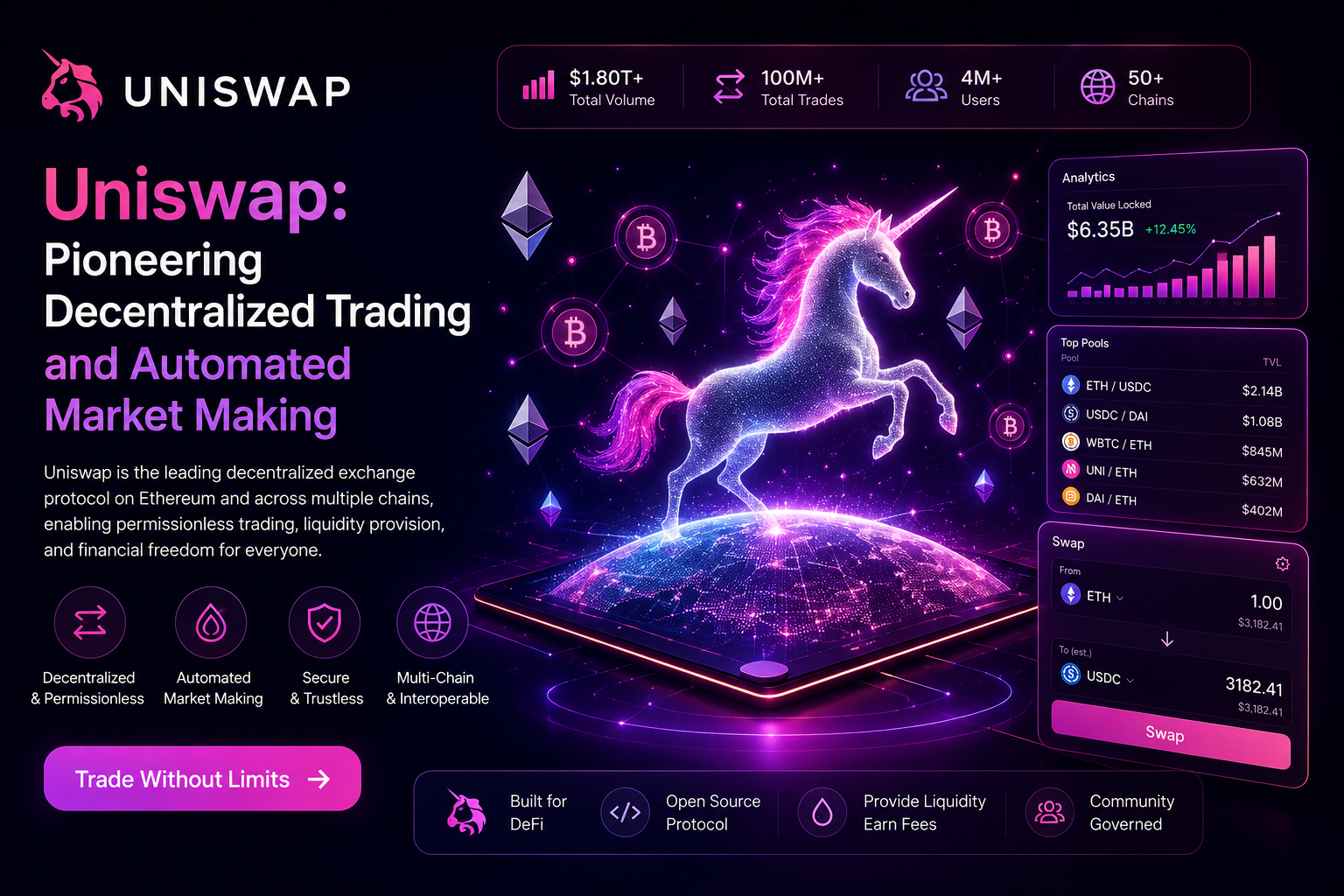
Few protocols have shaped the trajectory of decentralized finance as profoundly as Uniswap. Launched in 2018 on Ethereum, Uniswap introduced a radically different way to trade digital assets: instead of matching buyers and sellers through a traditional order book, it used a simple mathematical formula and pooled liquidity to let anyone swap tokens instantly, permissionlessly, and without ever handing custody of their funds to a centralized intermediary. That idea, the automated market maker, went on to become the backbone of an entire industry.
Today, Uniswap is not a single product but an evolving family of protocols, spanning four major versions, a dedicated Ethereum Layer 2 network, a governance token, and a sprawling ecosystem of integrations, aggregators, and third-party applications built on top of it. This article offers a comprehensive look at what Uniswap is, how its automated market maker model works, how the protocol has evolved from v1 through v4, what role the UNI token and Unichain play, and why Uniswap remains one of the most consequential pieces of infrastructure in decentralized finance.
What Is Uniswap?
Uniswap is a decentralized exchange protocol that allows users to trade cryptocurrency tokens directly from their own wallets, without depositing funds into a centralized platform and without relying on a traditional buy-and-sell order book. Instead, Uniswap relies on liquidity pools: smart contracts holding reserves of two or more tokens that traders swap against directly, with prices determined algorithmically based on the ratio of assets in the pool.
Because Uniswap’s smart contracts are permissionless and non-custodial, anyone can create a new trading pair, anyone can supply liquidity to an existing pool to earn a share of trading fees, and anyone can trade against that liquidity, all without asking permission from a central authority. This design principle, self-custody combined with open, permissionless access, has remained a constant throughout every version of the protocol, even as the underlying mechanics have grown dramatically more sophisticated.
Uniswap is developed and maintained primarily by Uniswap Labs, though governance of key protocol parameters and treasury decisions is directed by holders of the UNI governance token through a decentralized governance process. The protocol itself, however, is not operated by any single company; once deployed, its smart contracts run autonomously on the blockchain, executing exactly as coded regardless of what happens to any particular organization involved in building it.
The Automated Market Maker: A New Model for Trading
To appreciate why Uniswap was such a significant innovation, it helps to understand the problem it solved. Traditional exchanges, whether centralized crypto platforms or conventional stock markets, rely on order books: lists of buy and sell orders at various prices that need to be matched against one another. Order books work well when there is a deep and continuous stream of participants willing to place orders on both sides of the market, but they are difficult to bootstrap for new or thinly traded assets, and they are not naturally suited to a fully on-chain, permissionless environment where transaction costs and block times constrain how quickly orders can be placed and cancelled.
Uniswap’s founding insight was to replace the order book entirely with a mathematical formula. In its original design, a liquidity pool holds two tokens, and the product of their quantities is held constant: as one token is bought and removed from the pool, the price of the remaining token rises along a predictable curve, and vice versa. This constant product formula means that a price always exists for any trade size, liquidity can be supplied passively by anyone, and the entire system can operate autonomously through smart contracts without any need for off-chain matching infrastructure.
This model proved to be more than a clever workaround. It turned out to be remarkably resilient, composable, and easy to build on top of, and it directly inspired a wave of automated market makers across nearly every blockchain that followed, from Ethereum Layer 2 networks to entirely separate ecosystems like Solana and BNB Chain. Understanding Uniswap’s constant product formula is, in many ways, a prerequisite for understanding how the majority of on-chain trading works today.
From v1 to v4: The Evolution of Uniswap
Uniswap’s history is best understood as a series of major protocol upgrades, each addressing limitations of the version before it while introducing new capabilities.
Uniswap v1: Proof of Concept
The original version of Uniswap, launched in November 2018, supported only direct swaps between Ether and a single ERC-20 token per pool. It was a minimal, elegant proof of concept that demonstrated the constant product formula could function as a viable exchange mechanism entirely on-chain. While limited in scope, v1 established the core principles, permissionless pool creation, non-custodial trading, and passive liquidity provision, that every subsequent version would build upon.
Uniswap v2: Direct Token-to-Token Pools
Uniswap v2, launched in 2020, addressed one of v1’s most significant limitations by allowing direct pools between any two ERC-20 tokens, rather than requiring every trade to route through Ether. This single change dramatically expanded the range of trading pairs available and reduced the friction and price impact of many common trades. Uniswap v2 also introduced price oracle functionality, allowing other smart contracts to reference reliable, manipulation-resistant price data derived from pool activity, a feature that became foundational infrastructure for the broader DeFi ecosystem, powering everything from lending protocols to derivatives platforms.
Uniswap v3: Concentrated Liquidity
Released in 2021, Uniswap v3 introduced what remains one of the most influential innovations in AMM design: concentrated liquidity. Rather than spreading liquidity evenly across the entire possible price range from zero to infinity, as v1 and v2 did, v3 allowed liquidity providers to allocate their capital to specific price ranges where they expected trading to actually occur.
This change dramatically improved capital efficiency. A liquidity provider concentrating capital near the current market price could offer the same trading depth as a much larger v2-style position, translating into tighter spreads and better execution for traders, and the potential for significantly higher fee income for liquidity providers who actively managed their positions. Because each concentrated liquidity position could have a unique combination of price range and fee tier, v3 also represented liquidity positions as non-fungible tokens rather than simple fungible pool shares, reflecting the fact that no two positions were necessarily identical. Uniswap v3’s concentrated liquidity model was so influential that it was directly replicated, with attribution and without, across numerous other AMMs on other blockchains in the years that followed.
Uniswap v4: Hooks and a Singleton Architecture
Uniswap v4 represents the most architecturally ambitious upgrade in the protocol’s history. First announced in mid-2023, the upgrade spent well over two years moving through audits, formal verification, community feedback, and an extensive bug bounty program before finally going live on Ethereum mainnet in early 2026, with simultaneous deployments across several major Layer 2 networks including Arbitrum, Base, Optimism, and Polygon.
Two structural changes define v4. The first is a shift to a singleton contract architecture. In every previous version of Uniswap, each individual pool was deployed as its own separate smart contract, which was secure and conceptually clean but expensive: deploying a new pool required significant gas costs, and trades that routed through multiple pools had to make repeated calls between separate contracts. Uniswap v4 instead manages all pools within a single, shared contract, dramatically reducing the cost of both pool creation and multi-hop trades, and pairing this with a new flash accounting settlement system that further reduces the gas overhead of complex swaps.
The second, and arguably more transformative, change is the introduction of hooks. Hooks are external smart contracts that developers can attach to a given pool to customize its behavior at key points in the trading lifecycle, before and after a swap, before and after liquidity is added or removed, and so on. In earlier versions of Uniswap, any customization of pool behavior required forking the entire protocol’s codebase. With hooks, developers can instead plug custom logic directly into a standard Uniswap pool, enabling features such as dynamic, market-responsive fee schedules, on-chain limit orders, time-weighted average market maker execution for large trades, custom oracle designs, and automated liquidity management strategies, all without needing to rebuild the underlying AMM from scratch.
This modularity has turned Uniswap v4 into something closer to a platform than a single product. Within its first year, thousands of hook-based pools were deployed by third-party developers, with some hook-powered protocols individually processing billions of dollars in cumulative trading volume. Uniswap v4’s own code remains under a time-limited source-available license before converting to a fully permissive open-source license several years after launch, a structure intended to protect the protocol’s competitive position during its early growth phase while still preserving eventual full openness.
Unichain: Uniswap’s Own Layer 2 Network
Alongside the v4 upgrade, Uniswap Labs introduced Unichain, a dedicated Ethereum Layer 2 network built specifically to optimize for the needs of decentralized trading. Unichain offers block times of roughly one second, substantially lower gas fees than Ethereum’s base layer, and a specialized block-building design intended to reduce the impact of maximal extractable value, the practice of reordering or inserting transactions to profit at the expense of ordinary users, a persistent challenge for on-chain trading platforms.
Since its launch, Unichain has rapidly become the primary venue for Uniswap v4 activity, accounting for the large majority of v4 transaction volume, with Ethereum mainnet and other supported Layer 2 networks making up the remainder. This reflects a broader trend across the Ethereum ecosystem, where high-frequency, latency-sensitive activity increasingly migrates toward specialized Layer 2 networks, while Ethereum mainnet continues to serve as the settlement layer underpinning their security.
The UNI Token and Uniswap Governance
UNI is Uniswap’s governance token, first distributed in 2020 through a widely discussed airdrop to early users of the protocol. Holding UNI grants the ability to participate in Uniswap’s decentralized governance process, proposing and voting on changes to protocol parameters, treasury allocations, grant funding, and other decisions that shape the platform’s direction.
Uniswap governance operates through the Uniswap Foundation and a broader community of delegates, developers, and token holders who debate and vote on proposals affecting the protocol. Recent governance discussions have included topics such as standardizing how hook-based pools report their effective liquidity and total value locked, reflecting the genuinely new categories of questions that v4’s modular architecture has introduced compared to the more uniform pool structures of earlier versions.
UNI’s market price has fluctuated considerably alongside broader crypto market cycles, and as with most governance tokens tied to a specific protocol, its value is closely connected to expectations about Uniswap’s ongoing relevance, trading volume, and the eventual activation of any mechanism that might route protocol fee revenue toward token holders, a topic that has been debated within Uniswap’s governance community for years.
How Trading Fees Work on Uniswap
Every swap executed on a Uniswap pool incurs a trading fee, which is distributed to the liquidity providers whose capital enabled that trade. Since Uniswap v3, pools have offered multiple fee tiers, allowing liquidity providers and pool creators to select a fee level appropriate to the volatility and expected trading volume of a given pair; a highly liquid, low-volatility pair like two major stablecoins might use a very low fee tier, while a newly launched, more volatile token might warrant a higher fee tier to compensate liquidity providers for additional risk.
Uniswap v4’s hooks extend this further, enabling dynamic fee structures that can adjust in real time based on factors such as market volatility, order size, or other custom logic defined by the hook’s developer, rather than being fixed at pool creation. This flexibility allows pools to be tailored much more precisely to the trading conditions of a specific asset pair than was previously possible.
Beyond the pool’s own trading fee, users should also account for the underlying blockchain’s network transaction fee, which varies significantly depending on which chain a given pool is deployed on. Trading on Ethereum mainnet during periods of high congestion can be considerably more expensive than trading the equivalent pool on a Layer 2 network like Unichain, Arbitrum, or Base, a major reason why an increasing share of Uniswap’s overall trading volume has shifted toward Layer 2 deployments in recent years.
Risks and Considerations for Uniswap Users
As with any decentralized finance protocol, using Uniswap involves risks that go beyond simply the possibility of an asset’s price falling.
Liquidity providers are exposed to impermanent loss, the divergence between the value of assets held inside a pool and what those same assets would be worth if simply held outside the pool, caused by price movements between the pooled assets. Concentrated liquidity positions, introduced in v3 and carried forward into v4, add a further layer of complexity: a position whose price range no longer contains the current market price stops earning trading fees entirely until the price returns to that range or the liquidity provider actively adjusts their position.
Uniswap v4’s hook architecture introduces a genuinely new category of risk that did not exist in earlier, more rigid versions of the protocol. Because hooks are external smart contracts with the ability to intervene in a pool’s core logic, a poorly designed or malicious hook can behave in unexpected ways, including diverting a portion of trading fees, restricting how liquidity can be withdrawn, or creating opportunities for the hook’s operator to trade ahead of ordinary users. A widely discussed 2025 incident involving a major liquidity-optimization hook, in which a rounding flaw in its logic led to a loss of several million dollars despite the hook having passed independent security audits, illustrated concretely that hooks sit outside Uniswap’s own audited core contracts and therefore carry their own independent risk profile. Users interacting with hook-enabled pools, whether as traders or liquidity providers, are well advised to understand what a given hook actually does, whether it has been independently audited, and what level of control it holds over the pool before committing meaningful capital.
More broadly, as with any AMM, the price displayed for a trade is not necessarily the price a trader will actually receive, particularly for large trades against pools with limited depth. Price impact, slippage tolerance settings, and the general depth of a given pool all affect real-world execution quality, and traders moving significant size are generally better served by using aggregators that can split a trade across multiple pools and venues to minimize overall price impact.
Uniswap’s Role in the Broader DeFi Ecosystem
Uniswap’s influence extends well beyond its own trading volume. As one of the earliest and most heavily used sources of on-chain price data, its pools have historically served as a foundational price oracle for a wide range of other DeFi protocols, from lending platforms determining collateral values to derivatives protocols pricing synthetic assets. Its liquidity provider tokens have been integrated as collateral across numerous lending markets, and its contracts have been referenced, forked, and built upon by a large share of the automated market makers that followed it on other blockchains.
Aggregators such as 1inch, CoW Swap, Paraswap, and Matcha route a significant portion of their order flow through Uniswap’s pools, including its more recent hook-enabled v4 pools, meaning that a large share of trades that appear to originate from other interfaces are, in practice, ultimately executed against Uniswap’s underlying liquidity. This layered structure, aggregators and third-party interfaces sitting atop a foundational liquidity layer, mirrors patterns seen across the broader DeFi ecosystem and underscores why the depth and reliability of protocols like Uniswap matters even to users who never interact with its interface directly.
Uniswap has also maintained a multi-chain presence well beyond Ethereum mainnet, with deployments across numerous Layer 2 networks and, in earlier versions, several alternative blockchains as well. This multi-chain strategy reflects the broader fragmentation of on-chain liquidity across an increasingly diverse set of execution environments, and Uniswap’s ability to maintain a consistent, trusted brand and codebase across that fragmented landscape has been an important factor in sustaining its position as one of decentralized finance’s most recognized protocols.
Institutional Interest and the Wallet Layer
As decentralized finance has matured, Uniswap has increasingly found itself courted by a different class of user than the retail traders who dominated its early years. Institutions exploring on-chain finance are drawn to several of Uniswap’s characteristics: transparent, verifiable pricing derived directly from pool reserves; continuous, always-on liquidity that does not depend on a market maker’s willingness to keep quoting prices; and full self-custody of assets, which removes a category of counterparty risk that has repeatedly proven costly in the history of centralized crypto trading venues. Deep, well-established pools for major asset pairs, along with the emergence of dynamic-fee hooks capable of adjusting pricing in response to volatility, have made Uniswap’s more mature pools increasingly attractive as execution venues for larger, more sophisticated trading strategies.
Alongside protocol development, Uniswap Labs has also built out a broader product layer intended to make interacting with the protocol more accessible, including a standalone Uniswap Wallet supporting self-custody, cross-chain swaps, and integration with the underlying trading infrastructure. This reflects a broader trend across leading DeFi protocols: the core smart contracts remain minimal, permissionless, and open, while a separate, optional application layer competes on user experience, convenience, and additional features, without ever requiring users to give up custody of their assets to access those conveniences. Cross-chain functionality, allowing users to swap assets that live on entirely different blockchains through a single interface, has become a particularly important area of investment, reflecting the reality that liquidity and users are now spread across a growing number of Ethereum Layer 2 networks and, increasingly, other ecosystems entirely.
Developer Ecosystem and Composability
One of the most underappreciated aspects of Uniswap’s impact on decentralized finance is the sheer scale of the developer ecosystem that has grown up around it. Because Uniswap’s contracts are open for inspection and its pricing data is freely accessible on-chain, thousands of other protocols and applications have been built to read from, write to, or otherwise interact with Uniswap pools, ranging from simple portfolio trackers and tax reporting tools to complex automated trading strategies and entirely new categories of financial products built using v4 hooks.
This composability, often described as DeFi’s “money lego” property, means that improvements to Uniswap’s core infrastructure tend to ripple outward, benefiting the wider ecosystem rather than being captured solely by Uniswap itself. Conversely, it also means that Uniswap’s own security and reliability have outsized importance: a flaw in the core protocol would not just affect direct users but could cascade through the many other applications that depend on it for pricing, liquidity, or settlement. This dynamic has, over time, pushed Uniswap toward an unusually rigorous approach to protocol changes, favoring extensive audits, formal verification, and lengthy public testing periods before major upgrades go live, a pattern clearly visible in the multi-year development and audit process that preceded the v4 launch.
Comparing Uniswap to Other Automated Market Makers
Uniswap’s constant product and concentrated liquidity innovations have been so influential that most other AMMs across the crypto industry can trace direct lineage back to Uniswap’s design choices, whether through explicit forking of its code or through independent implementations of the same underlying mathematical principles. What continues to differentiate Uniswap from many of its imitators is less any single technical feature and more the combination of first-mover brand recognition, the depth and reliability of its liquidity across its most established pairs, its extensive integration across the broader DeFi and aggregator ecosystem, and its ongoing pace of protocol-level innovation, from concentrated liquidity in v3 to the fully modular, hook-based architecture of v4.
At the same time, competition within the automated market maker space remains intense, with other prominent DEXs on Ethereum and its Layer 2 networks, as well as on entirely separate blockchains, competing for liquidity and trading volume through their own variations on concentrated liquidity, order book hybrids, and increasingly customizable pool architectures. Uniswap’s response to this competitive pressure, most visibly through v4’s hooks, has been to lean further into extensibility, effectively inviting third-party developers to build specialized trading products directly on top of its core infrastructure rather than trying to anticipate and build every possible feature internally.
The Broader Significance of Uniswap for Decentralized Finance
Uniswap’s story offers a useful lens for understanding several broader dynamics that have shaped decentralized finance as a whole.
First, it demonstrates how a single, well-designed mechanism, the constant product automated market maker, can become foundational infrastructure that an entire industry builds upon, in ways its original creators likely could not have fully anticipated. The core formula behind Uniswap v1 remains conceptually present, in modified and extended forms, in the large majority of on-chain exchanges operating today, across essentially every major blockchain.
Second, Uniswap’s evolution illustrates a recurring pattern in DeFi protocol design: early versions prioritize simplicity and security, later versions progressively trade some of that simplicity for greater capital efficiency and flexibility, and each additional layer of sophistication introduces new categories of risk that need to be understood and managed. Concentrated liquidity introduced range management risk; hooks introduced external contract risk. Neither of these risks existed in the earliest, simplest version of the protocol, and understanding this progression is important context for anyone evaluating how much complexity, and how much corresponding risk, they are comfortable taking on.
Third, Uniswap’s ongoing evolution, from a single-chain, single-pair proof of concept into a multi-chain protocol with its own dedicated Layer 2 network and a fully modular, developer-extensible architecture, mirrors the broader maturation of decentralized finance from a niche experiment into a increasingly sophisticated financial infrastructure layer, one that continues to expand in scope while still adhering to its founding principles of permissionless access and non-custodial self-ownership of assets.
Conclusion
Uniswap’s journey from a simple proof-of-concept AMM in 2018 to a multi-version, multi-chain protocol with its own dedicated Layer 2 network and a fully modular hook architecture is, in many respects, the story of decentralized finance itself. Its core innovation, replacing the order book with an automated, algorithmic market maker, proved robust enough to become the template for the vast majority of on-chain exchanges that followed, while its subsequent upgrades, concentrated liquidity in v3 and programmable hooks in v4, have continued to push the boundaries of what is possible for a fully decentralized, non-custodial trading protocol.
At the same time, each new layer of capability has introduced new considerations that traders, liquidity providers, and developers need to understand, from impermanent loss and range management to the independent risk profile of third-party hooks. For anyone seeking to understand how decentralized trading actually works, and where it may be headed next, Uniswap remains essential reading, not merely as a product to use, but as a living case study in how open, permissionless financial infrastructure gets built, tested, and continuously reinvented.
Frequently Asked Questions
What makes Uniswap different from a centralized exchange? Uniswap is non-custodial and permissionless: users trade directly from their own wallets using automated smart contracts rather than depositing funds with a centralized company, and anyone can create a new trading pool without needing approval from an operator.
What is the difference between Uniswap v3 and v4? Uniswap v3 introduced concentrated liquidity, allowing liquidity providers to focus capital within specific price ranges. Uniswap v4 builds on this with a more gas-efficient singleton contract architecture and introduces hooks, external smart contracts that let developers customize pool behavior such as dynamic fees, limit orders, and custom execution logic.
What are Uniswap hooks? Hooks are modular smart contracts that developers can attach to a Uniswap v4 pool to customize its behavior at key points in the trading and liquidity lifecycle, enabling features that previously would have required forking the entire protocol.
What is Unichain? Unichain is an Ethereum Layer 2 network built by Uniswap Labs, designed for fast block times, low transaction costs, and reduced maximal extractable value, and it has become the primary venue for Uniswap v4 trading activity.
Is providing liquidity on Uniswap profitable? It can be, through a share of trading fees, but liquidity providers face impermanent loss and, for concentrated positions, the risk of a position moving outside its selected price range and no longer earning fees. Profitability depends heavily on trading volume, chosen price range, and prevailing market volatility.
What is UNI used for? UNI is Uniswap’s governance token, giving holders the ability to participate in decisions about protocol parameters, treasury spending, and the broader direction of the platform through Uniswap’s decentralized governance process.
Are Uniswap v4 hooks safe to use? Hooks operate outside Uniswap’s core audited contracts, so their safety depends entirely on the specific hook’s own code and audit history. Users should research a hook’s permissions and audit status before trading against it or supplying liquidity to a hook-enabled pool.