Last updated: July 2026
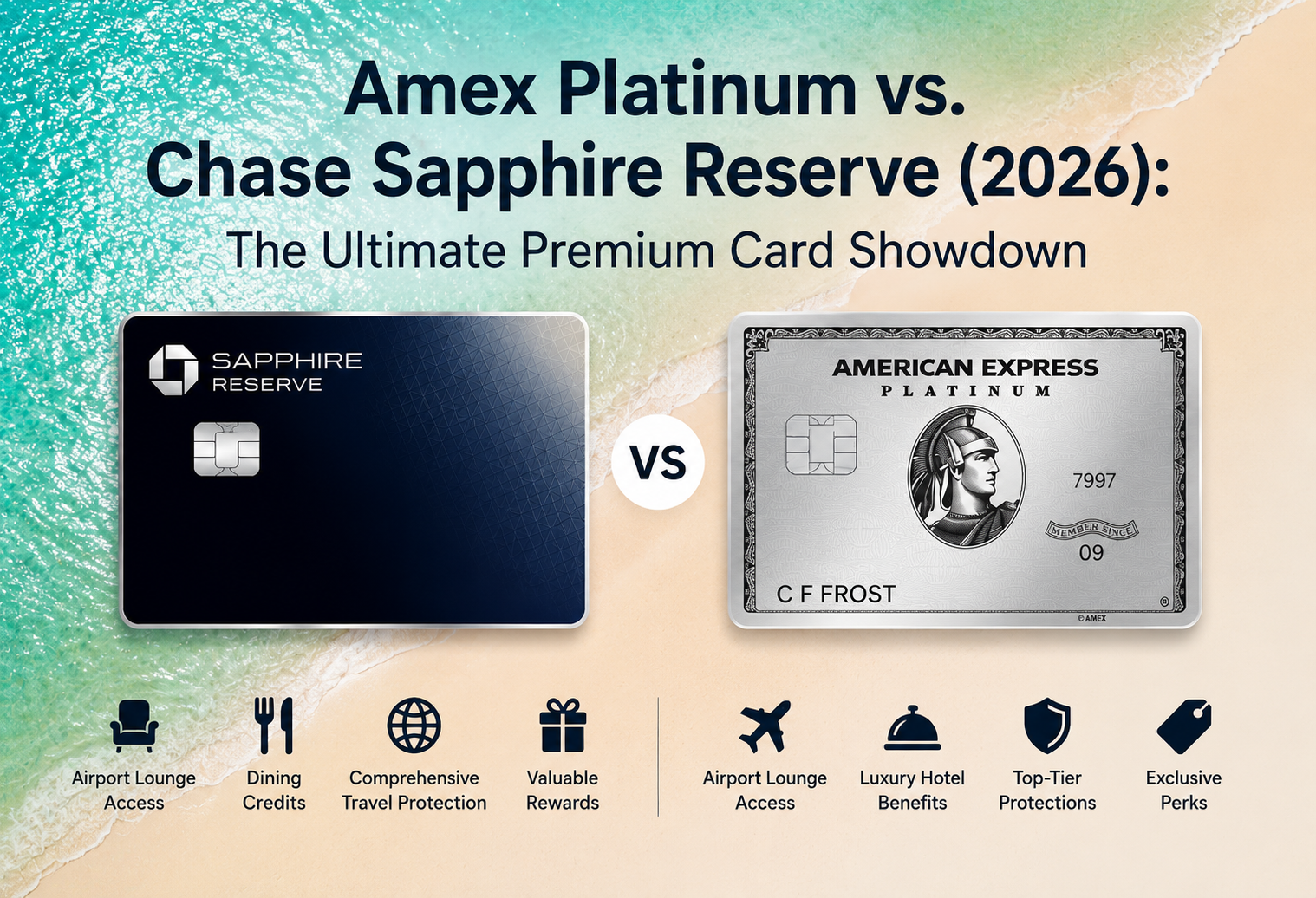
If you’ve narrowed your search for a premium travel credit card down to two options, chances are they’re the American Express Platinum Card® and the Chase Sapphire Reserve®. These two cards have defined the luxury travel rewards category for over a decade, and both went through major overhauls in the last two years — bigger annual fees, but also dramatically expanded benefits. In 2026, choosing between them is genuinely difficult, because both cards can deliver thousands of dollars in value if you use them the right way.
This guide walks through every major category — annual fees, welcome offers, earning rates, airport lounge access, travel protections, hotel and dining perks, and overall value — so you can figure out which card actually fits your life, rather than which one has the flashiest marketing.
Disclaimer: This article is for general educational and informational purposes only and does not constitute financial advice. Card benefits, fees, and terms are subject to change and vary based on your individual account, so always confirm current details on the issuer’s official website before applying. Consider consulting a licensed financial advisor for guidance specific to your situation.
Table of Contents
- Quick Verdict: Which Card Should You Choose?
- Annual Fees and Effective Cost
- Welcome Bonus Comparison
- Earning Rates: How Fast You Rack Up Points
- Airport Lounge Access
- Travel Credits and Statement Credits
- Hotel Benefits and Elite Status
- Dining and Lifestyle Perks
- Travel Protections and Insurance
- Points Value and Transfer Partners
- Who Should Get the Amex Platinum
- Who Should Get the Chase Sapphire Reserve
- Can You Have Both Cards?
- Alternatives If Neither Card Fits
- Frequently Asked Questions
- Final Verdict
1. Quick Verdict: Which Card Should You Choose?
Neither card is objectively “better” — they’re built for slightly different types of travelers.
- Choose the Amex Platinum if airport lounge access is your top priority, you frequently fly with airlines in Amex’s transfer partner network, and you value having the widest possible menu of luxury credits, even if you don’t use every single one.
- Choose the Chase Sapphire Reserve if you want a card that’s a little easier to extract full value from, you book a lot of travel directly with airlines and hotels or through Chase’s travel portal, and you’d rather have a slightly lower price of entry with strong everyday dining rewards.
Most people don’t need both. But frequent travelers who can genuinely use the bulk of each card’s credits sometimes do carry both cards simultaneously, using each one for the specific perks and bonus categories where it shines.
2. Annual Fees and Effective Cost
Both cards carry two of the highest annual fees in the mainstream credit card market. The Amex Platinum sits at the top of the pack, with an annual fee close to $900 — among the steepest of any widely available rewards card. The Chase Sapphire Reserve comes in roughly $100 lower, which on paper makes it the more affordable of the two premium heavyweights.
Sticker price only tells part of the story, though. Both issuers build in automatic statement credits designed to claw back a meaningful chunk of the fee without requiring much effort from the cardholder. Chase, for example, applies a travel statement credit automatically to nearly any travel-related purchase, which can bring the practical, out-of-pocket cost of the card down well below its advertised sticker fee before you’ve even touched any other perk.
The real question isn’t which card has the lower listed price — it’s which card’s bundle of credits and benefits you’ll actually use. A higher-fee card whose perks map perfectly onto your travel habits can end up cheaper in practice than a “cheaper” card whose benefits mostly sit unused.
3. Welcome Bonus Comparison
Both issuers have leaned on aggressive welcome offers to compete for new premium cardholders in 2026. The Amex Platinum has recently been marketed with one of the largest sign-up bonuses in the card’s history, on top of an advertised annual perk bundle valued well over $1,000. The Chase Sapphire Reserve has countered with its own large points bonus tied to a spending requirement in the first few months of account ownership.
Welcome offers change frequently and are often time-limited or targeted to specific applicants, so the exact current bonus for either card should always be confirmed directly on the issuer’s website before applying. As a general rule, a strong premium travel card welcome bonus in 2026 is worth well over $1,000 in travel value when redeemed strategically — often more than an entire year’s annual fee on its own.
When comparing bonuses, look past the headline number and ask:
- What’s the minimum spend requirement, and can you hit it naturally without overspending?
- How long do you have to meet that spend (commonly three to six months)?
- What’s the actual redemption value of the points or membership rewards currency, not just the raw point count?
4. Earning Rates: How Fast You Rack Up Points
This is one of the areas where the two cards diverge most clearly, and it comes down to philosophy: Amex rewards big-ticket airfare and hotel bookings heavily, while Chase spreads strong multipliers across more everyday categories.
The Platinum Card’s highest earning rate — around five points per dollar — applies narrowly to flights booked directly with airlines or through Amex Travel, and to prepaid hotel bookings made the same way. Nearly everything else on the card, from groceries to gas to restaurants, earns at just one point per dollar.
The Chase Sapphire Reserve casts a wider net. It offers its highest multiplier, around eight points per dollar, on purchases made through the Chase Travel portal, a strong four points per dollar on flights and hotels booked directly with the airline or property, and a solid three points per dollar on dining worldwide — a category most people spend in constantly.
The practical takeaway: if the bulk of your spending happens outside of flights and prepaid hotels, the Sapphire Reserve will almost certainly out-earn the Platinum on everyday purchases. If your spending is concentrated specifically in direct airfare and prepaid luxury hotel packages, the Platinum’s five-times rate can pull ahead in those narrower categories.
5. Airport Lounge Access
This is arguably the single biggest differentiator between the two cards, and it’s where the Amex Platinum has traditionally held a commanding lead.
Platinum cardholders get access to Amex’s own Centurion Lounges — widely regarded as some of the best airport lounges in the United States — along with a set number of complimentary Delta Sky Club visits each year, Priority Pass Select membership, and access to the Plaza Premium and Lufthansa lounge networks. Altogether, this adds up to well over 250 lounge locations worldwide.
The Chase Sapphire Reserve has significantly narrowed the gap in recent years. Chase now operates its own branded Sapphire Lounges through a partnership with The Club, in addition to offering Priority Pass Select membership — a major step up from where the card stood just a few years ago. Even so, the overall size and reputation of Amex’s Centurion network still generally give the Platinum the edge for travelers who prioritize lounge access above everything else.
Bottom line: If airport lounge access — especially Centurion Lounges — is your number one priority, the Platinum wins this category outright.
6. Travel Credits and Statement Credits
Both cards bundle in a long list of statement credits designed to offset the annual fee, though the structures differ.
The Amex Platinum’s credit menu includes several hundred dollars in annual hotel credit for prepaid stays booked through Amex Travel’s Fine Hotels + Resorts or The Hotel Collection programs, along with credits toward select dining and digital entertainment partners. Amex has marketed the full bundle as adding up to well over $1,000 in combined annual value.
The Chase Sapphire Reserve’s credit stack is similarly extensive: several hundred dollars in credits toward live event ticket purchases (split across two separate periods during the year), complimentary streaming and music subscriptions worth close to $300 combined, credits toward prepaid hotel bookings made through Chase Travel, and a smaller annual credit toward fitness memberships. Both cards also reimburse the application fee for Global Entry, NEXUS, or TSA PreCheck.
The catch with any credit-heavy card is that the advertised value only materializes if you actually use the specific services tied to each credit. A cardholder who doesn’t use the streaming subscriptions, doesn’t buy tickets through the card’s event partner, and doesn’t have a gym membership tied to the fitness credit will realize far less real-world value than the sticker total suggests — and the same logic applies to Amex’s dining and hotel credits if you don’t naturally use those specific partner programs.
7. Hotel Benefits and Elite Status
For hotel loyalists, the two cards point in somewhat different directions. The Chase Sapphire Reserve tends to offer stronger overall hotel value thanks to its one-to-one point transfer ratio with Hyatt’s loyalty program, credits toward a curated boutique hotel collection, and access to Chase’s own lounge network. It also comes bundled with a complimentary elevated elite status tier with a major hotel loyalty program, with a path to an even higher tier available to extremely high annual spenders.
The Amex Platinum’s hotel strategy leans instead toward its Fine Hotels + Resorts and Hotel Collection programs booked through Amex Travel, which can include perks like room upgrades, early check-in, late checkout, and daily breakfast for two at participating luxury properties — benefits that go beyond a simple statement credit and can meaningfully upgrade a single stay.
If your hotel loyalty centers on Hyatt specifically, the Sapphire Reserve’s transfer ratio gives it a clear edge. If you’d rather book one-off luxury stays through a curated program regardless of brand loyalty, the Platinum’s Fine Hotels + Resorts perks may appeal more.
8. Dining and Lifestyle Perks
Everyday dining rewards favor the Sapphire Reserve, which earns an elevated rate on dining worldwide — a category most cardholders spend in constantly, unlike some of the more specialized credits either card offers. The Platinum Card, by contrast, includes credits oriented toward specific dining partners rather than an ongoing elevated multiplier across all restaurant spending, which means its dining value is concentrated in a smaller set of usable credits rather than spread across every meal charged to the card.
Beyond dining, both cards include lifestyle-oriented extras — entertainment and streaming credits, wellness-adjacent benefits, and access to event pre-sales or curated experiences through each issuer’s respective programs. These perks are worth reviewing individually against your actual habits rather than treating them as guaranteed value, since unused credits contribute nothing to your card’s real-world return.
9. Travel Protections and Insurance
Both cards include a robust suite of travel protections that are standard for the premium card tier, generally covering trip cancellation and interruption, trip delay reimbursement, baggage delay and loss, rental car damage, and emergency medical evacuation on certain bookings. Coverage limits, eligibility requirements, and exclusions differ between the two issuers and change over time, so if travel insurance is a major factor in your decision, it’s worth comparing the current benefit guides for both cards directly rather than relying on general assumptions.
Both cards also include purchase protection and extended warranty coverage on eligible purchases, which can be a meaningful hidden benefit for cardholders who use their premium card for larger purchases.
10. Points Value and Transfer Partners
Redemption flexibility is where sophisticated points strategists spend the most time, and both cards offer strong — if different — options.
Amex Membership Rewards points are generally valued at around one cent apiece when redeemed for travel, though savvy transfers to Amex’s airline and hotel partners can push the effective value noticeably higher for the right redemption. Chase Ultimate Rewards points carry a similar baseline value of about one cent each through the Chase Travel portal, with additional upside available through Chase’s own transfer partner roster.
Amex generally offers a wider selection of transfer partners overall — roughly 20, compared to Chase’s 13 — giving Platinum cardholders a slightly bigger net for finding a strong transfer sweet spot on a specific flight or hotel redemption. That said, the number of partners matters less than whether the specific airlines and hotel chains on each list match the ones you actually use. Chase’s partner list includes major international carriers along with a strong domestic presence, most transferring at a one-to-one ratio.
The right move here is to check both issuers’ current transfer partner lists against your own preferred airlines and hotel chains before assuming one card’s points are inherently “worth more” than the other’s.
11. Who Should Get the Amex Platinum
The Platinum Card tends to make the most sense for:
- Travelers who fly frequently enough to make heavy use of premium airport lounges, especially Centurion Lounges
- People who book a meaningful share of their flights directly with airlines or through Amex Travel, where the elevated earning rate applies
- Cardholders who want the widest possible selection of transfer partners for maximizing point value on international travel
- Anyone who values a broad menu of luxury credits — even if they only end up using a portion of them — over a more streamlined, easier-to-max-out credit structure
- Loyalists to Delta Air Lines, given the card’s Delta Sky Club access and Amex’s close relationship with Delta’s frequent flyer program
12. Who Should Get the Chase Sapphire Reserve
The Sapphire Reserve tends to be the better fit for:
- Travelers who want a slightly lower entry price while still accessing a premium-tier card
- People whose spending is spread across everyday categories like dining, rather than concentrated in prepaid luxury hotel bookings and direct airfare
- Hyatt loyalists, thanks to the card’s one-to-one transfer ratio
- Cardholders who prefer a credit structure that’s more straightforward to fully utilize, rather than a longer list of narrower, harder-to-use credits
- Anyone who books most of their travel through a single portal and wants to maximize the elevated earning rate on Chase Travel purchases
13. Can You Have Both Cards?
Yes — there’s no restriction on holding cards from different issuers, and many frequent travelers do carry both the Amex Platinum and the Chase Sapphire Reserve at the same time, using each card strategically for the specific perks, bonus categories, and lounge networks where it has the advantage. This approach only makes financial sense if you can realistically use enough of both cards’ combined credits and benefits to justify paying close to $1,700 a year in combined annual fees. For most people, one premium card used well will deliver more net value than two premium cards used only partially.
If you’re on the fence, a useful middle ground is downgrading rather than canceling outright. Both American Express and Chase generally allow product changes to a lower-fee card within the same family without closing the account, which helps preserve your credit history and card age — a useful safety valve if a premium card ends up not delivering enough value for your situation after a year of ownership.
14. Alternatives If Neither Card Fits
If the combined weight of a $795–$895 annual fee feels hard to justify regardless of the perks, it’s worth considering the broader landscape of travel rewards cards before committing to either premium option:
- Mid-tier travel cards (often in the $95–$150 annual fee range) frequently offer a meaningful share of the earning power and travel protections of premium cards, without the same commitment to a near-$900 yearly cost.
- No annual fee travel cards have improved substantially in recent years, offering solid flat-rate earning and, in some cases, no foreign transaction fees — a reasonable starting point if you’re not ready to commit to a premium card’s credit-maximization game.
- Co-branded airline or hotel cards can make sense if your loyalty is concentrated on a single travel brand rather than spread across a flexible points ecosystem.
15. Frequently Asked Questions
Is the Amex Platinum or Chase Sapphire Reserve easier to get approved for? Both cards generally require excellent credit (typically a FICO score in the high 700s or above), along with a strong income and credit history relative to existing debt. Neither card is designed for first-time credit users.
Which card has better travel insurance? Both offer strong, comparable protections including trip cancellation and interruption insurance, delay reimbursement, and baggage coverage. Specific limits and exclusions vary, so it’s worth comparing the current benefits guide for each card if travel insurance is a deciding factor for you.
Do I need to spend a lot to make either card worth it? You don’t need to spend an enormous amount, but you do need to actually use a meaningful share of the credits and perks each card offers. A cardholder who ignores most of the built-in credits will struggle to justify either card’s annual fee purely through points earned on spending.
Which card is better for a once-a-year vacationer? Neither premium card is typically the most cost-effective choice for someone who travels only occasionally, since the value of both cards comes largely from consistently using lounge access, travel credits, and elevated earning rates. An infrequent traveler is often better served by a no annual fee or low annual fee travel card.
Can I downgrade instead of canceling if the card isn’t working for me? Yes. Both American Express and Chase generally allow you to downgrade to a lower-fee card in the same family without closing the account, which helps protect your credit history and average account age.
Does either card charge foreign transaction fees? No — both the Amex Platinum and the Chase Sapphire Reserve waive foreign transaction fees, making either a strong choice for international travel from a pure fee standpoint.
16. How the Two Cards Got Here: A Brief Evolution
It’s worth understanding how these two cards arrived at their current form, because it explains why both now carry such high fees relative to where they started.
The Chase Sapphire Reserve launched in 2016 and immediately reshaped the premium card market with an aggressive welcome bonus and a comparatively modest annual fee for the benefits offered. It forced American Express to respond, and for years the two issuers traded blows — matching each other’s lounge access, travel credits, and points multipliers in a kind of arms race that ultimately benefited cardholders.
That race accelerated sharply in 2025, when both issuers pushed through major refreshes that raised annual fees substantially while also expanding the credit and benefit stack attached to each card. The result is the market you see today: two cards priced near the very top of the mainstream credit card world, each packed with enough credits that, if fully utilized, can comfortably exceed the cost of the fee — but each also complex enough that a large share of cardholders never capture the full advertised value.
This history matters for one practical reason: both issuers are likely to continue adjusting fees, credits, and partner benefits over time. Whatever specific dollar figures apply to either card at the moment you’re reading this, expect them to keep evolving, and always check the issuer’s current terms before applying rather than relying on any single article or comparison, including this one.
17. Impact on Your Credit Score and Approval Odds
Both cards fall into the “excellent credit” tier of card products, and applying for either one comes with a few things worth understanding beforehand.
Hard inquiries. Applying for either card typically triggers a hard inquiry on your credit report, which can cause a small, temporary dip in your score. If you’re planning to apply for a mortgage, auto loan, or other major financing in the near future, it’s generally wise to space out new credit card applications rather than opening one right before a big loan application.
Application rules. Both American Express and Chase maintain their own internal rules limiting how often you can apply for new cards or receive welcome bonuses, particularly on repeat product lines. Chase, for instance, has long enforced a rule limiting new card approvals based on how many cards you’ve opened across all issuers within a rolling 24-month window. Amex, similarly, restricts how frequently you can earn a welcome bonus on the same card. These policies change periodically, so if you’ve held either card before, confirm your eligibility for a new bonus before applying again.
Credit limit expectations. Neither the Platinum Card nor the Sapphire Reserve publishes a fixed credit limit — approved limits vary significantly based on income, existing debt, and credit history. The Amex Platinum, notably, doesn’t function as a traditional revolving credit card at all; it’s a charge card, meaning the full balance is generally expected to be paid off each month rather than carried with an ongoing minimum payment structure. The Sapphire Reserve, by contrast, is a standard revolving credit card with a traditional APR that applies if you carry a balance.
Utilization considerations. Because the Platinum Card is a charge card, it typically doesn’t count against your credit utilization ratio the same way a revolving card does, which can actually be a modest advantage for your credit profile if you’re also managing other revolving balances.
18. Maximizing Value: Practical Tips for Either Card
Whichever card you choose, a handful of habits make the difference between actually profiting from a premium card and simply paying for one:
- Build a calendar reminder system for time-limited credits. Many of the credits on both cards — event tickets, hotel bookings, fitness memberships — are split into semi-annual or quarterly windows. Missing a window means losing that portion of the credit entirely, with no rollover.
- Book travel through the “right” channel deliberately. Since both cards reward travel booked through their own portals more generously than travel booked elsewhere, get in the habit of checking your issuer’s travel portal first, even if you ultimately book directly with the airline or hotel for other reasons like status credit or more flexible cancellation terms.
- Enroll in every available program. Some benefits, like Priority Pass membership, aren’t automatic — they require a one-time enrollment step. Skipping this step means leaving real value on the table for the entire year.
- Track your redemptions, not just your point balance. A large point balance means little if you redeem it at a poor rate. Before redeeming, compare the portal redemption value against a transfer-partner redemption for the same trip; the difference can sometimes be worth two or three times as much.
- Reassess annually. Both issuers periodically adjust their benefit packages. A card that was a clear win for your travel habits last year may shift after a refresh, so it’s worth a yearly gut-check on whether the fee is still paying for itself.
Final Verdict
There’s no universally “correct” answer in the Amex Platinum vs. Chase Sapphire Reserve debate — both cards are excellent, and the right choice comes down to matching each card’s strengths to your actual travel patterns rather than chasing the card with the flashier headline perks.
If lounge access is non-negotiable and you frequently book flights directly with airlines or luxury prepaid hotel stays, the Amex Platinum’s Centurion Lounge network and elevated airfare earning rate make a strong case for the extra $100 in annual fee. If you’d rather have a slightly more accessible price of entry, stronger everyday dining rewards, and a more straightforward path to using the bulk of your credits, the Chase Sapphire Reserve is the more practical everyday premium card for most travelers.
Whichever you choose, the golden rule remains the same as with any premium rewards card: the annual fee only pays for itself if you actually use the benefits. Before applying, map out realistically which specific credits, lounges, and bonus categories you’ll use in a typical year, and let that — not the marketing copy — make the final call.
This article is for general informational purposes only and is not financial advice. Card offers, rates, benefits, and terms change frequently — always verify current details on the issuer’s official website before applying.