Last updated: July 2026
Choosing a business credit card isn’t like choosing a personal one. You’re not just thinking about your own spending habits — you’re thinking about payroll-adjacent costs, software subscriptions, advertising spend, vendor payments, employee cards, and cash flow that can swing wildly from month to month. The right card can meaningfully offset those costs through cash back or points, extend your runway with an interest-free financing window, and give you better visibility into where your company’s money is actually going.
The wrong card, on the other hand, can mean paying an annual fee for perks you never use, missing out on rewards in the categories where your business actually spends, or getting locked into a card that punishes rather than rewards your company’s growth.
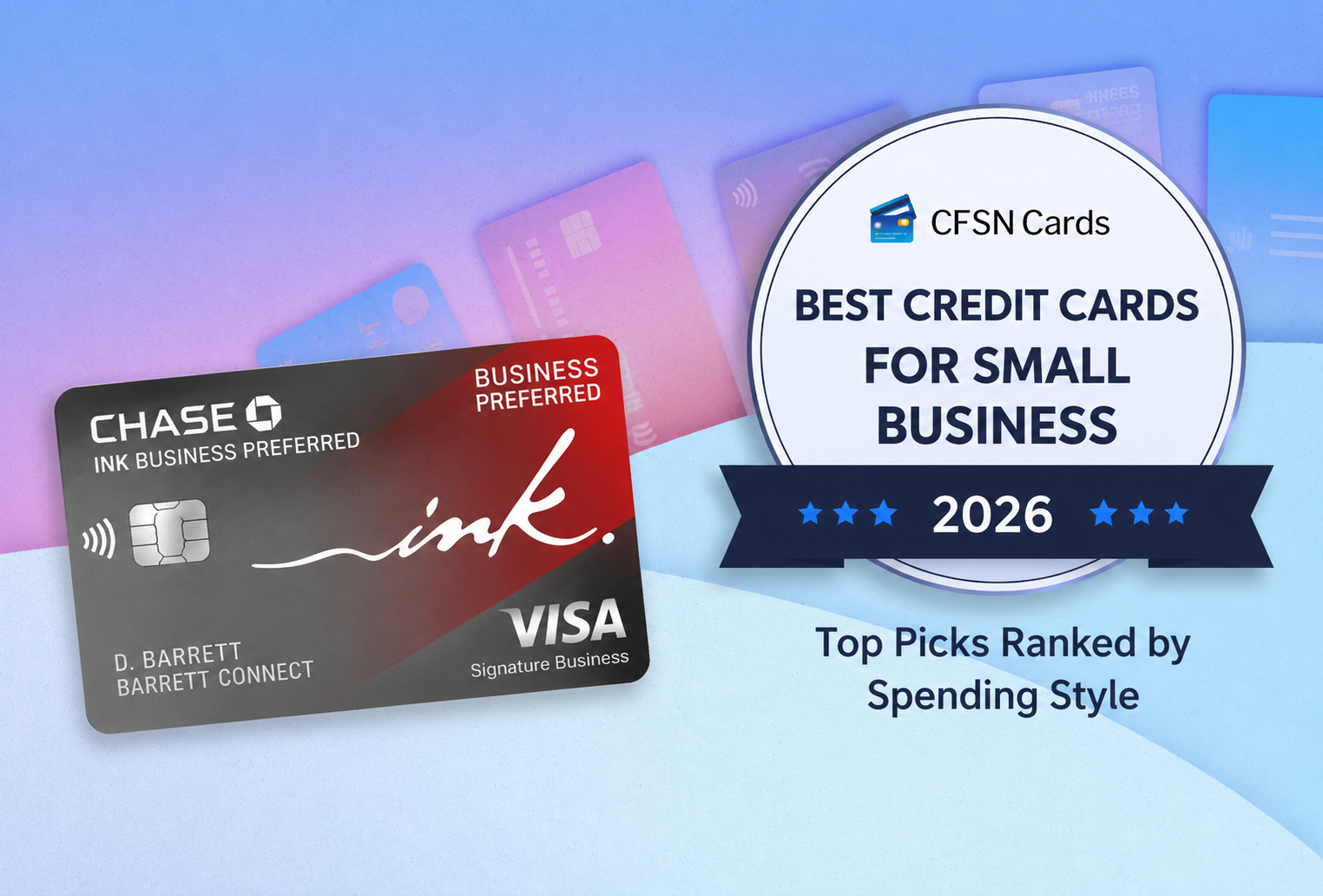
This guide ranks the best small business credit cards for 2026 by spending style rather than by a single “best overall” pick, because the right card for a marketing agency spending heavily on ad platforms looks nothing like the right card for a contractor buying materials and fuel, or a startup burning through SaaS subscriptions.
Disclaimer: This article is for general educational and informational purposes only and does not constitute financial or legal advice. Card terms, rewards rates, fees, and eligibility requirements vary by issuer and change frequently, so always confirm current details directly with the card issuer before applying. Consider consulting a licensed financial advisor or accountant for guidance specific to your business.
Table of Contents
- Why Business Owners Should Separate Business and Personal Spending
- How Business Credit Cards Differ From Personal Cards
- Key Factors to Compare Before Applying
- Best No Annual Fee Business Cards
- Best Business Cards for Everyday Flat-Rate Cash Back
- Best Business Cards for Bonus Categories (Ads, Software, Office Supplies)
- Best Business Cards for Travel Rewards
- Best Premium Business Cards With Lounge Access
- Best Business Cards for 0% Intro APR and Financing
- Best Business Cards for Startups and Newer Companies
- Best Business Cards for Heavy Spenders (No Preset Limit)
- Best Business Cards for Bad or Limited Credit
- Corporate Cards vs. Traditional Business Credit Cards
- Employee Cards and Spend Management
- How to Apply: What Issuers Look For
- Common Mistakes Business Owners Make
- Frequently Asked Questions
- Final Thoughts
1. Why Business Owners Should Separate Business and Personal Spending
Before comparing individual cards, it’s worth addressing a more fundamental question: why get a business credit card at all, instead of just using a personal card for company expenses?
Cleaner bookkeeping. Mixing business and personal spending on the same card creates a mess for tax season, makes it harder to track deductible expenses, and complicates any future accounting or audit process.
Liability protection. For businesses structured as an LLC or corporation, commingling personal and business finances can undermine the legal separation between you and your company — a concept sometimes referred to as “piercing the corporate veil.” Keeping business spending on a dedicated business card helps maintain that separation.
Higher credit limits. Business cards are often underwritten with business revenue in mind, which can result in meaningfully higher credit limits than a personal card, giving you more breathing room for larger purchases and better cash flow management.
Rewards that match business spending. Business cards are frequently built around categories that matter to companies specifically — advertising, software subscriptions, shipping, office supplies, and travel — rather than the categories that dominate personal spending, like groceries and gas.
Employee card management. Most business cards let you issue supplementary cards to employees with individual spending limits and category restrictions, giving you far more control than sharing a single personal card or reimbursing employees after the fact.
2. How Business Credit Cards Differ From Personal Cards
A few structural differences are worth understanding before you apply.
Personal guarantees. Most small business credit cards, particularly from traditional issuers, still require a personal guarantee from the business owner. This means that if the business can’t pay its balance, you’re personally on the hook — a meaningful distinction from newer corporate card products that evaluate the business itself rather than the founder’s personal credit.
Credit reporting. Some business cards report account activity to personal credit bureaus, while others report primarily or exclusively to business credit bureaus. This matters both for building your personal credit and for understanding what shows up on your personal credit report if something goes wrong.
Charge cards vs. revolving credit. Some premium business cards function as charge cards, meaning the balance is expected to be paid in full each month rather than carried with an ongoing minimum payment. Others are standard revolving credit cards with an ongoing APR that applies to any carried balance.
No preset spending limit cards. A subset of business cards, often charge cards, don’t advertise a fixed credit limit at all. Instead, your effective spending power flexes based on your payment history, spending patterns, and financial profile — useful for businesses with seasonal or unpredictable cash flow needs.
3. Key Factors to Compare Before Applying
Rewards Structure
Decide whether a flat-rate card (simple, predictable) or a bonus-category card (potentially higher rewards, more attention required) better fits your spending. If your expenses are concentrated in one or two categories — advertising, shipping, or office supplies, for example — a category-specific card can meaningfully outperform a flat-rate card.
Annual Fee vs. Value
A business card with a substantial annual fee can still be the right call if the bundled credits and elevated rewards categories genuinely offset the cost given your actual spending. Run the math against your real expenses rather than the advertised value.
Welcome Bonus and Spending Threshold
Business welcome bonuses can be extremely lucrative, but make sure the required spending threshold is realistic for your business’s typical monthly expenses rather than something you’d have to artificially inflate spending to reach.
Personal Guarantee Requirements
If you want to keep your personal credit fully insulated from business liabilities, prioritize cards or corporate card providers that evaluate business fundamentals rather than requiring a personal guarantee — though be aware these often come with stricter revenue or funding requirements.
Employee Card Features
If you have even a handful of employees making purchases on behalf of the business, look for free employee cards, individual spending limits, and real-time visibility into where money is going.
Financing Needs
If your business anticipates a large upcoming purchase or needs to smooth out uneven cash flow, an intro 0% APR period can be worth more than any rewards rate.
Credit Reporting Behavior
If you’re actively trying to build your personal credit alongside your business credit, confirm whether the card reports to personal bureaus, business bureaus, or both.
4. Best No Annual Fee Business Cards
For many small businesses, especially newer or leaner operations, a no annual fee card that still earns meaningful rewards is the smartest starting point. Several widely available business cards in this category offer unlimited flat-rate cash back — commonly in the 1.5% range — on every purchase with no categories to track and no annual cost eating into returns. This structure works particularly well for businesses with diverse spending that doesn’t cluster neatly into one or two bonus categories.
No annual fee doesn’t have to mean no welcome bonus, either — several cards in this tier offer bonuses worth several hundred dollars after a reasonable spending threshold in the first few months, on top of their ongoing flat-rate earnings.
5. Best Business Cards for Everyday Flat-Rate Cash Back
If you’d rather not think about bonus categories at all, a flat-rate cash back business card is the simplest option. These cards typically earn a consistent percentage — often between 1.5% and 2% — on every purchase, regardless of category. This is a strong fit for service-based businesses, consultants, and companies whose spending doesn’t concentrate heavily in any single area covered by a bonus-category card.
The main advantage of this category is predictability: you always know exactly what you’re earning, and there’s no risk of missing an elevated category because you didn’t activate it or hit a spending cap.
6. Best Business Cards for Bonus Categories (Ads, Software, Office Supplies)
For businesses with concentrated spending in specific categories, a bonus-category card can meaningfully outperform a flat-rate option. Cards in this space commonly offer elevated rewards — often in the 2x to 5x range — on categories like:
- Advertising purchases made directly with social media and search platforms
- Software and cloud computing services
- Office supply stores
- Shipping and postage
- Telecommunications and internet services
- Gas stations and vehicle-related expenses for businesses with a driving component
The trade-off is that these elevated rates often apply only up to an annual spending cap, after which rewards drop to a lower base rate. Businesses that spend heavily in these categories — a digital marketing agency running large ad budgets, for example, or a software company with substantial cloud infrastructure costs — should map their actual monthly spending in each category against a card’s specific caps before assuming the advertised rate will apply to their full spend.
7. Best Business Cards for Travel Rewards
For businesses with regular travel needs — client visits, conferences, sales trips — a travel rewards business card can turn routine expenses into meaningful value. These cards typically earn points or miles on travel-related purchases (flights, hotels, rental cars) at an elevated rate, alongside a decent flat rate on everyday business spending.
The strongest cards in this category allow points to be combined with a companion personal card from the same issuer, letting business owners pool points across accounts and unlock better transfer partner value than either card would offer on its own. This can be a meaningful advantage for owners who already hold a premium personal travel card and want their business spending to feed into the same rewards ecosystem.
Look for a business travel card with no foreign transaction fees if your company does any international business, along with travel protections like trip delay reimbursement and rental car insurance, which can offset costs that would otherwise come straight out of company funds.
8. Best Premium Business Cards With Lounge Access
At the top end of the business card market sit premium cards that mirror the benefits of top-tier personal travel cards — airport lounge access, substantial statement credits, and elevated earning rates on travel and select business categories — in exchange for annual fees that can run into the hundreds or, for the most premium options, close to $900.
These cards make the most sense for founders and executives who travel frequently for business and can genuinely use benefits like lounge access, elevated hotel status, and travel credits. Some premium business cards bundle in access to well over 1,500 airport lounges worldwide through partnerships with major lounge networks, along with the ability to transfer points to more than 20 airline and hotel loyalty programs.
For a business owner who travels several times a month, the combined value of lounge access, travel credits, and elevated point earning can comfortably exceed the annual fee. For a business owner who travels only occasionally, a mid-tier or no-fee business travel card will almost always deliver better net value.
9. Best Business Cards for 0% Intro APR and Financing
Cash flow is one of the most common challenges for small businesses, and a card with a long introductory 0% APR period can function as a genuinely useful, interest-free financing tool for a large purchase — new equipment, initial inventory, a marketing push, or bridging a seasonal revenue gap.
Look for cards offering some of the longest available intro APR windows on purchases, ideally paired with a low or no balance transfer fee if you’re consolidating existing business debt. As with any 0% intro offer, the key is having a concrete repayment plan in place before the promotional period ends, since the ongoing APR that follows is typically much higher than the introductory rate.
10. Best Business Cards for Startups and Newer Companies
Startups face a unique challenge: they often don’t have years of business revenue history to point to, and founders may be relying heavily on personal credit and savings in the early days. A handful of cards are specifically well-suited to this stage:
- Flat-rate, no annual fee cards that don’t require the complexity of tracking bonus categories while a founder is focused on a dozen other priorities
- Cards with simple, straightforward APR structures and intro financing offers, useful for bridging early cash flow gaps
- Cards from issuers with relatively accessible approval criteria, since a brand-new business may not yet have the credit history or revenue to qualify for the most premium products
As the business matures and revenue grows, it often makes sense to graduate to a more specialized card that better matches the company’s actual spending categories, or to add a second card focused specifically on travel or a high-volume expense category.
11. Best Business Cards for Heavy Spenders (No Preset Limit)
Businesses with large, sometimes unpredictable monthly spending — think agencies fronting client ad spend, or companies making large inventory purchases — often outgrow cards with a fixed credit limit. Charge-card-style business products with no preset spending limit are designed for exactly this situation: instead of a hard cap, your effective spending power adjusts based on your payment history, cash flow, and financial profile.
These cards typically require the balance to be paid in full each month rather than carried, and often carry a moderate annual fee in exchange for the flexibility. They can be a strong fit for businesses that occasionally need to charge amounts well beyond what a traditional card’s credit limit would allow, without going through a formal credit line increase request each time.
12. Best Business Cards for Bad or Limited Credit
If your personal credit is limited or has taken a hit, secured business credit cards offer a path forward. Like their personal-card counterparts, these require a refundable security deposit that typically sets your credit limit, and they report account activity to help build both business and personal credit history over time with responsible use.
A growing number of secured business cards also now offer modest cash back rewards, a meaningful improvement over older secured products that rarely offered rewards at all. Look for a card that reports to business credit bureaus (helping establish your company’s independent credit profile) and offers a clear path to graduating to an unsecured card as your credit improves.
13. Corporate Cards vs. Traditional Business Credit Cards
In recent years, a newer category of “corporate cards” from fintech-focused providers has emerged as a genuine alternative to traditional bank-issued business credit cards, particularly for venture-backed startups and fast-growing companies.
Traditional business credit cards (from major banks) typically rely on the owner’s personal credit and often require a personal guarantee. Approval and credit limits are influenced heavily by personal credit history, income, and time in business.
Corporate cards from newer providers frequently evaluate the business itself — cash in the bank, revenue, funding raised — rather than the founder’s personal credit score, and many don’t require a personal guarantee at all. Spending power on these cards is often tied to available company funds or financial profile rather than a traditional fixed credit line, and they typically come bundled with built-in expense management software, virtual card issuance, and real-time spend controls.
The right choice depends on your business’s stage and structure. An early-stage founder without significant revenue history may find it easier to qualify for a traditional business card backed by personal credit. A funded startup with substantial cash reserves, on the other hand, may qualify for a corporate card with more generous spending power and fewer personal liability concerns.
14. Employee Cards and Spend Management
As a business grows beyond a solo founder, the ability to issue and manage employee cards becomes increasingly important. Most traditional business cards allow you to add employee cards, often at no additional cost, with the ability to set individual spending limits and, in some cases, restrict specific merchant categories.
Corporate card platforms tend to go further, offering features like real-time spend notifications, automatic receipt matching, category-level budgets by department or employee, and integrations with accounting software that can dramatically cut down on the manual bookkeeping typically required to reconcile employee spending.
If managing a distributed team’s spending is a major pain point for your business, prioritizing a card or platform with strong built-in expense management tools may matter more than chasing the highest possible rewards rate.
15. How to Apply: What Issuers Look For
- Establish your business structure first. Whether you’re a sole proprietor, LLC, or corporation affects what documentation you’ll need and how the card is underwritten.
- Have your business details ready. This typically includes your legal business name, Employer Identification Number (EIN) or Social Security number for sole proprietors, business revenue, and time in business.
- Know your personal credit score. Even for cards marketed toward businesses, most traditional issuers still weigh the owner’s personal credit heavily, particularly for newer businesses without an established business credit history.
- Understand the personal guarantee. Read the fine print to know whether you’re personally liable for the balance, and factor that into your decision, especially if you’re taking on a card with a high credit limit relative to your personal finances.
- Compare pre-qualification tools where available. Some issuers allow you to check your approval odds with a soft credit pull that won’t affect your score before submitting a full application.
- Time your application strategically. Applying when your business has clean, consistent revenue and your personal credit is in good standing will generally result in better approval odds and higher credit limits than applying during a lean or volatile period.
16. Common Mistakes Business Owners Make
Choosing rewards over cash flow needs. A card with an excellent rewards rate does little good if your business actually needs financing flexibility more than points.
Ignoring the personal guarantee. Many business owners don’t realize they’re personally on the hook for a business card’s balance until something goes wrong. Understand this upfront.
Mixing personal and business spending anyway. Getting a business card only helps with bookkeeping and liability protection if you actually use it exclusively for business expenses.
Not issuing employee cards, and instead reimbursing manually. This creates unnecessary administrative overhead and makes it harder to catch spending issues in real time.
Overlooking spending caps on bonus categories. A card advertising 5% back on a category can quietly drop to a much lower rate once you exceed an annual cap — know your card’s limits.
Failing to separate business credit from personal credit. If personal credit protection is a priority, actively seek out cards or corporate card providers that don’t require a personal guarantee, rather than assuming all business cards work the same way.
Applying for too many cards at once. Multiple applications in a short window can hurt both personal and business credit profiles and may trigger automatic denials from issuers with strict application frequency rules.
16b. Matching Cards to Your Industry
Beyond the general categories above, certain industries tend to gravitate toward specific card features based on how their expenses are typically structured.
Freelancers and solo consultants. Spending is usually spread across software subscriptions, occasional travel, and modest office expenses. A no annual fee, flat-rate cash back card is often the best fit, since there’s rarely enough concentrated spend in any single category to justify tracking bonus categories.
E-commerce and retail businesses. These businesses often spend heavily on advertising platforms, shipping and postage, and inventory purchases. A card with elevated rewards specifically on advertising and shipping categories can generate substantially more value than a flat-rate alternative, especially for businesses running significant paid ad campaigns.
Construction and trades. Fuel, equipment rental, and building supply purchases dominate spending for many contractors and trades businesses. Cards with bonus categories on gas stations and home improvement or hardware stores tend to be the strongest fit, along with a reasonably high credit limit to cover large material purchases upfront.
Restaurants and hospitality. These businesses often carry significant recurring costs in food and beverage wholesale purchases, along with utilities and equipment maintenance. A flat-rate card with a strong base earning rate, paired with an intro APR offer to smooth out seasonal cash flow dips, is often more useful than a narrowly targeted bonus-category card.
Professional services (law firms, agencies, consultancies). Travel to client meetings, conferences, and software subscriptions tend to dominate spending. A travel rewards business card, potentially one that can pool points with a companion personal card, often delivers the best combined value for this group.
Tech startups. Cloud computing, software subscriptions, and advertising spend are usually the largest expense categories, often scaling quickly as the company grows. This is where corporate card platforms with strong expense management tools and category-specific rewards frequently outperform traditional bank-issued business cards, particularly once a company has meaningful cash reserves and wants to avoid a personal guarantee tied to the founder’s credit.
17. Frequently Asked Questions
Do I need an LLC or corporation to get a business credit card? No. Sole proprietors and freelancers can typically apply for business credit cards using their Social Security number in place of an EIN, though having a formal business structure can open up more options over time.
Will a business credit card affect my personal credit score? It depends on the card. Many traditional business cards report to personal credit bureaus, especially if you default, while some report primarily to business bureaus. Confirm this with the issuer if it’s a concern.
Can a new business with no revenue history get approved? Yes, though options may be more limited. Newer businesses often rely more heavily on the owner’s personal credit and income for approval, while corporate card products aimed at funded startups may evaluate cash reserves instead.
What’s the difference between a business charge card and a business credit card? A charge card generally requires the balance to be paid in full each month and often doesn’t have a preset spending limit, while a credit card allows you to carry a balance over time subject to interest, typically with a fixed credit limit.
Are business card rewards taxable? Cash back and points earned on legitimate business purchases are generally treated as a rebate on the purchase price rather than taxable income, but tax treatment can vary based on your specific situation. Consult a tax professional for guidance specific to your business.
How many business credit cards should a small business have? There’s no universal answer, but many businesses find value in pairing a no-fee flat-rate card for general spending with a category-specific or travel card for concentrated expenses, rather than relying on a single card for everything.
17b. A Simple Framework for Deciding
If you’re still unsure where to start, run through these four questions in order:
- What are my top two spending categories by dollar amount? Pull your last three months of business expenses and rank them. This tells you whether a flat-rate or bonus-category card makes more sense.
- Do I need financing, or just rewards? If cash flow is tight or you’re planning a large purchase, prioritize a long intro APR window over a marginally higher rewards rate.
- How many people need spending access? If you have employees making purchases, weigh free employee cards and spend controls heavily in your decision.
- Am I comfortable with a personal guarantee? If not, focus your search on corporate card providers or business cards explicitly marketed as not requiring one — understanding that this may mean a stricter revenue or funding bar for approval.
Answering these four questions honestly will narrow the field far more effectively than chasing whichever card currently has the flashiest welcome bonus.
18. Final Thoughts
There’s no single “best” small business credit card — only the best card for how your specific business actually spends. A flat-rate no annual fee card is often the smartest starting point for newer or leaner businesses, while companies with concentrated spending in advertising, software, or travel can extract significantly more value from a card built around those categories, even if it comes with a higher annual fee.
As your business grows, revisit your card strategy periodically. The spending patterns that made a particular card ideal in your first year may shift substantially as you add employees, scale marketing spend, or start traveling more for client meetings and conferences. The right business card isn’t a one-time decision — it’s a tool that should evolve alongside your company.
This article is for general informational purposes only and is not financial or legal advice. Card offers, rates, and terms change frequently — always verify current details on the issuer’s official website before applying, and consult a qualified accountant or financial advisor for guidance specific to your business.