
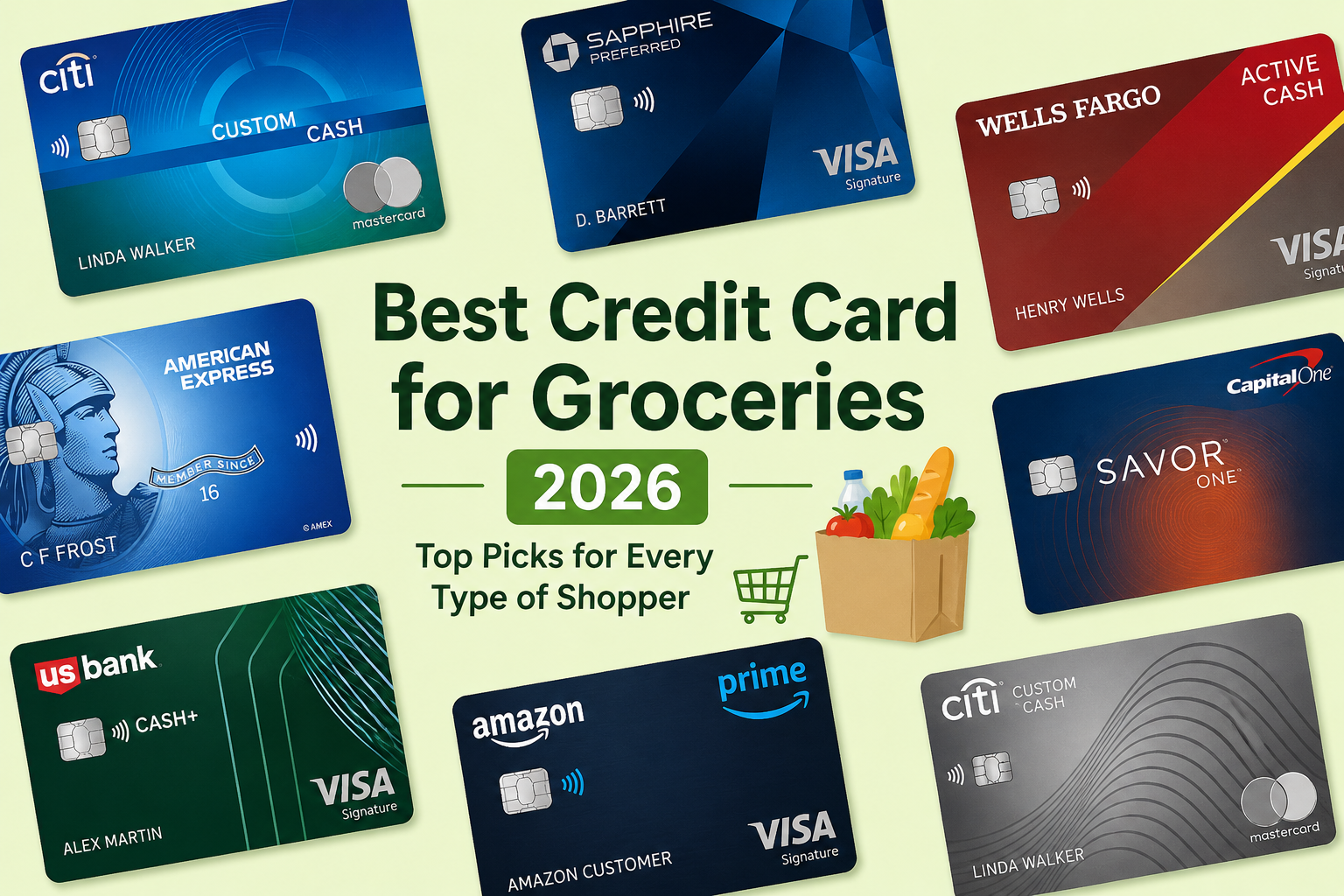
Groceries are one of the biggest recurring expenses in most household budgets, typically ranking right behind housing and transportation. A typical family can easily spend several hundred to well over a thousand dollars a month at the supermarket. That makes grocery spending one of the single most valuable categories to optimize with the right credit card — because unlike a vacation or a big one-time purchase, grocery shopping happens every single week, all year long.
Choosing the right grocery credit card can put anywhere from a couple hundred to over a thousand dollars back in your pocket each year, simply from spending you were already going to do. But not all “grocery rewards” cards are created equal. Some offer eye-catching cash back percentages that are capped at a low annual spending limit. Others technically reward “groceries” but exclude the specific stores where you actually shop, such as Walmart, Target, or Costco. Picking the wrong card means leaving real money on the table — or worse, earning a rate that sounds great on paper but rarely applies to your actual shopping habits.
This guide walks through the best credit cards for groceries in 2026, broken down by shopper type, so you can match the right card to how — and where — you actually buy your food.
How Grocery Rewards Categories Actually Work
Before comparing cards, it’s important to understand how issuers define “groceries,” because this single detail determines whether a card’s advertised rewards rate will actually apply to your shopping.
Most card issuers use merchant category codes (MCCs) assigned by payment networks to determine what counts as a “supermarket” or “grocery store” purchase. This distinction matters enormously:
Traditional supermarkets — regional and national grocery chains — almost always qualify for bonus grocery rewards.
Superstores and big-box retailers like Walmart and Target are frequently excluded from “supermarket” bonus categories, even though many people do the bulk of their grocery shopping there. Card issuers typically code these merchants differently because they sell far more than just food.
Warehouse clubs such as Costco and Sam’s Club are also commonly excluded from standard grocery bonus categories, and often require a specific co-branded card (like the Costco Anywhere Visa) to earn elevated rewards there at all.
Online grocery delivery and pickup services — Instacart, Amazon Fresh, Whole Foods online orders — are sometimes included under grocery categories and sometimes treated separately, depending on the card and how the transaction is coded.
Before choosing a card based on its advertised grocery rewards rate, it’s worth checking exactly which categories and merchants qualify, since a shopper who does most of their food shopping at Costco or Walmart may earn little to nothing extra with a card marketed heavily around “supermarket” rewards.
Best Overall: American Express Blue Cash Preferred® Card
The Blue Cash Preferred Card from American Express is widely regarded as the top overall choice for grocery spending in 2026, and for good reason: it offers 6% cash back at U.S. supermarkets on up to $6,000 in purchases per year (dropping to 1% after that cap), which works out to as much as $360 annually at the elevated rate. It also offers 6% cash back on select U.S. streaming subscriptions and 3% cash back at U.S. gas stations and on transit.
The trade-off: This card carries a $95 annual fee (often waived for the first year through a promotional offer), and the 6% category applies specifically to supermarkets — not superstores or warehouse clubs. For most households that do the bulk of their shopping at a traditional grocery store, though, the math works heavily in this card’s favor, especially when paired with a strong welcome bonus offer for new cardholders who meet an initial spending requirement within the first several months.
Best for: Households that spend heavily at traditional supermarkets and want the single highest ongoing grocery cash-back rate available on an uncapped-enough (relative to typical spending) basis.
Best No-Annual-Fee Option: Capital One Savor Cash Rewards Credit Card
For shoppers who don’t want to deal with an annual fee, the Capital One Savor Cash Rewards Credit Card stands out by offering 3% cash back on groceries with no cap on how much you can earn — a meaningful advantage over capped competitors for high-volume grocery shoppers. It also earns 3% on dining, entertainment, and popular streaming services, and comes with no annual fee.
The trade-off: The Savor typically excludes superstores like Walmart and Target from its grocery bonus category, and its 3% rate, while uncapped, is lower than the Blue Cash Preferred’s 6% rate on supermarket spending.
Best for: Shoppers who want a permanently free card with strong, uncapped rewards across groceries, dining, and entertainment — a great everyday card for people who eat out as much as they cook at home.
Best for Amazon, Whole Foods, and Amazon Fresh Shoppers: Prime Visa
If your grocery routine revolves around Whole Foods or Amazon Fresh, the Prime Visa (available to Amazon Prime members) is a standout, uncapped option. It offers 5% back at Whole Foods Market and Amazon Fresh, matching its top rate on Amazon.com purchases, along with 2% back at gas stations, restaurants, and on local transit and rideshares, plus 1% on everything else. There’s no annual fee beyond an active Amazon Prime membership.
The trade-off: You need an active Amazon Prime subscription to hold this card, and the elevated grocery rate is limited specifically to Whole Foods and Amazon Fresh rather than all supermarkets.
Best for: Amazon Prime members who do some or all of their grocery shopping through Whole Foods or Amazon Fresh, rather than a traditional local supermarket chain.
Best for Costco Shoppers: Costco Anywhere Visa® Card by Citi
Because Costco doesn’t accept most standard grocery bonus categories from other cards, shoppers who do a lot of their food buying at Costco need a card built specifically around it. The Costco Anywhere Visa Card by Citi is the primary option here, offering 2% cash back inside Costco warehouses and on Costco.com, and a notably higher 5% back on gas purchased at Costco (and eligible gas stations elsewhere, up to a spending cap).
The trade-off: You need an active Costco membership to use this card, and its in-warehouse rewards rate is more modest than the top supermarket-focused cards.
Best for: Costco members who do a substantial share of their household shopping — including bulk groceries — at Costco warehouses.
Best for Choosing Your Own Bonus Category: Bank of America® Customized Cash Rewards Credit Card
For shoppers who want flexibility rather than being locked into a single predetermined grocery rate, the Bank of America Customized Cash Rewards Credit Card lets you choose your own 3% bonus category each month from a list that includes groceries, along with 2% back at wholesale clubs and gas stations, and no annual fee.
The trade-off: The 3% and 2% combined categories are subject to a combined quarterly spending cap, after which the rate drops, and Bank of America customers who also hold a Bank of America banking relationship can unlock a meaningful rewards boost through the bank’s preferred rewards program — a perk that non-customers won’t have access to.
Best for: Shoppers who want the flexibility to prioritize groceries as their bonus category, potentially alongside other spending patterns from month to month, especially existing Bank of America banking customers.
Best for Everyday, Multi-Category Spending: Blue Cash Everyday® Card from American Express
If you want strong grocery rewards without the annual fee attached to its Preferred sibling, the Blue Cash Everyday Card from American Express offers 3% cash back at U.S. supermarkets (up to an annual spending cap, then 1%), along with 3% back on U.S. online retail purchases and U.S. gas stations, and no annual fee.
The trade-off: The grocery rate is half of what the Blue Cash Preferred offers, but you avoid the annual fee entirely, which makes it a strong choice for moderate grocery spenders who don’t want to do the math on whether a fee-based card pays for itself.
Best for: Everyday households that want solid, well-rounded rewards across groceries, online shopping, and gas — all with no annual fee.
Best for Dining and Grocery Combined: Regions Prestige Visa® Signature Credit Card
Some shoppers spend nearly as much on dining out as they do on groceries. For that lifestyle, the Regions Prestige Visa Signature Credit Card offers a combined structure of 3 points per dollar on dining and entertainment, and 2 points per dollar on gas and grocery store purchases, with 1 point per dollar on everything else, and no annual fee. New cardholders can also typically earn a solid points bonus after meeting an initial spending threshold.
Best for: Households whose spending is fairly evenly split between eating out and cooking at home, and who want one well-rounded card to cover both.
Best Premium Card for Groceries and Beyond: American Express® Gold Card
For shoppers willing to pay a higher annual fee in exchange for premium rewards and benefits, the American Express Gold Card remains one of the top choices, earning elevated rewards at U.S. supermarkets (up to an annual spending cap) alongside strong rewards at restaurants worldwide, plus valuable statement credits toward dining and other lifestyle categories that can help offset its annual fee.
The trade-off: The annual fee is significantly higher than the no-fee and mid-tier cards on this list, so this card only makes sense for shoppers who will actually use its dining credits and other built-in perks, not just its grocery rewards.
Best for: High spenders who eat out frequently in addition to grocery shopping, and who will make consistent use of the card’s statement credits and travel-adjacent perks.
Best for Rotating Categories: Discover it® Cash Back
The Discover it Cash Back card takes a different approach, offering 5% cash back in categories that rotate each quarter — which frequently include grocery stores for at least part of the year — up to a quarterly spending cap, with 1% back on everything else. New cardholders also benefit from Discover matching all cash back earned in the first year, effectively doubling first-year rewards.
The trade-off: Because the 5% grocery category is only active during specific quarters (and requires activation each time), this card works best as a secondary card used strategically during its grocery bonus quarters, rather than a year-round primary grocery card.
Best for: Reward optimizers willing to track and activate quarterly categories, who want to stack an elevated grocery rate on top of a first-year cash back match.
Choosing the Right Grocery Card for Your Shopping Habits
With so many strong options on the market, the right choice comes down to a few honest questions about your actual shopping habits:
Where do you actually shop? If you’re loyal to a traditional supermarket chain, cards like the Blue Cash Preferred or Blue Cash Everyday will maximize your rewards. If Costco or Walmart is your primary grocery destination, you’ll need a card built around that specific retailer, since most “supermarket” bonus categories exclude both.
How much do you spend on groceries each month? High-volume grocery shoppers should pay close attention to annual spending caps. A card offering 6% back sounds incredible until you realize the bonus rate stops after the first $6,000 spent in a year — a threshold moderate spenders may never hit, but that heavy grocery shoppers could reach well before year’s end. For very high spenders, an uncapped 3% card (like the Capital One Savor) can sometimes out-earn a capped 6% card once you calculate your actual annual grocery spend.
Are you willing to pay an annual fee? Cards with annual fees generally offer meaningfully higher rewards rates, but they only make financial sense if your grocery (and other bonus category) spending is high enough to outearn the fee. Run the math on your own typical monthly grocery bill before committing to a fee-based card.
Do you want a single card or a rewards strategy across multiple cards? Some shoppers prefer simplicity: one card, one grocery rate, used everywhere. Others prefer to combine cards — for example, using a supermarket-focused card at the regular grocery store, a Costco-branded card at the warehouse club, and a flexible cash-back card for everything else — to maximize rewards across every type of purchase.
A Note on Card Availability and Changes
The credit card rewards landscape shifts frequently, with issuers regularly adjusting rewards categories, discontinuing older products to new applicants, or launching updated versions of existing cards. For example, some previously popular grocery-rewards cards have been closed to new applicants in 2026, with issuers steering new customers toward similar, updated alternatives. Because of this, it’s worth double-checking a card’s current terms, rewards categories, and application availability directly on the issuer’s website before applying, since a card’s rewards structure — or its very existence as an open product — can change from what was true even a few months earlier.
Grocery Rewards and Inflation: Why the Category Matters More Than Ever
Grocery prices have climbed steadily in recent years, which means the dollar value of a strong grocery rewards card has grown right along with your weekly bill. A rewards rate that once translated into a modest annual bonus can now represent a meaningfully larger sum simply because the underlying spending base — the actual cost of feeding a household — has increased. This is part of why card issuers have leaned so heavily into grocery-focused rewards in recent years: it’s a category that touches nearly every cardholder, every single week, regardless of income level or lifestyle.
This also means it’s worth periodically recalculating whether your current card is still the right fit. A card that comfortably covered your grocery spending at a 6% capped rate a couple of years ago might now push you past that cap several months earlier in the year than it used to, simply because the same basket of groceries costs more today. Reassessing your grocery card choice isn’t a one-time decision — it’s worth revisiting as both your spending habits and the cost of everyday goods continue to shift.
How to Maximize Your Grocery Card Rewards
Once you’ve chosen a card, a few habits can help you get the most value out of it:
Track your spending against annual or quarterly caps. If your card’s bonus grocery rate resets annually or quarterly, keep a rough mental note of where you stand so you’re not caught off guard when the rate drops back down to the base rate partway through the year.
Pair a grocery card with a warehouse club card if needed. If you split your shopping between a traditional supermarket and a club store like Costco or Sam’s Club, consider carrying two cards — one optimized for each — rather than expecting a single card to cover both well.
Watch for sign-up bonuses. Many of the top grocery cards offer a welcome bonus for new cardholders who meet an initial spending requirement within the first few months. Timing a card application around a period when you know you’ll naturally hit that threshold — without artificially overspending — can add significant extra value in your first year.
Redeem rewards strategically. Cash back is straightforward, but some cards offer bonus redemption value when points or cash back are applied toward specific purchases (such as Amazon.com checkout) or transferred to airline and hotel partners. Check your card’s redemption options to make sure you’re getting full value, not just the minimum statement credit rate.
Review your card annually. Grocery spending habits change, and so do card rewards structures. It’s worth revisiting your grocery credit card choice once a year to confirm it’s still the best fit for where and how you’re actually shopping.
Real-World Savings Example: Comparing Two Grocery Cards Over a Year
Numbers make the difference between grocery credit cards much clearer than percentages alone. Consider a household that spends $700 a month on groceries at a traditional supermarket — that’s $8,400 a year.
With a flat 1% cash back card (the kind of default rewards rate found on many basic no-category cards), that household would earn just $84 a year from grocery spending — barely enough to notice.
With the Blue Cash Preferred Card’s 6% rate, the same household would earn 6% on the first $6,000 of that spending ($360) and 1% on the remaining $2,400 ($24), for a total of $384 in grocery cash back alone — even after accounting for the annual fee, this remains a significant net gain for a household spending at this level, before factoring in the card’s additional rewards on streaming and gas.
With the Capital One Savor’s uncapped 3% rate, that same $8,400 in grocery spending would earn a flat $252 for the year — less than the Blue Cash Preferred in this scenario, but with no annual fee to subtract, and no cap to worry about if grocery spending increases in future years.
This kind of side-by-side math — applied to your own actual monthly grocery spend — is the single most reliable way to determine which card structure truly serves you best, rather than relying on the headline percentage alone.
Grocery Cards vs. General Cash Back Cards: Which Approach Is Better?
Some shoppers wonder whether it’s even worth bothering with a dedicated grocery-focused card, versus simply using a flat-rate cash back card (commonly offering around 2% on everything) for all purchases, groceries included.
The answer depends heavily on how concentrated your spending is. If groceries make up a large share of your monthly budget, a dedicated grocery card with a rate of 3% to 6% will almost always outperform a generic 2% flat-rate card on that portion of your spending. However, if your spending is spread fairly evenly across many categories — travel, dining, utilities, subscriptions, groceries — a single flat-rate card can be simpler to manage and may come surprisingly close in total annual rewards, without requiring you to think about category caps, exclusions, or rotating bonus periods.
Many reward-optimizing households land on a middle path: one dedicated grocery (and/or dining) card for their highest-spending categories, paired with a simple flat-rate card for everything that doesn’t fit neatly into a bonus category. This approach captures the best of both worlds without becoming an overly complex, multi-card juggling act.
Building a Grocery Card Strategy Around Household Size
Grocery card value scales directly with household size and spending, so the “best” card can look different for a single shopper than for a family of five.
Individuals and couples with more modest grocery budgets (under roughly $400–$500 a month) often benefit most from no-annual-fee cards, since they’re less likely to spend enough to justify an annual fee through elevated rewards alone. The Capital One Savor or Blue Cash Everyday tend to be strong fits here.
Larger families with higher monthly grocery bills — particularly those regularly spending $600 or more a month — are far more likely to benefit from a card like the Blue Cash Preferred, where the higher rewards rate on a larger spending base can comfortably outweigh the annual fee, sometimes several times over.
Households that shop primarily at warehouse clubs to feed larger families should prioritize a club-specific card like the Costco Anywhere Visa, since standard supermarket bonus categories won’t apply to warehouse purchases at all, regardless of how generous the headline rate looks.
Common Mistakes Shoppers Make When Choosing a Grocery Card
Assuming “grocery rewards” apply everywhere you buy food. As covered above, superstores and warehouse clubs are very often excluded from standard grocery bonus categories. Confirm the specific merchant list or MCC eligibility before assuming your regular store qualifies.
Ignoring the spending cap until it’s too late. Many shoppers don’t realize their elevated rewards rate has dropped to the base rate partway through the year because they weren’t tracking their cumulative spending against the card’s cap.
Choosing a fee-based card without doing the math. An annual fee can absolutely be worth it — but only if your spending in the bonus categories is high enough to outearn it. Blindly choosing the card with the flashiest percentage, without checking whether your actual spending clears the break-even point, is one of the most common (and costly) mistakes.
Overlooking sign-up bonus timing. Missing the window to meet a welcome bonus’s spending requirement means leaving free money on the table. Plan any major purchases you were already going to make around your new card’s bonus period, rather than adding unnecessary spending.
Forgetting to update card choices as habits change. A card that was ideal a few years ago may no longer be the best fit if you’ve moved, changed where you shop, or your household size and grocery budget have shifted.
Do grocery credit card rewards apply to Walmart and Target? Usually not. Most cards that advertise bonus rewards at “supermarkets” or “grocery stores” specifically exclude superstores like Walmart and Target, since these retailers are categorized differently by payment networks. If Walmart or Target is where you do most of your grocery shopping, look for a card offering strong uncapped rewards on general purchases instead, or check whether the issuer has since expanded its category definitions.
Does Costco accept credit cards other than Visa? In the United States, Costco warehouses generally accept only Visa credit cards at checkout (alongside cash, debit, and Costco Cash Cards), which is part of why the Costco Anywhere Visa Card by Citi is such a popular choice for members who want to earn rewards while shopping in-store.
Is it better to get a card with a high capped rate or a lower uncapped rate? It depends on your annual grocery spend. Calculate your typical yearly grocery budget and compare it against the cap. If you regularly spend beyond a card’s bonus category cap, an uncapped card with a slightly lower percentage may earn you more over the full year.
Can I use my grocery rewards card for online grocery delivery too? It depends on the card and how the delivery service codes its transactions. Some issuers include services like Instacart or Amazon Fresh under their grocery bonus category, while others treat them separately. Check your card’s specific terms, or the issuer’s list of qualifying merchants, to confirm.
Should I get a store-branded grocery credit card instead? Store-branded cards, offered directly by some grocery chains, can offer strong discounts or rewards specifically at that one retailer, but they typically lack the flexibility and broader earning potential of a general-purpose cash back or rewards card. For most shoppers, a general-purpose card usable everywhere tends to provide more overall value unless you are extremely loyal to a single grocery chain.
Will applying for a new grocery card hurt my credit score? Applying for any new credit card typically triggers a small, temporary dip in your credit score due to the hard inquiry involved. Responsible use afterward — on-time payments and manageable utilization — generally outweighs this initial, minor impact over time.
Comparing the Top Picks at a Glance
To recap the standout options covered in this guide, organized by the shopper type each one serves best:
- Highest capped grocery rate: American Express Blue Cash Preferred (6% at U.S. supermarkets, up to the annual cap)
- Best uncapped, no-fee option: Capital One Savor Cash Rewards (3% on groceries, no cap, no annual fee)
- Best for Amazon-affiliated grocery shopping: Prime Visa (5% at Whole Foods and Amazon Fresh for Prime members)
- Best for warehouse club shoppers: Costco Anywhere Visa by Citi (2% in-warehouse, 5% on Costco gas)
- Best flexible bonus category: Bank of America Customized Cash Rewards (choose groceries as your 3% category)
- Best no-fee, well-rounded option: Blue Cash Everyday (3% at supermarkets, plus online retail and gas)
- Best for dining-and-groceries combined: Regions Prestige Visa Signature (points on both categories)
- Best premium option: American Express Gold Card (elevated grocery rewards plus dining credits)
- Best for rotating bonus chasers: Discover it Cash Back (5% during active grocery quarters, plus first-year match)
There is no single “best” grocery card for every shopper — the right pick depends entirely on where you shop, how much you spend, and whether you’re willing to pay an annual fee in exchange for a higher rewards ceiling.
Final Thoughts
Because groceries are one of the few spending categories that virtually every household shares, choosing the right grocery credit card is one of the highest-leverage financial decisions you can make with relatively little effort. The best choice isn’t necessarily the card with the flashiest advertised percentage — it’s the one whose bonus categories, spending caps, and included merchants actually line up with where and how you shop.
Take a few minutes to review your last several months of grocery spending: where you shopped, how much you spent, and whether you also spend heavily in adjacent categories like dining, gas, or streaming. Matching that real spending pattern to the right card, rather than chasing the single highest headline percentage, is what actually turns your weekly grocery run into a meaningful, ongoing source of rewards.
This article is for informational purposes only and does not constitute financial advice. Credit card rewards rates, categories, fees, and terms change frequently and vary by issuer and individual creditworthiness. Always review the most current terms and conditions directly with the card issuer before applying.