Introduction
Decentralized exchanges (DEXs) have fundamentally changed how people trade cryptocurrency. Instead of relying on a centralized order book managed by a single company, DEXs use liquidity pools and smart contracts to let anyone trade tokens directly from their own wallet. This shift has unlocked enormous innovation, but it has also created a serious challenge: data fragmentation. With thousands of tokens launching across dozens of blockchains every single day, and liquidity spread across countless different pools, it becomes extremely difficult for traders to keep track of what is actually happening in the market.
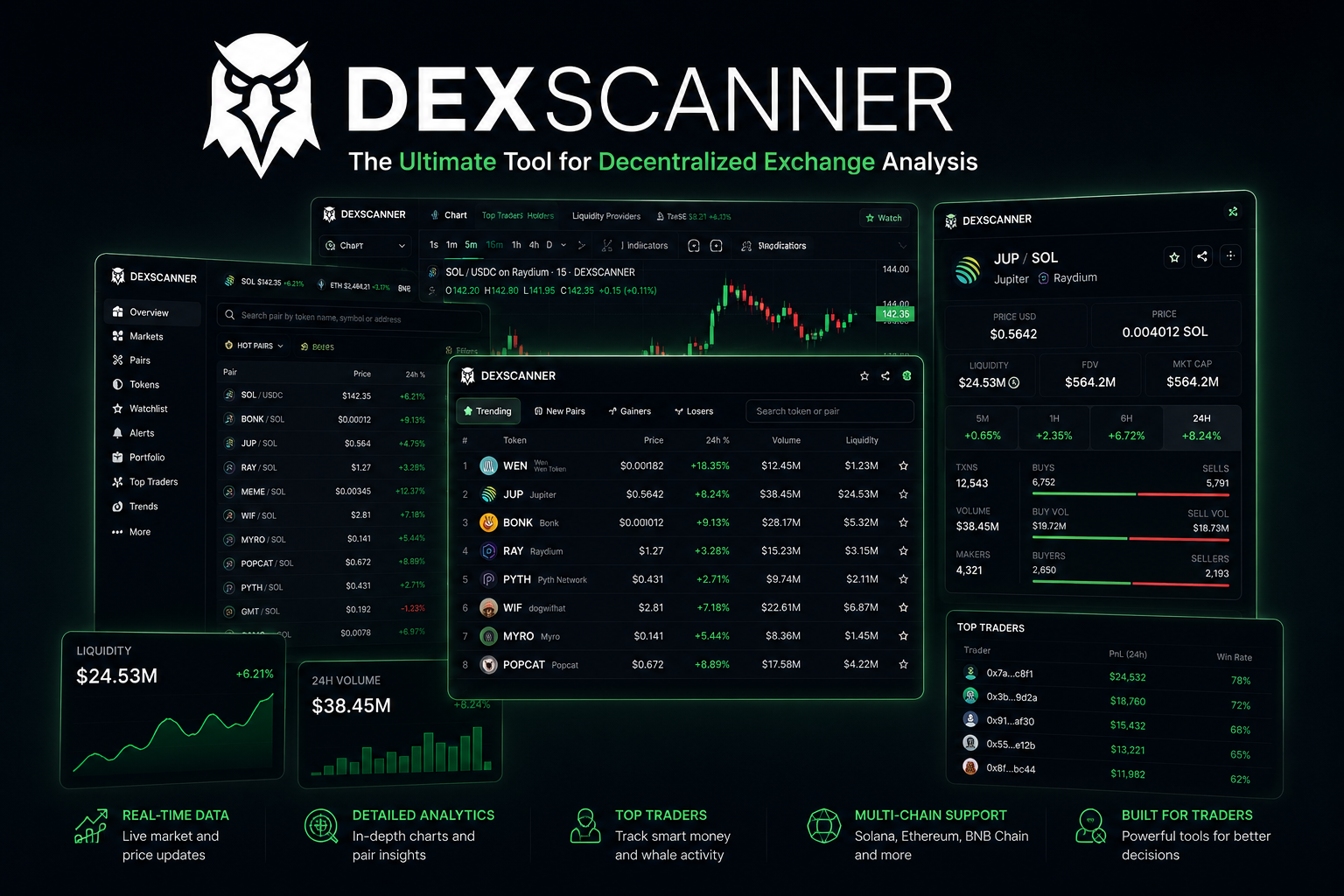
This is the exact problem that DexScreener was built to solve. Often referred to informally as a “DEX scanner” because of how it lets users scan and filter through enormous volumes of on-chain trading data, DexScreener has become one of the most widely used analytics platforms in the decentralized finance (DeFi) space. It aggregates real-time data from decentralized exchanges across more than a hundred blockchain networks, giving traders, investors, and researchers a single, unified window into token prices, liquidity, trading volume, and overall market activity.
This article explores what DexScreener is, how it works, its most important features, and why it has become an essential tool for anyone serious about navigating the decentralized exchange landscape in 2026.
What Is DexScreener?
DexScreener is a real-time on-chain analytics and charting platform that aggregates trading data from decentralized exchanges across a wide range of blockchain networks. Rather than requiring users to visit dozens of separate DEX websites to check prices and liquidity, DexScreener consolidates all of that information into a single, searchable interface.
Unlike traditional market data providers that track centralized exchanges, DexScreener is built specifically for the decentralized world. It connects directly to on-chain smart contracts, extracting information such as trade history, liquidity pool changes, and transaction counts as they happen. This direct connection to blockchain data, rather than reliance on third-party APIs, allows DexScreener to deliver near-instantaneous updates on critical metrics like token price, liquidity depth, and trading volume.
The platform covers a broad set of networks, including Ethereum, BNB Chain, Solana, Polygon, Avalanche, Arbitrum, Optimism, and many others, giving it one of the widest coverage footprints of any DEX analytics tool currently available. Because of this breadth, DexScreener has become a common starting point for traders researching new tokens, regardless of which blockchain those tokens are launched on.
How DexScreener Works
At a technical level, DexScreener operates using a custom-built indexing system that reads data directly from blockchain networks rather than depending on centralized data aggregators. This indexer continuously scans supported blockchains for new liquidity pools, trading pairs, and transactions, then processes that raw on-chain information into a format that is easy for traders to interpret.
Because the platform pulls data directly from DEX smart contracts, the information displayed on DexScreener reflects actual executed trades and pool states, rather than data that has been filtered or delayed through third-party sources. This design gives it a reputation for accuracy that closely mirrors the state of the blockchain itself, which is particularly important in fast-moving markets where price and liquidity can shift dramatically within seconds.
Key Features of DexScreener
1. Real-Time Price Charts
At the core of DexScreener’s functionality is its live charting system. Users can view real-time price charts for virtually any token traded on a supported decentralized exchange, with data updating continuously as new trades occur. These charts typically include standard technical analysis tools, allowing traders to study price action using familiar candlestick formats and time frames.
2. Multi-Chain Coverage
DexScreener’s defining strength is the sheer breadth of its blockchain coverage. The platform tracks trading pairs across dozens of networks, from major ecosystems like Ethereum and Solana to a long list of smaller and emerging chains. This makes it possible for a trader to research a token on a relatively obscure blockchain using the same interface they would use to check a well-established token on Ethereum, without needing to learn a new tool for every network.
3. Liquidity and Volume Metrics
Liquidity is one of the most important factors in decentralized trading, since low-liquidity tokens are far easier to manipulate and far riskier to trade. DexScreener displays detailed liquidity data for each trading pair, along with trading volume over various time frames. By comparing liquidity and volume side by side, traders can quickly identify whether a token has enough depth to support meaningful trading activity or whether it carries a higher risk of slippage and price manipulation.
4. New Pair Alerts and Token Discovery
One of the most popular use cases for DexScreener is discovering newly launched tokens. As soon as a new trading pair is created on a supported decentralized exchange, DexScreener typically detects it and adds it to its listings, often within moments. This has made the platform particularly popular among traders looking to identify new opportunities early, especially within fast-moving sectors like memecoins and newly launched Solana tokens.
5. Custom Screener and Filters
DexScreener includes a powerful filtering system that allows users to search across its entire dataset using specific criteria, such as minimum liquidity, trading volume, token age, or price change over a given period. This screener functionality is what gives the platform its “scanner” reputation, since it allows traders to scan through thousands of tokens at once and narrow the list down to those that meet a specific set of conditions.
6. Watchlists and Alerts
For users who create a free account, DexScreener offers the ability to build personalized watchlists of tokens they want to track over time. Combined with custom alerts based on price, volume, or liquidity thresholds, this allows traders to monitor a curated list of assets without needing to constantly refresh the page or manually check each token.
7. Wallet and Transaction Tracking
Beyond simple price charts, DexScreener also provides visibility into individual transactions and, in some cases, wallet-level activity associated with a given trading pair. This allows users to see the flow of buy and sell orders in real time, offering insight into whether a token is experiencing accumulation, distribution, or unusually concentrated trading activity from a small number of wallets.
8. Integration With Token Launch Platforms
DexScreener has expanded beyond pure analytics by integrating with token launch platforms, most notably its own associated launch tool. This allows certain newly created tokens to be purchased directly through the DexScreener ecosystem, blurring the line between a pure analytics tool and a more complete trading gateway. For most other tokens, however, DexScreener remains primarily a research and analytics tool, with actual trade execution taking place on a separate decentralized exchange such as Uniswap, Raydium, or PancakeSwap.
Why Traders Rely on DexScreener
A Single Source of Truth Across Fragmented Markets
Because decentralized exchanges are spread across so many different blockchains, traders previously had no easy way to compare token performance across networks. DexScreener solves this by consolidating fragmented on-chain data into one consistent interface, dramatically reducing the time and effort required to research a token, regardless of which blockchain it lives on.
Free and Accessible to Everyone
One of the most significant reasons for DexScreener’s popularity is that its core functionality is completely free to use. Users do not need to create an account to search for tokens, view charts, or check liquidity and volume data. Optional account creation is only required to unlock personalized features like watchlists and alerts, which lowers the barrier to entry considerably compared to many paid analytics platforms.
Speed and Accuracy
Because DexScreener indexes blockchain data directly rather than depending on slower third-party sources, it is able to reflect new pairs, trades, and liquidity changes with very little delay. In markets where prices can move significantly within seconds, this speed advantage is a critical factor in the platform’s popularity among active traders.
A Starting Point for Both Beginners and Professionals
DexScreener’s interface is designed to be approachable for newcomers, while still offering enough depth and filtering power to satisfy experienced traders. A beginner can use the platform to simply check a token’s price and liquidity before deciding whether to trade it, while a professional trader can use its advanced screener filters to systematically scan the market for tokens matching a specific strategy.
How to Use DexScreener: A Step-by-Step Overview
- Search for a Token or Pair. Enter a token name, symbol, or contract address into the search bar to pull up its associated trading pairs across supported exchanges.
- Review the Chart. Examine the live price chart, including recent price action, volume, and available time frame options.
- Check Liquidity and Volume. Look at the liquidity pool size and recent trading volume to assess how easily the token can be traded without significant price impact.
- Use the Screener for Discovery. If you are looking for new opportunities rather than researching a specific token, use the screener tool to filter the entire market by criteria such as liquidity, volume, or token age.
- Set Up a Watchlist. Create a free account to save tokens of interest to a personalized watchlist for easier tracking over time.
- Configure Alerts. Set custom alerts based on price movement, volume spikes, or liquidity changes so you can be notified of significant developments without needing to monitor the platform constantly.
- Execute Trades Elsewhere. Once you have identified a token you want to trade, use the token’s contract address to execute the actual trade on a decentralized exchange that supports that specific blockchain, unless the token is available through DexScreener’s own launch platform.
Important Safety Considerations When Using DexScreener
While DexScreener is a powerful research tool, it is important to remember that it is fundamentally an analytics platform, not a guarantee of a token’s legitimacy or safety. Because DEXs allow anyone to launch a token instantly, the space is unfortunately home to a large number of low-quality or outright fraudulent projects. A few important practices can help reduce risk when using DexScreener for research:
- Set a minimum liquidity threshold. Tokens with very low liquidity, often cited as a common rule of thumb around ten thousand dollars or less, are significantly easier to manipulate through large buy or sell orders.
- Treat rising volume as a stronger signal than volume alone. A token with a large but static volume figure is less informative than one showing a clear upward trend in trading activity over time.
- Remember that DexScreener is a research tool, not an exchange. For most tokens, actual trade execution happens on the underlying decentralized exchange, not on DexScreener itself, so always verify you are interacting with the correct, official trading platform when it comes time to execute a trade.
- Be cautious of imitation websites. Because DexScreener is such a popular and trusted brand, scammers frequently create lookalike websites or browser extensions designed to trick users into connecting their wallets or approving malicious transactions. Always verify you are using the platform’s official website and never connect a wallet to a site you are not fully confident is legitimate.
- Cross-reference data when making major decisions. While DexScreener’s direct on-chain indexing is generally considered accurate, using it alongside other analytics tools or blockchain explorers can help confirm important details before committing significant funds to a trade.
Common Use Cases for DexScreener
Researching a Specific Token Before Trading
Perhaps the most common way traders use DexScreener is as a first stop before buying any token. By pulling up a token’s contract address, a trader can instantly see its current price, how that price has moved over recent hours or days, how much liquidity backs the trading pair, and how much volume the token has seen. This gives a trader a quick sense of whether a token is actively traded and reasonably liquid, or whether it is thinly traded and potentially risky.
Hunting for New Token Launches
Because DexScreener detects new trading pairs almost as soon as they are created on-chain, it has become a favorite tool for traders who specifically look for newly launched tokens. This is particularly common in fast-moving categories such as memecoins, where early entry can make a significant difference in potential returns, but where the risk of encountering a poorly designed or fraudulent project is also considerably higher.
Comparing Liquidity Across Multiple Chains
Because a single token or project may sometimes have pools on more than one blockchain, or because a trader may be comparing similar projects across different ecosystems, DexScreener’s multi-chain coverage makes it easy to place these comparisons side by side. This is useful not only for individual traders but also for researchers and analysts studying broader trends across the decentralized exchange landscape.
Monitoring an Existing Portfolio
Traders who already hold a range of tokens across different blockchains can use DexScreener’s watchlist feature to keep an eye on their entire portfolio from a single dashboard, rather than needing to check multiple blockchain explorers or exchange interfaces separately. Combined with custom alerts, this allows for a more passive monitoring approach, where the trader is only prompted to take action when a meaningful price, volume, or liquidity event occurs.
Studying Broader Market Trends
Beyond individual token research, some users rely on DexScreener to observe broader trends across the decentralized exchange landscape, such as which sectors or blockchain ecosystems are currently seeing the most new pair creation, or where trading volume is concentrating at a given moment. This bird’s-eye view can be useful for identifying emerging narratives before they become widely recognized.
Getting the Most Out of the Screener Tool
The screener feature is one of DexScreener’s most powerful capabilities, but it is also one of the most underused by casual visitors who only ever search for individual tokens. Learning to use it effectively can significantly improve the quality of a trader’s research process.
Start with liquidity and volume filters. Setting a reasonable minimum liquidity threshold immediately removes a large number of low-quality or high-risk tokens from consideration, allowing a trader to focus on pairs that have enough depth to support meaningful trading.
Layer in token age. Depending on strategy, a trader might specifically want to filter for very recently created pairs when hunting for new opportunities, or conversely filter for more established tokens with a longer trading history when looking for more stable, lower-risk assets.
Sort by relative price change. Rather than simply looking at raw price movement, comparing percentage change over a specific time frame, such as the last hour or the last day, can help identify tokens that are experiencing unusually strong momentum relative to the broader market.
Combine chain and category filters. Because DexScreener covers so many different blockchains, narrowing a search to a specific chain, or a specific category of token, can make the screener results far more manageable and relevant to a trader’s particular area of interest.
Save recurring searches. For traders who repeatedly look for the same type of opportunity, saving a specific filter combination as part of a personalized watchlist or recurring search can save significant time compared to manually reconfiguring filters every session.
DexScreener vs. Other DEX Analytics Tools
DexScreener vs. Dedicated Charting Platforms
Some specialized analytics platforms focus heavily on advanced, customizable charting and technical analysis, offering a large library of configurable indicators and dashboard components for professional traders. DexScreener, by comparison, prioritizes breadth of coverage and speed of discovery across a very large number of chains and tokens, making it especially strong for quickly scanning the market rather than performing deep, highly customized technical analysis on a single asset.
DexScreener vs. Centralized Market Data Aggregators
Traditional market data aggregators built primarily for centralized exchanges are not designed to handle the unique structure of decentralized trading, where price discovery happens through liquidity pools rather than order books. DexScreener’s architecture, built specifically around DEX smart contracts, gives it a structural advantage when it comes to tracking decentralized markets, including the ability to detect brand-new trading pairs the moment they are created on-chain.
DexScreener vs. Wallet-Focused Trackers
Some tools focus primarily on tracking the activity of specific wallets, often described as “smart money” trackers, to follow the buying and selling patterns of particularly successful or influential traders. While DexScreener does provide some visibility into transaction-level activity, its primary focus remains on token-level analytics rather than wallet-level behavior, making it a strong complement to, rather than a replacement for, dedicated wallet tracking tools.
The Role of DexScreener in the Broader DeFi Ecosystem
As decentralized finance continues to grow, the sheer number of tokens, liquidity pools, and blockchain networks in existence makes it practically impossible for any trader to manually track the market without the help of aggregation tools. DexScreener has positioned itself as one of the primary lenses through which every day traders, researchers, and even developers view the decentralized trading landscape.
Its role extends beyond simple price tracking. By making on-chain data transparent and easily searchable, DexScreener helps improve overall market efficiency, giving more participants access to the same high-quality information that was once available only to those with the technical skill to query blockchain data directly. This democratization of access has, in turn, contributed to increased trading activity and liquidity across the decentralized exchanges it tracks, since traders are more confident participating in markets they can properly research and understand.
Quick Comparison: DexScreener at a Glance
| Category | Details |
|---|---|
| Platform type | Decentralized exchange analytics and charting tool |
| Cost | Free core features; optional free account for watchlists and alerts |
| Chain coverage | 80+ blockchain networks, including Ethereum, Solana, BNB Chain, Polygon, Avalanche, Arbitrum, and Optimism |
| Data source | Direct on-chain indexing of DEX smart contracts |
| Core features | Real-time charts, liquidity and volume metrics, new pair detection, custom screener, watchlists, alerts |
| Trade execution | Primarily research-only; trades executed on the underlying DEX, with some tokens tradable via an associated launch platform |
| Best suited for | Token research, new pair discovery, cross-chain market monitoring |
| Not designed for | Deep fundamental analysis, wallet-level portfolio management, or verifying token legitimacy on its own |
Pros and Cons of DexScreener
Pros:
- Free to use, with no account required for core functionality
- Extremely broad multi-chain coverage
- Near-instant detection of new trading pairs
- Direct on-chain data sourcing for high accuracy
- Powerful screener for filtering thousands of tokens at once
- Watchlists and custom alerts for ongoing monitoring
- Approachable interface for beginners, with enough depth for advanced users
Cons:
- Does not verify the legitimacy or safety of any individual token
- Primarily a research tool rather than a full trading platform for most assets
- The sheer volume of low-quality tokens on decentralized exchanges means extra due diligence is still required
- Popularity has made it a frequent target for imitation websites and phishing attempts
The Growing Importance of DEX Analytics Tools
The broader category of DEX screeners and scanners, of which DexScreener is the most prominent example, has grown alongside the decentralized finance industry itself. In the early days of DeFi, checking a token’s price or liquidity often meant manually querying a blockchain explorer or relying on scattered community reports. As the number of active DEXs, blockchains, and tokens exploded, this manual approach quickly became impractical, creating strong demand for tools capable of aggregating and simplifying this data at scale.
This demand has led to steady innovation across the category, with modern DEX analytics platforms increasingly offering features that go beyond simple price tracking. Wallet analytics, integrated trading, customizable dashboards, and mobile-first designs have all become more common as the space matures. DexScreener’s continued expansion, including its move into token launch functionality, reflects this broader industry trend of analytics platforms evolving into more complete on-chain trading hubs over time.
For traders, this evolution is generally a positive development. Access to better, faster, and more comprehensive market data lowers the barrier to entry for newcomers, while giving experienced traders more sophisticated tools to refine their strategies. As decentralized exchanges continue to expand into new blockchain ecosystems and new categories of digital assets, the role of platforms like DexScreener in making that activity transparent and navigable is only likely to grow in importance.
Frequently Asked Questions
Is DexScreener free to use? Yes. The core functionality of DexScreener, including searching for tokens and viewing real-time charts, is completely free and does not require an account. Creating a free account unlocks additional features such as personalized watchlists and custom alerts.
Does DexScreener support Solana? Yes. DexScreener covers a wide range of blockchains, including Solana, alongside networks such as Ethereum, BNB Chain, Polygon, Avalanche, Arbitrum, and Optimism, among many others.
Can I trade tokens directly on DexScreener? For most tokens, DexScreener functions purely as an analytics and research platform, with actual trade execution taking place on the underlying decentralized exchange. Some newly launched tokens can be purchased directly through DexScreener’s associated launch platform.
How accurate is DexScreener’s data? Because DexScreener indexes data directly from on-chain smart contracts rather than relying on third-party APIs, its data is generally considered highly accurate and reflective of actual executed trades and current liquidity pool states.
Is DexScreener safe to use? DexScreener itself is a legitimate and widely used analytics platform, but users should always be cautious of imitation websites and unofficial browser extensions that attempt to mimic the platform. Additionally, because anyone can list a token on a decentralized exchange, users should apply their own due diligence when evaluating any token they discover through the platform.
What makes DexScreener different from a centralized exchange tracker? Centralized exchange trackers are built around order-book-based markets, while DexScreener is built specifically for the liquidity-pool-based structure of decentralized exchanges, allowing it to detect new trading pairs and liquidity changes as they happen directly on-chain.
Can DexScreener tell me if a token is a scam? Not directly. DexScreener provides transparent data such as liquidity, volume, and transaction history, which can help a trader spot warning signs like extremely low liquidity or unusual transaction patterns, but it does not label tokens as safe or fraudulent. Traders should always combine DexScreener’s data with their own independent research before making a decision.
Do I need to connect my wallet to use DexScreener? No. Viewing charts, checking liquidity, and using the screener tool do not require connecting a wallet. A wallet connection is only relevant if you choose to execute a trade through an integrated launch platform, and even then, users should always verify they are on the platform’s official website before connecting.
Conclusion
DexScreener has firmly established itself as one of the most important tools available to anyone participating in decentralized finance. By aggregating real-time, on-chain data from decentralized exchanges across a huge number of blockchain networks, it solves one of the most persistent challenges in the DeFi space: the fragmentation of market information across countless different platforms and chains.
Whether used by a newcomer checking a token’s liquidity before making a first trade, or by a professional trader systematically scanning the market with advanced screener filters, DexScreener provides a level of accessibility, speed, and coverage that few other tools can match. As decentralized exchanges continue to grow in both number and complexity, platforms like DexScreener are likely to remain an essential part of how traders and researchers navigate this rapidly evolving landscape.
Ultimately, the value of any analytics tool comes down to how it is used. DexScreener removes much of the friction involved in gathering raw market data, but it does not remove the need for careful judgment, healthy skepticism, and independent research on the part of the trader. Used correctly, alongside sound risk management practices, it can meaningfully sharpen the quality of decisions made in one of the fastest-moving corners of the financial world.
This article is for informational purposes only and does not constitute financial advice. Cryptocurrency trading carries significant risk, and readers should conduct their own research and exercise caution before making any financial decisions.