Introduction: The Gateway to Crypto for Millions
When most people think about their first experience buying cryptocurrency, there’s a good chance that experience happened on Coinbase. For over a decade, Coinbase has positioned itself not just as a cryptocurrency exchange, but as the on-ramp through which everyday people, institutions, and even governments have entered the digital asset economy. While thousands of exchanges have come and gone — many collapsing under the weight of hacks, mismanagement, or outright fraud — Coinbase has endured, grown, and become a publicly traded, regulated financial institution trusted by well over a hundred million users worldwide.
This is the story of how Coinbase built that trust, why accessibility became its core philosophy, and how it continues to shape the future of cryptocurrency adoption at a global scale.
The Origins: A Simple Idea in a Chaotic Market
Coinbase was founded in 2012, at a time when Bitcoin was still viewed by most of the world as a fringe experiment used primarily by cryptography enthusiasts and early adopters. Buying Bitcoin at the time was a genuinely difficult and often risky process, typically requiring users to navigate obscure forums, peer-to-peer trades, or poorly designed exchanges with minimal security and no regulatory oversight.
The founders of Coinbase recognized a simple but powerful opportunity: if cryptocurrency was ever going to become mainstream, someone needed to make it as easy and safe to buy as any other financial product. That founding insight — that accessibility, not just technology, would determine whether crypto succeeded — became the guiding philosophy behind everything the company would go on to build.
In its earliest form, Coinbase was a straightforward Bitcoin brokerage: a simple website where users could link a bank account and purchase Bitcoin directly, without needing to understand blockchain technology, manage complex private keys, or navigate unregulated exchanges. This simplicity, paired with a strong early emphasis on security and regulatory compliance, set Coinbase apart from many of its early competitors and laid the foundation for the trust it would spend the next decade building.
Building Trust in an Industry Defined by Volatility
Trust has always been the scarcest resource in the cryptocurrency industry. The sector’s history is littered with exchange collapses, security breaches, and fraud scandals that have wiped out user funds and shaken public confidence again and again. Against this backdrop, Coinbase made a deliberate strategic choice early on: to prioritize regulatory compliance and transparency, even when doing so meant slower growth or higher operating costs than less scrupulous competitors.
Regulatory Compliance as a Competitive Advantage
Rather than treating regulation as an obstacle to route around, Coinbase treated it as an opportunity to differentiate itself. The company pursued licensing across multiple jurisdictions, registered as a Money Services Business with U.S. federal regulators, obtained money transmitter licenses across the majority of U.S. states, and secured the New York BitLicense — widely regarded as one of the most demanding regulatory approvals in the entire crypto industry. Internationally, Coinbase has continued expanding its regulatory footprint, including authorization under the UK’s Financial Conduct Authority and, more recently, securing investment services authorization in the UK that allows for an expanded product suite combining crypto, derivatives, and equities under a single platform.
This approach has extended into the European Union as well, where Coinbase has pursued licensing under the EU’s Markets in Crypto-Assets (MiCA) regulatory framework, positioning the company to operate across the European market with a unified regulatory foundation rather than a patchwork of country-by-country approvals.
Becoming a Publicly Traded Company
Perhaps no single event did more to cement Coinbase’s reputation for legitimacy than its decision to become a publicly traded company through a direct listing on the Nasdaq stock exchange. This move made Coinbase subject to the same rigorous financial disclosure requirements, audits, and regulatory scrutiny as any other major public company — a level of transparency virtually unmatched by other cryptocurrency exchanges, many of which remain privately held with limited public financial reporting.
Being publicly traded also gave everyday investors a way to gain exposure to the broader growth of the crypto industry without directly holding digital assets themselves, further reinforcing Coinbase’s role as a bridge between traditional finance and the crypto economy.
Institutional-Grade Custody and Security
As Coinbase grew, it increasingly became not just a retail brokerage but a critical piece of infrastructure for institutional investors entering the crypto market. The company’s custody division now secures hundreds of billions of dollars’ worth of digital assets on behalf of institutional clients, and Coinbase serves as the custodian for a substantial majority of U.S. spot Bitcoin and Ethereum exchange-traded fund assets, reflecting the depth of trust major financial institutions have placed in its security infrastructure.
This institutional trust didn’t happen by accident. Coinbase has invested heavily in cold storage solutions, insurance coverage for digital assets, multi-layered security protocols, and rigorous internal controls designed to protect client funds even in the event of a broader security incident.
Accessibility: Making Crypto Usable for Everyone
Beyond trust, the second pillar of Coinbase’s success has been an unwavering focus on accessibility — the idea that cryptocurrency should be usable by anyone, regardless of technical background.
A Beginner-Friendly Interface
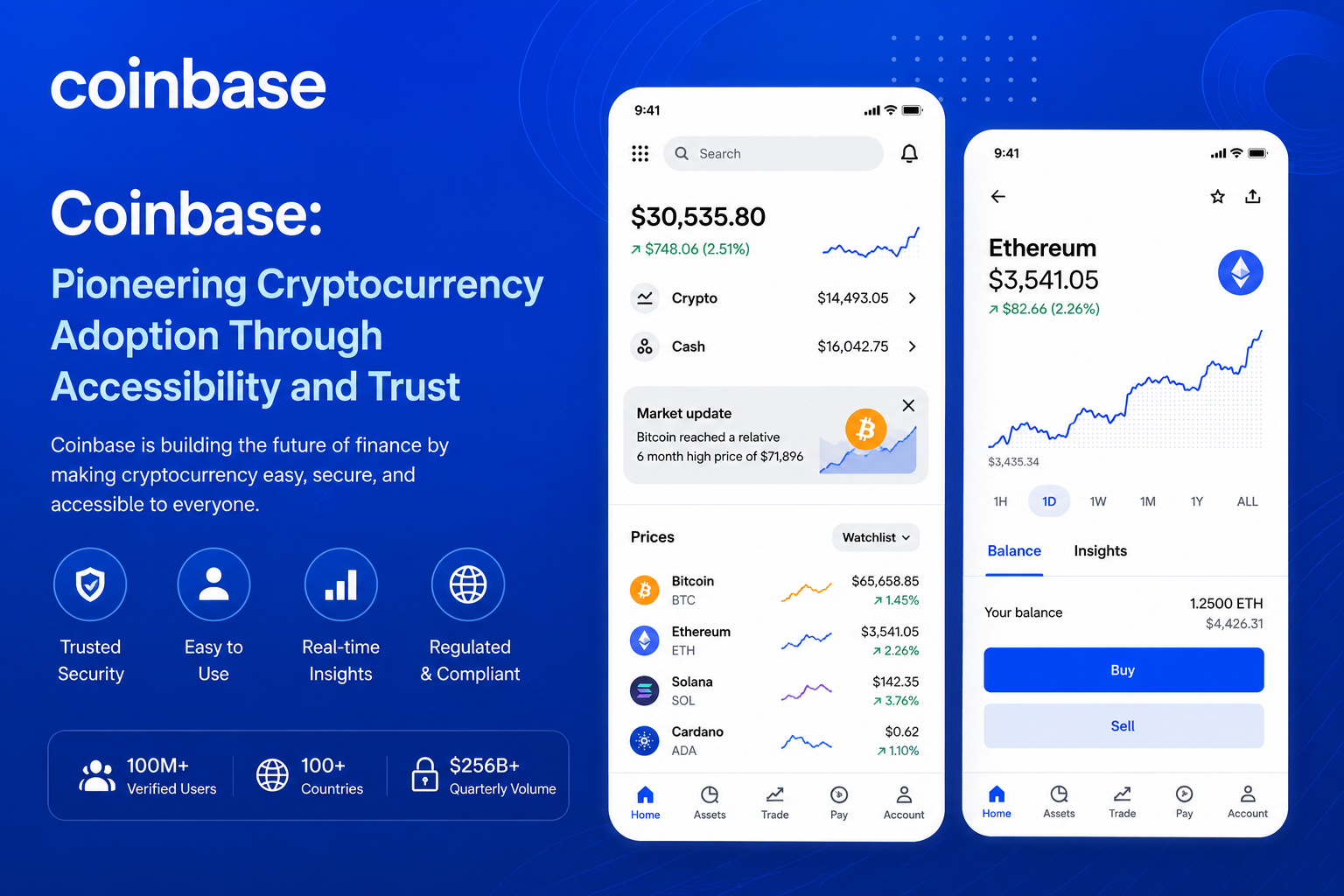
From its earliest days, Coinbase designed its core product around simplicity. While more advanced trading platforms in the crypto space often overwhelm new users with complex charts, order types, and technical jargon, Coinbase’s primary consumer app has consistently prioritized a clean, intuitive interface that resembles a traditional banking or investment app more than a specialized trading terminal. This design philosophy has made Coinbase a common recommendation for people buying their first cryptocurrency, even among users who otherwise have little interest in the more technical aspects of blockchain technology.
For more experienced traders, Coinbase also offers an advanced trading platform with deeper order book access, lower fees at higher volumes, and more sophisticated charting tools — allowing the company to serve both total beginners and professional traders without forcing either group to compromise on their experience.
Educational Initiatives
Recognizing that adoption depends heavily on financial literacy, Coinbase built out extensive educational resources designed to help new users understand not just how to use the platform, but the underlying concepts of blockchain technology, digital asset security, and responsible investing. Programs that reward users with small amounts of cryptocurrency for completing educational content have introduced millions of people to specific digital assets and blockchain concepts in a low-risk, hands-on way, turning passive learning into active, incentivized engagement.
Mobile-First Design
As smartphone usage became the dominant way people access financial services globally, Coinbase adapted accordingly, building a mobile app experience that allows users to buy, sell, send, and store cryptocurrency directly from their phones. This mobile accessibility has proven especially important in regions where traditional banking infrastructure is less developed, allowing Coinbase to serve as a meaningful financial access point for underbanked populations in various parts of the world.
Global Expansion
Coinbase has steadily expanded its footprint beyond its original U.S. base, now operating in dozens of countries across North America, Europe, Latin America, and the Asia-Pacific region. This international expansion reflects a broader strategic recognition that cryptocurrency adoption is a global phenomenon, not one confined to any single market, and that meeting local regulatory requirements in each new jurisdiction is essential to sustainable long-term growth.
Beyond Trading: Coinbase’s Expanding Product Ecosystem
While Coinbase built its initial reputation as a place to buy and sell cryptocurrency, the company has evolved considerably beyond simple spot trading, building out an increasingly diverse ecosystem of financial products.
Staking Services
Coinbase allows users to stake certain cryptocurrencies directly through the platform, earning rewards for participating in blockchain network validation without needing to manage the technical complexity of running their own validator infrastructure. The company has grown into one of the largest institutional participants in Ethereum network staking, reflecting the scale at which it now operates within core blockchain infrastructure itself, rather than simply facilitating trades on top of it.
Stablecoin Integration
Coinbase has developed a deep relationship with the USDC stablecoin, integrating it extensively across its platform and building meaningful revenue streams tied to stablecoin interest income. This has allowed the company to diversify its business model considerably, reducing its historical overreliance on trading fee revenue, which tends to fluctuate dramatically with overall crypto market sentiment and trading volume.
Coinbase One and Subscription Services
Recognizing the volatility inherent in transaction-fee-based revenue, Coinbase introduced a subscription membership program offering benefits such as reduced or eliminated trading fees, enhanced account protection, and other premium features. This subscription model has grown into a meaningful and increasingly important part of the company’s overall revenue mix, reflecting a broader industry shift toward more predictable, recurring revenue streams alongside traditional trading activity.
Derivatives and Institutional Trading
Coinbase has expanded significantly into derivatives trading, an area historically dominated by offshore and less-regulated platforms. Through strategic acquisitions and product development, Coinbase has built out a derivatives offering that appeals to institutional clients seeking regulated access to more sophisticated trading instruments, further extending its role as a bridge between institutional finance and the crypto markets.
The Base Network and Web3 Expansion
One of Coinbase’s more ambitious initiatives has been the development of Base, a layer-2 blockchain network built to make decentralized applications, or “Web3” services, more accessible to everyday users. Base allows developers to build applications with lower transaction costs than directly using Ethereum’s main network, while giving Coinbase users a more integrated pathway into decentralized finance, NFTs, and other blockchain-based applications directly from within the broader Coinbase ecosystem, rather than needing to navigate entirely separate and often less user-friendly platforms.
Expansion into Traditional Financial Products
More recently, Coinbase has taken steps to expand beyond pure cryptocurrency products, including offering stock trading services to U.S. users and pursuing broader “everything exchange” ambitions that would allow users to manage crypto, equities, and derivatives from a single unified platform. This expansion reflects Coinbase’s evolving self-conception — not merely as a crypto exchange, but as a comprehensive financial services platform built around digital-first infrastructure.
Navigating Challenges: Security, Competition, and Regulation
Coinbase’s growth has not been without significant challenges, and understanding these obstacles is essential to understanding the company’s ongoing evolution.
Security Incidents
No cryptocurrency platform of Coinbase’s scale is entirely immune to security threats, and the company has faced its own challenges in this regard, including incidents involving unauthorized access to certain user data. Coinbase’s response to these incidents — including public disclosure, remediation efforts, and continued investment in security infrastructure — has been closely watched as a test of whether its trust-focused reputation could withstand real-world security pressures. The company’s willingness to publicly acknowledge and address such incidents, rather than attempting to conceal them, has generally been viewed as consistent with its broader transparency-focused philosophy, even when the underlying incidents themselves represented genuine setbacks.
Regulatory Scrutiny
Operating at the intersection of a fast-evolving technology and a cautious, often slow-moving regulatory environment has meant that Coinbase has faced its share of regulatory scrutiny and legal challenges over the years, including questions from securities regulators about specific products and disclosure practices. Rather than avoiding these engagements, Coinbase has generally positioned itself as an active participant in shaping crypto policy discussions, advocating publicly for clearer regulatory frameworks that it argues would benefit both the industry and everyday consumers.
Competitive Pressure
The cryptocurrency exchange market has grown increasingly crowded and competitive, with both crypto-native platforms and traditional financial institutions expanding into digital asset services. Coinbase has faced competition from other major exchanges, decentralized trading platforms that eliminate intermediaries entirely, and traditional brokerages adding crypto trading capabilities to their existing offerings. Maintaining its market position has required continuous investment in product development, fee competitiveness, and expanding into higher-margin services like subscriptions, custody, and institutional products, rather than relying solely on retail trading fee revenue.
Market Cycle Sensitivity
Like the broader cryptocurrency industry, Coinbase’s financial performance remains closely tied to overall crypto market sentiment and trading volumes, which can fluctuate dramatically based on broader economic conditions, regulatory developments, and shifts in investor risk appetite. The company has worked to build more resilient, diversified revenue streams less directly tied to trading volume, but it continues to operate within an industry defined by significant cyclicality — a structural reality that both the company and its investors have had to learn to navigate.
The Institutional Shift: Coinbase as Financial Infrastructure
One of the most significant developments in Coinbase’s evolution has been its transformation from a primarily retail-focused exchange into a foundational piece of institutional crypto infrastructure. Major financial institutions, corporations holding cryptocurrency on their balance sheets, and asset managers launching crypto investment products have increasingly turned to Coinbase’s custody and prime brokerage services to safely manage digital assets at scale.
This institutional trust has been particularly evident in the exchange-traded fund market, where Coinbase serves as the custodian for the substantial majority of U.S.-listed spot Bitcoin and Ethereum ETFs. This role places Coinbase at the center of one of the most significant developments in recent financial history: the mainstream integration of cryptocurrency into traditional investment products accessible through conventional brokerage accounts.
This shift toward institutional infrastructure represents a natural evolution of Coinbase’s original mission. If the company’s early years were about proving that everyday individuals could safely and easily access cryptocurrency, its more recent years have been about proving that the world’s largest financial institutions can do the same — extending the same core promise of accessibility and trust to an entirely different class of market participant.
Cultural and Economic Impact
Coinbase’s influence extends well beyond its own platform and user base. As one of the most visible and widely recognized brands in the cryptocurrency industry, the company has played a significant role in shaping broader public perception of digital assets.
Legitimizing Cryptocurrency in the Public Eye
For many people outside the crypto industry, Coinbase has served as a kind of proof of concept — evidence that cryptocurrency could be integrated into a regulated, publicly accountable financial institution rather than existing solely within an unregulated, high-risk fringe market. This legitimizing effect has had ripple effects across the broader industry, making it easier for other companies, financial institutions, and even policymakers to engage seriously with cryptocurrency as a legitimate asset class rather than dismissing it outright.
Policy Advocacy
Coinbase has taken an active role in cryptocurrency policy advocacy, engaging with lawmakers and regulators to push for clearer legal frameworks governing digital assets. This advocacy work reflects a recognition that long-term industry growth depends heavily on regulatory clarity, and that companies operating within the space have a vested interest in helping shape sensible, workable policy rather than leaving that process entirely to policymakers with limited technical understanding of the underlying technology.
Job Creation and Economic Activity
As a major public company, Coinbase has created substantial direct employment across engineering, compliance, customer support, and corporate functions, while also indirectly supporting a broader ecosystem of developers, partners, and businesses building on top of its infrastructure, including the growing developer community building applications on the Base network.
Looking Ahead: What’s Next for Coinbase
As the cryptocurrency industry continues to mature, several key trends are likely to shape Coinbase’s future direction.
Continued product diversification appears likely, as the company builds out its “everything exchange” ambitions, potentially combining crypto trading, equities, derivatives, and traditional banking-adjacent services within a single unified platform.
Deeper institutional integration is expected to continue, as more traditional financial institutions look to Coinbase’s custody and infrastructure services to safely offer crypto exposure to their own clients, further blurring the line between traditional and crypto-native finance.
Expanded international regulatory approvals will likely remain a priority, as Coinbase continues pursuing licensing across new jurisdictions to support its global growth ambitions, particularly in markets with rapidly growing crypto adoption.
Growth of the Base ecosystem is likely to remain a significant strategic focus, as Coinbase looks to capture value not just from trading activity, but from the broader decentralized application economy being built on top of its layer-2 network.
Continued emphasis on diversified revenue away from pure trading fees will likely persist, given the inherent volatility of transaction-based revenue and the more predictable, recurring nature of subscription, custody, and interest-based income streams.
Whatever specific direction these developments take, Coinbase’s core strategic identity — building trust through regulatory compliance and transparency, while relentlessly prioritizing accessibility for both everyday users and large institutions — appears likely to remain the throughline connecting its next chapter to its founding mission.
The Business Model Behind the Trust
Understanding Coinbase’s staying power also requires understanding the economics behind the platform, since a company’s financial resilience directly affects its ability to maintain security investments, regulatory compliance, and product development over the long term.
Diversifying Away From Trading Fees
In its earlier years, Coinbase’s revenue was overwhelmingly dependent on transaction fees generated by retail trading activity. This created a business model that rose and fell dramatically with overall crypto market sentiment — during bull markets, trading volume and revenue would surge, while during prolonged downturns, revenue could contract sharply as retail interest cooled. Recognizing the risks of this dependency, Coinbase has spent recent years deliberately building out subscription revenue, stablecoin interest income, custody fees, staking commissions, and institutional service fees, each of which tends to be considerably more stable and predictable than trading volume alone.
This diversification strategy has produced a growing number of individual product lines that each generate substantial annualized revenue on their own, reducing the company’s overall exposure to any single revenue source and providing a more resilient financial foundation even during periods of broader crypto market weakness.
Institutional Revenue Growth
Institutional clients have become an increasingly important part of Coinbase’s business, both through direct trading activity and through custody and prime brokerage fees. The expansion into derivatives trading, accelerated through strategic acquisitions, has further deepened institutional engagement, giving large trading firms and asset managers access to more sophisticated products through a regulated, U.S.-based provider rather than turning to offshore alternatives with less regulatory oversight.
Maintaining Profitability Through Market Cycles
Despite operating in a notoriously cyclical industry, Coinbase has worked to demonstrate consistent operational discipline, maintaining positive adjusted operating profitability across multiple consecutive quarters even during periods when overall net results were affected by broader market volatility or one-time costs. This operational resilience has been an important signal to investors and institutional partners that Coinbase’s business model can weather the inevitable downturns that have historically plagued the crypto industry, rather than depending entirely on sustained bull market conditions to remain viable.
Comparing Coinbase to Traditional Financial Institutions
Part of what makes Coinbase’s growth story compelling is how directly it now competes with, and in some respects resembles, traditional financial institutions rather than purely crypto-native platforms.
In terms of user base, Coinbase now serves a number of active users that rivals or exceeds many established online brokerages, reflecting how thoroughly cryptocurrency trading has moved from a niche activity into a mainstream financial behavior for a significant portion of the population. At the same time, Coinbase’s assets under custody, while still smaller than the largest traditional wealth management institutions, have grown into the hundreds of billions of dollars, placing the company within a similar order of magnitude to well-established financial services firms in terms of the sheer scale of assets it is trusted to safeguard.
This comparison matters because it illustrates just how far cryptocurrency exchanges have come from their unregulated, often chaotic origins. Where early crypto exchanges operated with minimal oversight and limited accountability, Coinbase now files public financial reports, undergoes regular audits, and operates under a regulatory license structure that increasingly mirrors traditional brokerage and banking oversight — a transformation that has been central to bringing skeptical institutional and retail users alike into the cryptocurrency market.
Frequently Asked Questions
What makes Coinbase different from other cryptocurrency exchanges? Coinbase has differentiated itself primarily through its strong emphasis on regulatory compliance, transparency as a publicly traded company, and a deliberately accessible, beginner-friendly user experience, distinguishing it from many competitors that have prioritized aggressive growth over regulatory caution.
Is Coinbase safe to use? Coinbase has invested heavily in security infrastructure, insurance coverage, and regulatory compliance, and operates as a publicly traded, regulated company subject to significant financial disclosure requirements. That said, as with any financial platform, users should practice strong personal security habits, including enabling two-factor authentication and remaining cautious of phishing attempts.
Does Coinbase only support Bitcoin? No. While Coinbase began as a Bitcoin-focused brokerage, it now supports a wide range of cryptocurrencies and has expanded into staking, derivatives, stablecoins, and even traditional stock trading in certain markets.
What is the Base network? Base is a layer-2 blockchain network developed to make decentralized applications more accessible and affordable to use, offering lower transaction costs than directly using Ethereum’s main network while integrating closely with the broader Coinbase ecosystem.
Does Coinbase serve institutional investors? Yes. Coinbase has become a major provider of institutional custody, prime brokerage, and derivatives trading services, and serves as the custodian for a significant majority of U.S.-listed spot Bitcoin and Ethereum exchange-traded funds.
Is Coinbase available worldwide? Coinbase operates in dozens of countries across North America, Europe, Latin America, and the Asia-Pacific region, though specific product availability varies by jurisdiction based on local regulatory requirements.
How does Coinbase make money? Coinbase generates revenue through a mix of retail and institutional trading fees, subscription income from its membership program, stablecoin interest income, custody and staking fees, and derivatives trading revenue. In recent years, the company has deliberately diversified away from relying primarily on trading fees toward more stable, recurring revenue streams.
Can beginners use Coinbase without technical crypto knowledge? Yes. Coinbase’s core consumer app was specifically designed to be accessible to first-time users, offering a simple, guided experience for buying, holding, and eventually exploring more advanced features such as staking or decentralized applications, without requiring prior technical knowledge of blockchain technology.
Conclusion
Coinbase’s journey from a small, simple Bitcoin brokerage to one of the world’s most influential cryptocurrency companies reflects a broader story about what it takes to build lasting trust in a historically volatile and often distrusted industry. By consistently prioritizing regulatory compliance, transparency, and genuine accessibility over shortcuts and unchecked growth, Coinbase has built something increasingly rare in the crypto space: durable, mainstream credibility.
That credibility did not emerge overnight, and it has not come without real setbacks along the way — security incidents, regulatory disputes, and the ever-present volatility of crypto markets have all tested the company at various points in its history. Yet what distinguishes Coinbase’s trajectory is not the absence of challenges, but its consistent pattern of responding to them through greater transparency, deeper regulatory engagement, and continued investment in the infrastructure needed to protect user funds, rather than retreating from accountability. That pattern, repeated across more than a decade, is precisely what has allowed trust to compound over time in an industry where trust is otherwise in chronically short supply.
As cryptocurrency continues its slow but steady march toward broader mainstream integration — through institutional adoption, regulatory clarity, and expanding real-world use cases — Coinbase’s role as a trusted bridge between traditional finance and the digital asset economy seems likely to only grow in importance. Its expansion into staking, stablecoins, derivatives, layer-2 infrastructure through Base, and even traditional equities trading suggests a company no longer content to be defined solely as a cryptocurrency exchange, but one working toward becoming a more comprehensive, digitally native financial platform for the decades ahead.
In an industry often defined by hype, speculation, and volatility, Coinbase has staked its long-term success on a much simpler and more enduring proposition: making cryptocurrency accessible, secure, and trustworthy enough for anyone, anywhere, to use with confidence. Whether that proposition continues to hold as the industry matures further will depend on the company’s ability to keep pace with technological change, evolving regulation, and the expectations of an increasingly sophisticated global user base — but if its first decade is any indication, accessibility and trust will remain the twin pillars guiding whatever comes next.