Introduction
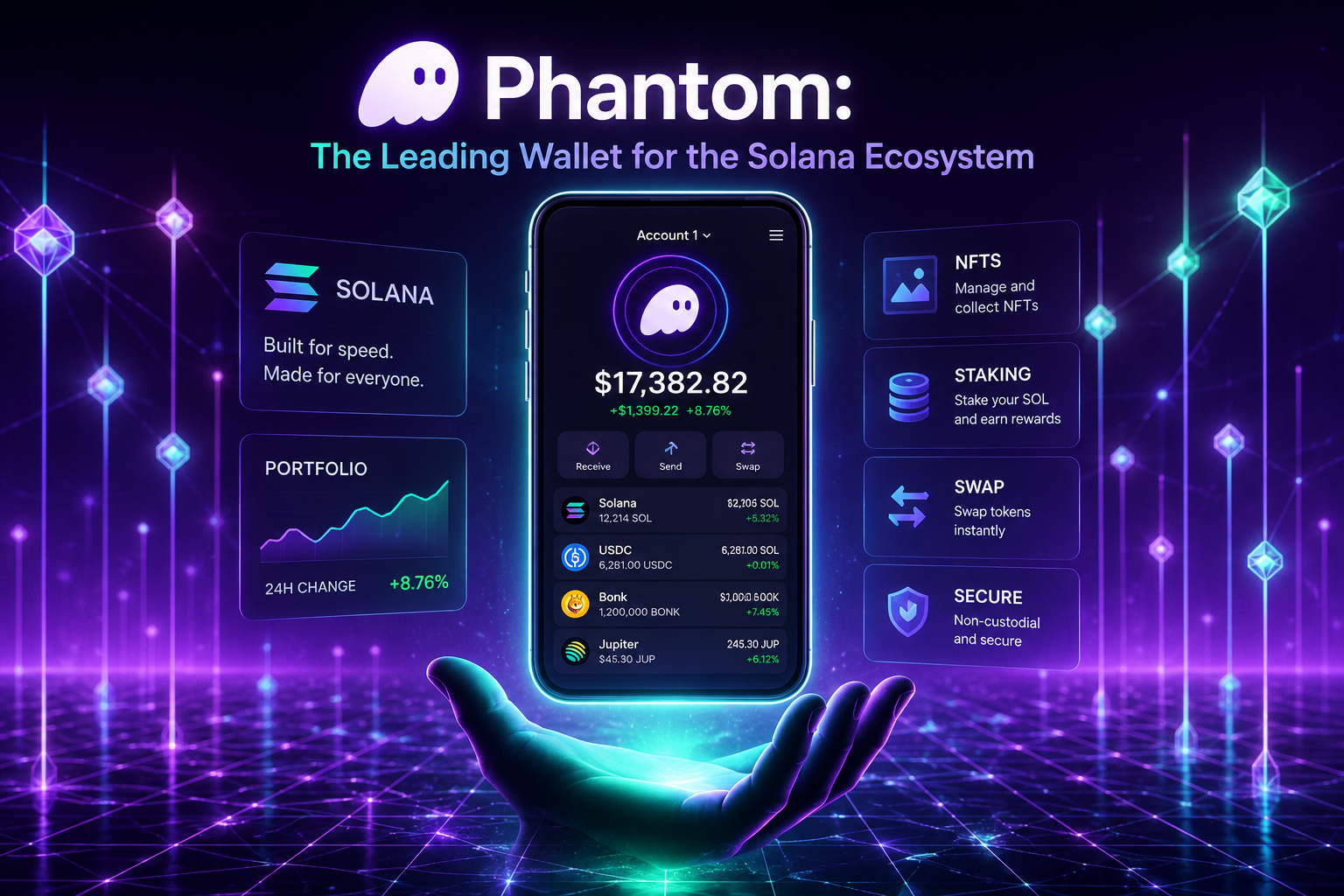
The rise of Solana as one of the fastest and most cost-efficient blockchains has brought with it a wave of decentralized applications, NFT marketplaces, and DeFi protocols. Yet none of this would be accessible to everyday users without a reliable gateway — a crypto wallet that turns complex blockchain interactions into a few simple clicks. That gateway, for millions of users around the world, is Phantom.
Since its launch, Phantom has grown from a small Solana-focused browser extension into one of the most widely used self-custody wallets in the entire crypto industry. It is now available on Chrome, Brave, Edge, and Firefox, as well as dedicated iOS and Android apps, and it has expanded far beyond Solana to support Ethereum, Bitcoin, Base, Polygon, Sui, HyperEVM, and Monad. Despite this multichain expansion, Solana remains the backbone of the Phantom experience, and the wallet continues to be regarded as the default choice for anyone serious about exploring the Solana ecosystem.
This guide takes an in-depth look at what makes Phantom stand out, how it works, what features it offers, how secure it is, and why it continues to be considered the leading wallet for Solana users in 2026.
What Is Phantom Wallet?
Phantom is a non-custodial cryptocurrency wallet, which means that users retain full control over their private keys and, by extension, their digital assets. Unlike custodial wallets offered by centralized exchanges, Phantom does not hold or manage funds on behalf of its users. Instead, private keys are encrypted and stored directly on the user’s device, giving individuals complete ownership over their crypto holdings, NFTs, and other digital assets.
Phantom was originally built as a Solana-native wallet, designed specifically to make it easy for users to send and receive SOL and SPL tokens, interact with Solana-based decentralized applications, and store Solana NFTs. Over time, as demand for multichain functionality grew, Phantom expanded its supported networks to include Ethereum, Bitcoin, Polygon, Base, Sui, HyperEVM, and Monad. Even with this broader reach, the wallet’s design, feature set, and user experience remain most deeply optimized for Solana, which is why it continues to be described as the leading wallet within the Solana ecosystem specifically.
A Brief History of Phantom
Phantom entered the market in 2021 at a time when Solana’s ecosystem was just beginning to take shape. Early Solana users were often forced to rely on clunky, difficult-to-use wallet solutions that made onboarding new users a significant challenge. Phantom addressed this gap by offering a clean, intuitive interface modeled after the simplicity of wallets like MetaMask, but tailored specifically for Solana’s architecture.
As Solana-based platforms such as Magic Eden, Jupiter, Raydium, Orca, and Tensor grew in popularity, Phantom became the default companion wallet for interacting with them. Its simple onboarding process, clear transaction previews, and built-in scam detection helped it stand out from competing wallets, and it quickly became the most recommended wallet for anyone entering the Solana ecosystem for the first time.
In the years since, Phantom has continued to evolve. It introduced support for NFTs, then added token swapping directly within the wallet, followed by SOL staking. It later expanded into multichain support, added Bitcoin Ordinals compatibility, and more recently introduced access to tokenized stocks and prediction markets directly through supported decentralized applications. This continuous expansion of features reflects Phantom’s ambition to become not just a Solana wallet, but a full-featured, all-in-one hub for on-chain activity.
Key Features of Phantom Wallet
1. Multichain Support With a Solana-First Focus
While Phantom began as a Solana-exclusive wallet, it has since broadened its scope considerably. As of 2026, Phantom supports Solana, Ethereum, Bitcoin (including Native SegWit and Taproot), Base, Polygon, Sui, HyperEVM, and Monad. This means users can manage a diverse portfolio of assets across multiple blockchains from a single interface, without needing to juggle several different wallet applications.
That said, industry reviewers consistently note that Solana still feels like Phantom’s core product rather than an afterthought. The wallet’s swap engine, staking flow, NFT gallery, and dApp integrations are most deeply developed for Solana-based activity, and its coverage of other EVM-compatible chains remains narrower than dedicated multichain wallets like MetaMask or Trust Wallet. For users whose primary activity revolves around Solana DeFi, NFTs, and staking, Phantom remains the most polished and full-featured option available.
2. Built-In Token Swaps
One of Phantom’s most convenient features is its built-in swap function, which allows users to exchange one token for another directly within the wallet interface, without needing to visit an external decentralized exchange. When performing a swap, users can view real-time details such as slippage rates and associated fees before confirming a transaction. This built-in aggregation saves time and reduces the friction that would otherwise come from manually navigating to platforms like Jupiter or Raydium.
3. SOL Staking Made Simple
Phantom also includes a native staking feature that allows users to delegate their SOL tokens to a validator directly from within the wallet. After depositing SOL, users can select from a list of validators with varying annual percentage yields (APYs) and begin earning staking rewards without ever leaving the Phantom interface. This eliminates the need for third-party staking platforms and makes the process accessible even to newcomers who may be unfamiliar with how validator delegation works. It is worth noting that staked SOL is subject to an unstaking period before it becomes liquid again, and reward rates fluctuate depending on network conditions and validator performance.
4. NFT Storage and Management
Phantom offers a dedicated gallery for storing, viewing, and managing NFTs, with particularly strong support for Solana-based collections. The wallet integrates seamlessly with popular NFT marketplaces such as Magic Eden and Tensor, allowing users to browse, buy, and sell NFTs while keeping their assets securely stored in Phantom. The interface is designed to make it easy to organize a collection, view individual NFT details, and track ownership history.
5. Bitcoin Ordinals Support
As Bitcoin-based NFTs, known as Ordinals, gained traction, Phantom added dedicated support for storing and managing them. This allows users who hold Bitcoin Ordinals to view and manage these assets in the same interface they already use for their Solana and multichain holdings, rather than needing a separate specialized wallet.
6. Tokenized Stocks and Prediction Markets
Reflecting Phantom’s ambition to become a broader on-chain finance hub, the wallet now provides access to emerging categories of decentralized applications, including platforms offering tokenized stock exposure and prediction markets. Through integrations with Solana-based protocols, users can gain blockchain-based exposure to tokenized versions of major public companies, with these assets trading continuously and settling on-chain. Separately, Phantom users can also connect to decentralized prediction platforms to trade on the outcomes of major sporting events across leagues such as the NFL, NBA, Champions League, Formula 1, and UFC. These features illustrate how Phantom is expanding beyond simple asset storage and into a broader gateway for on-chain financial activity.
7. Ledger Hardware Wallet Integration
For users holding larger balances, Phantom supports integration with Ledger hardware wallets. This allows the convenience of Phantom’s software interface to be combined with the added security of offline private key storage, giving users a stronger signing layer for significant holdings while still benefiting from Phantom’s user experience for day-to-day interactions.
8. Simplified Onboarding Options
Phantom supports both the traditional recovery-phrase method of wallet creation and a more streamlined login option using a Google or Apple account paired with a four-digit PIN. This dual approach lowers the barrier to entry for newcomers who may find a twelve- or twenty-four-word recovery phrase intimidating, while still preserving the option of a fully self-custodial recovery phrase for those who prefer traditional wallet security.
9. Scam and Phishing Protection
Phantom has built a reputation for including clear transaction previews and proactive scam warnings that help users understand exactly what a transaction will do before they approve it. This is particularly valuable in the NFT and DeFi space, where malicious contracts and phishing attempts are unfortunately common. By flagging suspicious transactions and providing simulation previews, Phantom helps reduce the risk of users unknowingly approving harmful smart contract interactions.
10. Cross-Platform Availability
Phantom is available as a browser extension for Chrome, Brave, Edge, and Firefox, as well as native mobile applications for iOS and Android. This cross-platform availability ensures that users can access their wallet whether they are browsing decentralized applications on a desktop computer or managing assets on the go from a mobile device.
Understanding the Solana Ecosystem Phantom Was Built For
To appreciate why Phantom holds such a strong position, it helps to understand the ecosystem it was designed to serve. Solana is a high-throughput blockchain built to process a large volume of transactions quickly and at a low cost compared to many older networks. This combination of speed and affordability has made Solana an attractive home for a wide range of applications, including decentralized exchanges, NFT marketplaces, lending protocols, and increasingly, tokenized real-world assets.
Because transaction costs on Solana are typically a small fraction of a cent, the network has become particularly popular for use cases that require frequent, low-value transactions — something that would be impractical on networks with higher gas fees. This includes everyday token swaps, NFT minting, in-game asset transfers, and high-frequency trading strategies. A wallet built for this kind of environment needs to be fast, responsive, and capable of handling frequent interactions without becoming a bottleneck, and Phantom was designed with exactly these requirements in mind.
The Solana ecosystem has also developed a strong cluster of flagship applications that most users interact with regularly:
- Decentralized exchanges such as Jupiter, Raydium, and Orca, which allow users to swap between thousands of SPL tokens.
- NFT marketplaces such as Magic Eden and Tensor, which host a huge range of digital collectibles, from generative art projects to gaming assets.
- Lending and borrowing protocols that allow users to earn yield or access liquidity against their crypto holdings.
- Liquid staking platforms that let users stake SOL while retaining a tradable, liquid representation of their staked position.
Because Phantom connects natively to all of these platforms, it functions less like a simple storage tool and more like a control center for a user’s entire on-chain presence within the Solana ecosystem. This is a key reason why the wallet has remained the default recommendation across Solana-focused communities, tutorials, and onboarding guides.
Why Solana Users Choose Phantom
Deep Integration With the Solana Ecosystem
Phantom’s history as a Solana-native wallet gives it an advantage that few competitors can match: deep, mature integration with the platforms that define the Solana ecosystem. Decentralized exchanges like Jupiter, Raydium, and Orca, along with NFT marketplaces like Magic Eden and Tensor, all support seamless Phantom connectivity. For users whose primary activity takes place on Solana, this level of integration translates into a smoother, more reliable experience compared to wallets that treat Solana as one of many supported chains rather than a primary focus.
Ease of Use for Beginners
Crypto wallets have historically had a reputation for being intimidating to newcomers, with confusing terminology, unclear security practices, and clunky interfaces. Phantom was built with the explicit goal of making blockchain interaction approachable. Its clean dashboard, straightforward send-and-receive functionality, and built-in access to swaps and staking mean that new users do not need to rely on a patchwork of third-party tools to participate in the Solana ecosystem. Whether someone is depositing their first SOL, purchasing an NFT, or delegating tokens to a validator, Phantom’s interface is designed to make the process approachable.
A Genuinely All-in-One Wallet
Rather than requiring users to bounce between a wallet application, a separate decentralized exchange, a third-party staking platform, and yet another app for NFT management, Phantom consolidates these functions into a single interface. This all-in-one approach reduces friction, minimizes the number of approvals and connections a user needs to manage, and lowers the overall risk exposure that comes with connecting a wallet to multiple external platforms.
Continuous Feature Expansion
Phantom’s product team has consistently added new functionality over time, expanding from a simple Solana wallet into a platform that supports multichain assets, Bitcoin Ordinals, tokenized stocks, and prediction markets. This pattern of continuous expansion suggests that Phantom is positioning itself not just as a wallet, but as a long-term hub for a wide range of on-chain financial activity.
Security: How Phantom Protects Its Users
Security is one of the most important considerations for any crypto wallet, and Phantom has built several layers of protection into its product.
Non-Custodial Architecture. Because Phantom is non-custodial, private keys are encrypted and stored locally on the user’s own device rather than on Phantom’s servers. This design significantly reduces the risk associated with centralized breaches, since there is no central database of user keys for attackers to target.
Encryption Standards. Sensitive information, including private keys and transaction data, is encrypted to protect it from unauthorized access, both while stored on the device and during transmission.
Hardware Wallet Compatibility. For users who want an additional layer of protection for larger holdings, Phantom supports Ledger hardware wallet integration, allowing private keys to be stored entirely offline while still enabling convenient interaction with Solana and other supported networks.
Transaction Simulation and Warnings. Before a transaction is finalized, Phantom provides users with a preview of what the transaction will actually do, along with warnings if a transaction appears risky or matches patterns associated with known scams. This proactive approach helps prevent users from unknowingly signing malicious smart contract interactions.
Recovery Phrase Backup. Regardless of whether a user sets up Phantom using a traditional recovery phrase or a simplified social login, the underlying recovery phrase remains the most important backup mechanism. Users are strongly encouraged to store this phrase securely offline, since anyone with access to it can gain full control of the associated wallet.
Despite these protections, it is important to remember that Phantom is fundamentally a hot wallet, meaning it remains connected to the internet. As with any hot wallet, this makes it best suited for active, everyday use rather than long-term storage of significant funds. Industry reviewers consistently recommend treating Phantom as an active wallet for spending, swapping, and interacting with decentralized applications, while reserving larger holdings for cold storage solutions such as hardware wallets.
How to Set Up Phantom Wallet: Step-by-Step
Setting up Phantom is designed to be simple even for users with no prior crypto experience. The general process looks like this:
- Download the Extension or App. Visit Phantom’s official website or the appropriate app store for your device, and install the browser extension (Chrome, Brave, Edge, or Firefox) or the mobile app (iOS or Android).
- Create a New Wallet. Choose to create a new wallet rather than importing an existing one if this is your first time using Phantom.
- Choose Your Onboarding Method. Select between generating a traditional recovery phrase or using a simplified Google or Apple login paired with a four-digit PIN.
- Secure Your Recovery Phrase. If you choose the traditional method, write down your recovery phrase and store it somewhere safe and offline. Never share this phrase with anyone, and never store it digitally in a way that could be accessed by hackers.
- Set a Password. Create a strong password to protect access to the wallet on your specific device.
- Fund Your Wallet. Deposit SOL or other supported tokens from an exchange or another wallet to begin using Phantom’s features.
- Explore Features. From here, you can explore token swaps, connect to decentralized applications, browse NFT marketplaces, or begin staking SOL.
Staking SOL Through Phantom
Staking is one of the simplest ways for Solana holders to earn passive rewards, and Phantom makes the process accessible directly within its interface. After depositing SOL into the wallet, users can navigate to the staking section and select the option to start earning rewards. Phantom then presents a list of available validators, each displaying a different annual percentage yield along with other relevant performance metrics. After choosing a validator, users can delegate their SOL and begin earning rewards over time.
It is worth understanding that staking rewards are not fixed and will vary depending on overall network conditions and the performance of the chosen validator. Additionally, unstaking is not instantaneous — there is typically a cooldown period before staked SOL becomes liquid again. Users should always review the current terms and reward rates within the app before staking, since these details can change over time.
Managing NFTs With Phantom
Phantom’s NFT gallery is designed to give users a clear, organized view of their digital collectibles. Because Solana NFTs are generally cheaper to mint and transfer than their Ethereum counterparts, the Solana ecosystem has become a popular home for NFT projects, and Phantom has positioned itself as the primary wallet for interacting with them.
Within the wallet, users can view individual NFTs, check ownership details, and connect directly to marketplaces such as Magic Eden and Tensor to buy, sell, or list their collectibles. This tight integration between wallet and marketplace reduces the number of steps required to participate in the NFT economy, making it easier for collectors to manage their portfolios without needing separate tracking tools.
Phantom vs. Other Wallets
Phantom vs. MetaMask
MetaMask remains the most widely used wallet in the Ethereum and broader EVM ecosystem, but it does not offer native Solana support. Phantom, by contrast, was built specifically with Solana in mind, and its features — from staking to NFT galleries to swap integration — are tailored to that ecosystem in a way that MetaMask simply is not. For users whose activity spans both Solana and Ethereum-based chains, some choose to run both wallets side by side, using Phantom for Solana-centric activity and MetaMask for broader EVM interactions.
Phantom vs. Trust Wallet
Trust Wallet offers broader multichain coverage than Phantom, supporting a wider range of blockchain networks. However, reviewers consistently note that if Solana-specific functionality and polish matter more to a user than sheer number of supported chains, Phantom remains the stronger choice. Trust Wallet may be preferable for users who need extensive coverage across many different blockchains, while Phantom is preferable for those whose primary focus is the Solana ecosystem.
Phantom vs. Other Solana Wallets
Compared to other Solana-native wallets, Phantom has maintained its position as the most recognizable and widely adopted option, largely due to its early-mover advantage, continuous feature development, and deep integrations with the platforms that define the Solana DeFi and NFT landscape. Its combination of built-in swaps, staking, NFT support, and scam protection gives it a more complete feature set than many alternative Solana wallets.
Quick Comparison: Phantom at a Glance
| Category | Details |
|---|---|
| Wallet type | Non-custodial (self-custody) |
| Core network | Solana |
| Other supported networks | Ethereum, Bitcoin, Base, Polygon, Sui, HyperEVM, Monad |
| Platforms | Chrome, Brave, Edge, Firefox, iOS, Android |
| Key features | Swaps, SOL staking, NFT gallery, Bitcoin Ordinals, tokenized stocks, prediction markets |
| Hardware wallet support | Yes, via Ledger |
| Onboarding options | Recovery phrase or Google/Apple login with PIN |
| Best suited for | Active Solana DeFi, NFT, and staking users |
| Not ideal for | Long-term cold storage of very large holdings, deep multi-EVM coverage |
Best Practices for Using Phantom Safely
Even with strong built-in protections, how a wallet is used matters just as much as the security features it offers. A few practical habits can significantly reduce risk for Phantom users:
- Never share your recovery phrase. No legitimate support team, project, or platform will ever ask for it. Anyone who does is attempting a scam.
- Store your recovery phrase offline. Writing it down on paper or engraving it on metal and storing it in a secure physical location is far safer than saving it in a text file, email, or cloud storage account.
- Treat Phantom as a hot wallet for active use. Keep only the funds you plan to actively trade, swap, or use with dApps in Phantom, and move larger, long-term holdings to a hardware wallet.
- Review transaction previews carefully. Before approving any transaction, take a moment to read what Phantom’s simulation preview says the transaction will actually do, rather than clicking through automatically.
- Double-check URLs before connecting your wallet. Phishing sites that mimic popular Solana dApps are a common attack vector; always verify you are on the official website before connecting.
- Keep your software updated. Regularly updating the Phantom extension or app ensures you benefit from the latest security patches and scam-detection improvements.
- Use Ledger integration for significant balances. If you hold a meaningful amount of value in your wallet, pairing Phantom with a Ledger hardware wallet adds an important extra layer of protection.
The Road Ahead for Phantom and Solana
Phantom’s trajectory over the past several years — from a simple Solana wallet to a multichain platform offering staking, NFT management, Bitcoin Ordinals support, tokenized stocks, and prediction markets — suggests a clear direction of travel. Rather than positioning itself purely as a place to store crypto, Phantom is increasingly positioning itself as an entry point into a much broader range of on-chain financial activity.
As the Solana ecosystem continues to mature, with faster settlement, growing institutional interest, and an expanding range of real-world asset projects, Phantom is well placed to remain the primary interface through which everyday users access that ecosystem. Its continued investment in security, usability, and feature breadth indicates that the wallet is likely to keep expanding its role, rather than settling into a static feature set.
Fees: What to Expect When Using Phantom
Like most wallets that offer built-in swap functionality, Phantom applies a fee to transactions conducted through its integrated swap feature. These fees are displayed transparently at the time of the transaction, alongside details such as slippage, so users can see exactly what they will pay before confirming. Network transaction fees, which are paid in SOL for Solana-based transactions, are separate from Phantom’s own service fees and are determined by the underlying blockchain rather than by Phantom itself. Because Phantom retains the right to adjust its fee structure and the specific trading pairs it applies to, users should always check current fee details directly within the app before executing larger trades, since swap fees can add up meaningfully on bigger transactions.
Pros and Cons of Phantom Wallet
Pros:
- Deep, mature integration with the Solana ecosystem, including major DeFi and NFT platforms
- Clean, beginner-friendly interface that simplifies wallet setup and everyday use
- Built-in token swaps with transparent fee and slippage information
- Native SOL staking directly within the wallet
- Strong NFT gallery and marketplace integration
- Support for Bitcoin, Ethereum, Base, Polygon, Sui, HyperEVM, and Monad alongside Solana
- Ledger hardware wallet compatibility for enhanced security
- Helpful scam warnings and transaction simulation previews
- Availability across major browsers and both major mobile platforms
Cons:
- Narrower EVM chain coverage compared to dedicated multichain wallets like MetaMask or Trust Wallet
- As a hot wallet, it carries more inherent risk than cold storage solutions for very large holdings
- Swap fees can become significant on larger transactions
- Fiat on-ramp purchases depend on third-party providers rather than being fully native
Who Should Use Phantom?
Phantom is best suited for active users of the Solana ecosystem who want a single, streamlined application for swapping tokens, managing NFTs, staking SOL, and connecting to decentralized applications. It is particularly well suited to newcomers, thanks to its simplified onboarding options and intuitive interface, as well as to more experienced users who value having built-in access to swaps, staking, and NFT management without needing to rely on a collection of separate tools.
Users whose primary interest lies in extensive coverage across many different EVM-compatible blockchains, or those seeking a dedicated cold-storage solution for very large holdings, may want to pair Phantom with other tools — such as a hardware wallet for long-term storage or a more EVM-focused wallet for chains that Phantom does not yet support.
Frequently Asked Questions
Is Phantom a custodial or non-custodial wallet? Phantom is a non-custodial wallet. This means users retain full control over their private keys and digital assets, and Phantom itself does not have access to or control over user funds.
Which blockchains does Phantom support? Phantom supports Solana, Ethereum, Bitcoin, Base, Polygon, Sui, HyperEVM, and Monad, with Solana remaining its most deeply integrated and feature-rich network.
Can I stake SOL directly in Phantom? Yes. Phantom includes a built-in staking feature that lets users delegate SOL to a validator of their choice and earn staking rewards directly within the app.
Does Phantom support NFTs? Yes. Phantom provides a dedicated NFT gallery and integrates directly with popular marketplaces such as Magic Eden and Tensor, making it easy to view, buy, and sell NFTs.
Is Phantom safe to use? Phantom includes strong security measures, including encryption, hardware wallet support, and proactive scam warnings. However, as a hot wallet connected to the internet, it should be treated as an active-use wallet rather than a long-term vault for very large holdings.
Does Phantom charge fees? Phantom applies a fee to transactions made through its built-in swap feature, which is displayed transparently before a transaction is confirmed. Network fees for Solana transactions are paid separately in SOL.
Is Phantom available on mobile? Yes. Phantom offers dedicated apps for both iOS and Android, in addition to browser extensions for Chrome, Brave, Edge, and Firefox.
Conclusion
Phantom has earned its reputation as the leading wallet for the Solana ecosystem through years of consistent feature development, a strong focus on usability, and deep integration with the platforms that define Solana’s DeFi and NFT landscape. While it has expanded into a genuinely multichain product supporting networks like Bitcoin, Ethereum, Base, Polygon, Sui, HyperEVM, and Monad, Solana remains at the heart of the Phantom experience.
For anyone looking to swap tokens, stake SOL, manage NFTs, or explore decentralized applications within the Solana ecosystem, Phantom offers one of the most complete, secure, and user-friendly solutions currently available. As with any hot wallet, users should treat it as a tool for active, everyday use, while considering additional cold-storage protection for significant long-term holdings. With continuous updates and an expanding feature set, Phantom shows every sign of remaining the go-to wallet for Solana users well into the future.
This article is for informational purposes only and does not constitute financial advice. Cryptocurrency investments carry risk, and readers should conduct their own research before making financial decisions.