Last updated: July 2026
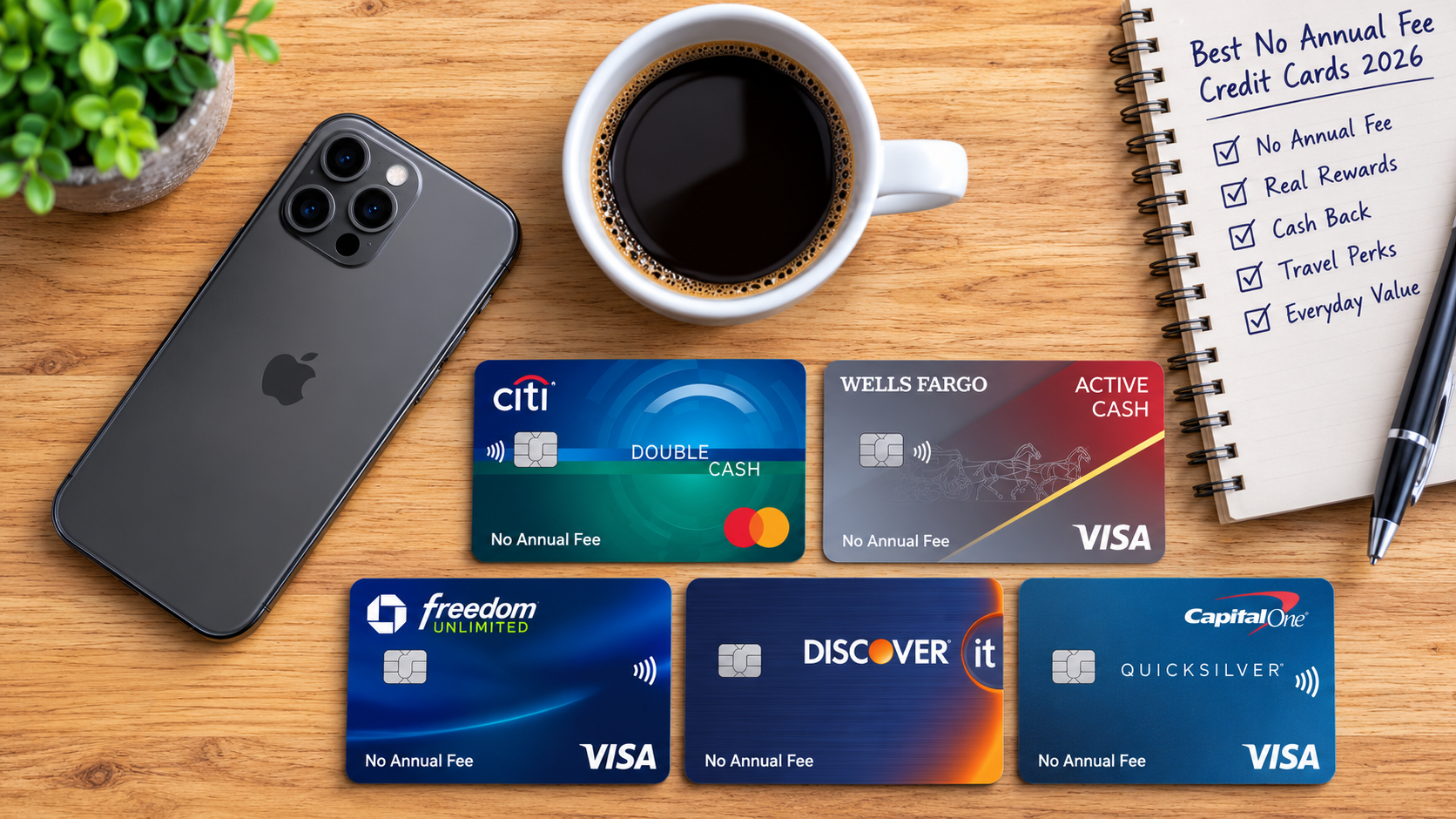
Choosing a credit card can feel overwhelming, especially when so many of the most heavily advertised products come loaded with annual fees ranging anywhere from $95 to $695. The good news is that you don’t have to pay a cent in yearly membership costs to get a genuinely rewarding card. In 2026, no annual fee credit cards have closed much of the gap with their premium counterparts, offering strong cash back rates, generous welcome bonuses, long 0% introductory APR periods, and even select travel perks — all without the recurring cost.
This guide breaks down everything you need to know about no annual fee credit cards in 2026: how they work, who they’re best for, what separates a good one from a great one, and how to pick the right card for your specific spending habits. Whether you’re a student building credit for the first time, a family trying to maximize grocery and gas rewards, or someone who simply refuses to pay for the privilege of using a piece of plastic, this article will help you make an informed decision.
Disclaimer: This article is for general educational and informational purposes only and does not constitute financial or legal advice. Card terms, APRs, rewards structures, and welcome offers change frequently and vary by issuer, so always confirm current details directly with the card issuer before applying. Consider speaking with a licensed financial advisor for guidance tailored to your personal situation.
Table of Contents
- Why No Annual Fee Credit Cards Are Worth Considering in 2026
- How No Annual Fee Cards Actually Make Money
- Key Features to Compare Before You Apply
- Best No Annual Fee Cards by Category
- Cash Back vs. Points vs. Miles: Which Rewards Type Fits You?
- No Annual Fee Cards for Building or Rebuilding Credit
- No Annual Fee Cards for Students
- Balance Transfer and 0% Intro APR Considerations
- Common Mistakes to Avoid
- How to Apply and Get Approved
- Frequently Asked Questions
- Final Thoughts
1. Why No Annual Fee Credit Cards Are Worth Considering in 2026
For years, the conventional wisdom in the personal finance world was that premium travel cards with hefty annual fees were the only way to unlock “real” rewards. That thinking has shifted considerably. Issuers now compete aggressively for everyday spenders, and the no annual fee category has become one of the most innovative segments of the credit card market.
A no annual fee card simply means you’re not charged a recurring yearly cost just to hold the account open. Every dollar of cash back, every point, and every mile you earn is pure upside — there’s no fee eating into your rewards before you even start spending. This makes the effective return on a no annual fee card mathematically superior for a large share of cardholders, particularly those who don’t spend enough annually to fully offset a premium card’s fee through its bundled credits and bonus categories.
Several trends are driving this shift in 2026:
- Higher base rewards rates. Many no annual fee cards now offer 1.5% to 2% unlimited cash back on all purchases, a rate that used to be reserved for fee-based cards just a few years ago.
- Rotating and flat bonus categories. Cards increasingly offer 3% to 5% cash back in categories like groceries, gas, dining, streaming services, and online shopping, often without requiring quarterly activation.
- Long introductory 0% APR windows. Many no-fee cards now offer 12 to 21 months of 0% APR on purchases, balance transfers, or both — a feature historically associated with fee-based cards.
- Stronger welcome bonuses. Sign-up bonuses in the $150–$300 range (or equivalent in points/miles) after modest spending thresholds are increasingly common on no annual fee cards.
- Fewer trade-offs for occasional travelers. Some no annual fee travel cards now include no foreign transaction fees, points transfer partners, and travel purchase protections that used to be exclusive to premium cards.
In short, if you’re disciplined about paying your balance in full and choosing a card that matches your spending habits, a no annual fee card can outperform a premium card in net value, especially in your first year or two of card ownership.
2. How No Annual Fee Cards Actually Make Money
It’s a fair question: if the issuer isn’t charging you an annual fee, how do they profit? Understanding this helps you use these cards responsibly and avoid the pitfalls that can turn a “free” card into an expensive one.
Interchange fees. Every time you swipe, tap, or enter your card number online, the merchant pays a small percentage of the transaction to the card network and issuing bank. This is invisible to you as the cardholder but is the primary way issuers profit from responsible spenders who pay their balance in full every month.
Interest charges. If you carry a balance past your due date, you’ll be charged interest — often in the high-teens to high-20s percentage range annually. This is where issuers make the bulk of their profit from cardholders who don’t pay in full. It’s also the single biggest reason a “free” card can end up costing you far more than a card with an annual fee, if you’re not careful.
Foreign transaction fees. Some no annual fee cards (though a shrinking number) charge 1% to 3% on purchases made outside your home country or in a foreign currency.
Late fees and penalty APRs. Missing a payment can trigger a late fee and, in some cases, a penalty APR that’s significantly higher than your standard rate.
Cross-selling. Issuers often view a no annual fee card as a foot in the door. Once you’re a customer in good standing, they may offer you upgrades to premium fee-based cards, personal loans, savings accounts, or other financial products.
Understanding this business model reinforces the golden rule of credit card use: pay your statement balance in full every month. If you do that consistently, a no annual fee card is essentially a rewards program that costs you nothing.
3. Key Features to Compare Before You Apply
Not all no annual fee cards are created equal. Before you apply, run through this checklist.
Rewards Rate and Structure
Look at whether the card offers a flat rate on all purchases (simpler, more predictable) or tiered/bonus categories (potentially higher rewards if your spending aligns with the categories, but requires more attention). Some cards combine both: a strong flat rate plus elevated categories.
Welcome Bonus and Minimum Spend
A welcome bonus can be worth more than a year or two of ongoing rewards, but only if you can naturally hit the minimum spending requirement without overspending. Compare the dollar value of the bonus against the spending threshold and time window (usually three to six months).
Introductory APR Offers
If you’re planning a large purchase or want to consolidate debt, a long 0% intro APR period can be worth more than any cash back rate. Just be aware that these promotional rates expire, and the ongoing APR that follows is often high.
Ongoing APR Range
Even if you plan to pay in full every month, life happens. Knowing your card’s regular APR range gives you a safety net understanding of the cost if you ever need to carry a balance temporarily.
Foreign Transaction Fees
If you travel internationally or shop on non-U.S. websites, prioritize a card with no foreign transaction fee.
Credit Score Requirements
Cards generally fall into categories: building/rebuilding credit (fair credit), everyday rewards (good credit), and premium no-fee cards (good to excellent credit). Applying for a card outside your credit tier can result in a denial and an unnecessary hard inquiry on your credit report.
Redemption Flexibility
Cash back is straightforward, but points and miles programs vary widely in value depending on how you redeem them. Cards that allow statement credits, direct deposit, gift cards, or transfers to travel partners give you more flexibility than those locked into a single redemption method.
Additional Perks
Look for extras like purchase protection, extended warranties, cell phone protection (often available when you pay your bill with the card), rental car insurance, and free credit score monitoring. These “invisible” benefits can add real value even though they don’t show up as a percentage rate.
4. Best No Annual Fee Cards by Category
Rather than crowning a single “best” card — because the right choice depends entirely on your spending habits — here’s a breakdown by category, reflecting how the market has evolved through 2026.
Best for Simple, Unlimited Cash Back
Cards in this category typically offer a flat cash back rate (commonly around 1.5%–2%) on every purchase with no rotating categories to track and no caps to worry about. Some structure the reward as a two-step process — for example, earning a percentage when you make a purchase and an additional percentage when you pay it off — which effectively rewards responsible repayment behavior. These cards are ideal for people who want a “set it and forget it” rewards card that they can use for every purchase without doing any mental math about bonus categories.
Best for Groceries and Everyday Spending
Several issuers offer no annual fee cards with elevated cash back — often in the 3% range — on U.S. supermarkets, up to an annual spending cap, alongside similar bonus rates on other everyday categories like gas stations, streaming subscriptions, and select retail purchases. Beyond the cap, purchases typically fall back to a lower base rate. For a household that spends heavily on groceries, this structure can generate meaningfully more rewards than a flat-rate card.
Best for Gas and Commuting
Commuter-focused no annual fee cards emphasize bonus rewards at gas stations, on transit purchases, and sometimes on rideshare or parking. If you have a long commute or drive frequently for work, these categories can add up quickly.
Best for Dining and Entertainment
Cards oriented around dining and entertainment often bundle restaurants, takeout and delivery apps, movie theaters, and streaming services into an elevated bonus category, making them attractive for people who spend a large share of their discretionary income eating out or on entertainment subscriptions.
Best for Travel Without an Annual Fee
A newer development in the no annual fee space is the rise of legitimate travel rewards cards that charge nothing to hold. These typically offer a flat rate of miles or points on all spending, with bonus categories for travel-related purchases like flights, hotels, and rideshares. The best of these cards also waive foreign transaction fees entirely and, in some cases, allow you to transfer points to airline or hotel loyalty programs — a feature that was almost exclusively reserved for premium travel cards until recently.
Best for 0% Intro APR
If your priority is financing a large purchase interest-free or transferring existing high-interest debt, look for cards advertising some of the longest available 0% intro APR windows on purchases and balance transfers — in some cases extending well over a year. Just remember that a balance transfer typically comes with an upfront fee (commonly 3%–5% of the transferred amount), so run the math to confirm it’s actually cheaper than your existing debt’s interest.
Best for Building or Rebuilding Credit
Secured and starter no annual fee cards are designed for people with limited or damaged credit history. Some now offer modest cash back rewards even in this category — a meaningful improvement over older secured cards, which rarely offered rewards at all.
5. Cash Back vs. Points vs. Miles: Which Rewards Type Fits You?
Cash Back
Cash back is the simplest and most universally useful rewards currency. A dollar earned is worth a dollar, whether you redeem it as a statement credit, direct deposit, or check. There’s no need to research redemption “sweet spots” or worry about devaluation. Cash back cards are the best fit for people who want simplicity and guaranteed value.
Points
Points-based cards, often tied to a specific bank’s rewards ecosystem, can offer more value than straight cash back if you’re willing to redeem strategically — for instance, transferring points to airline or hotel partners, or redeeming through a issuer’s travel portal at a bonus rate. The tradeoff is complexity: points systems often have fluctuating transfer ratios and partner availability.
Miles
Airline and general travel miles are best suited to people who travel frequently and want to redeem for flights or hotel stays. No annual fee travel cards typically offer a straightforward flat earn rate, which trades some of the outsized value potential of premium travel cards for simplicity and zero cost.
Rule of thumb: If you’re not sure which type of rewards fits your lifestyle, start with a straightforward cash back card. You can always add a points or miles card to your wallet later once you understand your spending patterns and travel habits better.
6. No Annual Fee Cards for Building or Rebuilding Credit
If your credit history is thin, damaged, or nonexistent, most premium rewards cards will be out of reach. That’s where secured and starter credit cards come in.
Secured cards require a refundable security deposit, which typically becomes your credit limit. They function exactly like a normal credit card in terms of reporting to the credit bureaus, and responsible use — low utilization, on-time payments — can help you build a strong credit history over 6 to 12 months. Many issuers offer automatic graduation to an unsecured card (and refund of your deposit) once you’ve demonstrated responsible use.
Unsecured starter cards don’t require a deposit but often come with lower credit limits and higher regular APRs to offset the issuer’s risk. These are typically available to people with fair credit (roughly in the 580–669 range) rather than no credit at all.
Whichever type you choose, look for a few key features:
- Reporting to all three major credit bureaus (Equifax, Experian, and TransUnion)
- No annual fee (many secured and starter cards do charge one, so this is not guaranteed — read the fine print carefully)
- A clear path to graduating to an unsecured card
- Free access to your credit score so you can track your progress
Building credit with a no annual fee card is one of the lowest-cost ways to establish a strong financial foundation. Just remember: the goal is to use the card lightly, keep your utilization low (generally under 30%, ideally under 10%), and pay your statement balance in full every single month.
7. No Annual Fee Cards for Students
Student credit cards are a specific subcategory of no annual fee cards designed for college students who are often building credit for the first time. Compared to general starter cards, student cards typically have more lenient approval criteria (sometimes accepting proof of income that includes financial aid or part-time work) and often include rewards structured around categories that matter to students, such as dining, streaming services, and online shopping.
Many student cards also include:
- Cash back or points on everyday spending with no annual fee
- A modest welcome bonus after an easily achievable spending threshold
- Free credit score tracking tools built into the issuer’s app
- Potential credit limit increases after a period of responsible use, which can improve your credit utilization ratio
For students, the biggest value of a no annual fee card isn’t the rewards — it’s the opportunity to start building a credit history responsibly, years before they’ll need a strong credit score for a car loan, apartment lease, or mortgage. A good habit to build early: treat the credit card like a debit card, only spending what you can pay off immediately, and never carrying a balance if you can avoid it.
8. Balance Transfer and 0% Intro APR Considerations
No annual fee cards have become some of the strongest options on the market for people looking to tackle existing credit card debt or finance a large purchase interest-free. Here’s what to keep in mind.
How 0% Intro APR Periods Work
When you open a card with a 0% introductory APR offer, you won’t be charged interest on qualifying purchases and/or balance transfers for a set promotional period, commonly ranging from 12 to 21 months depending on the card and offer. After that period ends, any remaining balance will start accruing interest at the card’s standard ongoing APR, which can be significantly higher.
The Balance Transfer Math
Transferring a balance from a high-interest card to a new card with a 0% intro APR can save you a substantial amount in interest — but only if you account for the balance transfer fee, typically 3% to 5% of the amount transferred. For most people carrying a meaningful balance at 20%+ interest, this fee is still far cheaper than months of ongoing interest charges, but it’s worth calculating the exact numbers before committing.
Tips for Using an Intro APR Period Successfully
- Divide your balance by the number of promotional months to calculate exactly how much you need to pay each month to reach zero before the promotional rate expires.
- Set up autopay for at least the minimum payment to avoid accidentally losing the promotional rate due to a missed payment (many issuers will revoke the intro APR if you’re late).
- Avoid adding new purchases to a balance transfer card unless the offer explicitly covers purchases too, since payments are often applied to the promotional balance first, leaving new purchases to accrue interest.
- Have a plan for what happens after the intro period ends. If you won’t have paid off the balance in time, research whether a second balance transfer to another 0% card makes sense, understanding this isn’t a strategy you can repeat indefinitely without consequences to your credit score from multiple applications.
9. Common Mistakes to Avoid
Even a great no annual fee card can end up costing you money if you fall into a few common traps.
Carrying a balance to “maximize rewards.” No rewards rate — not even 5% cash back — comes close to offsetting a 20%+ interest charge. Always pay your statement balance in full if at all possible.
Chasing bonus categories you don’t actually spend in. A card with 5% back on a category you rarely use is worth less than a simpler card with a strong flat rate on everything.
Ignoring spending caps. Elevated cash back rates often apply only up to a certain annual or quarterly spending limit, after which the rate drops significantly. Know your card’s caps so you’re not surprised.
Letting a welcome bonus drive overspending. A $200 bonus isn’t worth it if you spend an extra $500 on things you didn’t need just to hit the minimum spend requirement.
Applying for too many cards in a short window. Each hard inquiry can temporarily ding your credit score, and issuers sometimes have explicit rules (like application frequency limits) that can result in automatic denials if you apply too often.
Forgetting about foreign transaction fees before a trip. Double-check this before international travel, even on a card you use daily domestically.
Not reading the redemption fine print. Some points and miles programs have expiration policies, minimum redemption thresholds, or devaluation risk. Understand how and when you can actually use what you earn.
10. How to Apply and Get Approved
- Check your credit score first. Most major issuers and many free financial apps offer free credit score access. Knowing your approximate score before applying helps you target cards you’re actually likely to be approved for.
- Use pre-qualification tools when available. Many issuers let you check your odds of approval with a soft credit pull, which doesn’t affect your credit score, before submitting a full application.
- Gather your information. You’ll typically need your Social Security number (or equivalent), income information, employment status, and housing payment amount.
- Apply during a period of financial stability. Avoid applying right before a major purchase like a mortgage or auto loan, since a new credit inquiry and account can temporarily affect your score.
- Read the full terms before accepting. Pay particular attention to the ongoing APR range, any fees, and the exact requirements of any welcome bonus.
- Set up autopay immediately after approval. This is the single easiest way to protect your credit score and avoid late fees from day one.
11. Frequently Asked Questions
Are no annual fee credit cards actually worth it compared to premium cards? For most people, yes. Unless you consistently spend enough in a premium card’s specific bonus categories to more than offset its annual fee through both rewards and bundled credits, a no annual fee card will generally deliver better net value.
Can a no annual fee card still charge other fees? Yes. While there’s no yearly membership cost, most cards can still charge late fees, foreign transaction fees (on select cards), balance transfer fees, and cash advance fees. Always review the card’s full fee schedule.
Will opening a no annual fee card hurt my credit score? Applying typically triggers a hard inquiry, which can cause a small, temporary dip in your score. Over time, however, having the card open and using it responsibly — paying on time and keeping utilization low — generally helps build a stronger credit profile.
Can I have more than one no annual fee card? Yes, and many people do, often combining a flat-rate cash back card with a category-specific card to maximize rewards across different types of spending, all without paying any annual fees.
Do no annual fee cards have lower credit limits than premium cards? Not necessarily. Credit limits are based primarily on your income, credit history, and existing debt, not on whether the card charges an annual fee.
What happens if I stop using a no annual fee card? Since there’s no fee to keep it open, many people keep older no annual fee cards active indefinitely, which can help your credit history length and overall utilization ratio — two factors that matter for your credit score. Just be aware that issuers may close inactive accounts after an extended period of no use, so it’s a good idea to make at least one small purchase on the card every few months.
Should I upgrade to a premium card later? If your spending grows into a premium card’s bonus categories, or you start valuing airport lounge access, travel credits, or elevated status perks, upgrading can make sense. Many issuers even allow you to upgrade an existing no annual fee card to a premium version without a new hard inquiry or application.
12. Final Thoughts
The idea that you need to pay an annual fee to access meaningful credit card rewards is increasingly outdated. In 2026, no annual fee credit cards offer competitive cash back rates, long 0% intro APR windows, solid welcome bonuses, and — for the first time at scale — legitimate travel rewards, all without a recurring cost.
The best card for you depends entirely on your own spending patterns. Someone who spends heavily on groceries will benefit from a different card than someone who eats out frequently or travels several times a year. Take an honest look at your last three months of statements, identify where your money actually goes, and match that spending pattern to a card’s bonus categories.
Above all, remember that the single biggest factor in whether a credit card saves or costs you money isn’t the rewards rate — it’s whether you pay your balance in full every month. A no annual fee card used responsibly is one of the simplest and most effective financial tools available: it costs nothing to hold, it can actively pay you back a percentage of what you already planned to spend, and it helps build the credit history you’ll rely on for years to come.
This article is for general informational purposes only and is not financial advice. Card offers, rates, and terms change frequently — always verify current details on the issuer’s official website before applying.