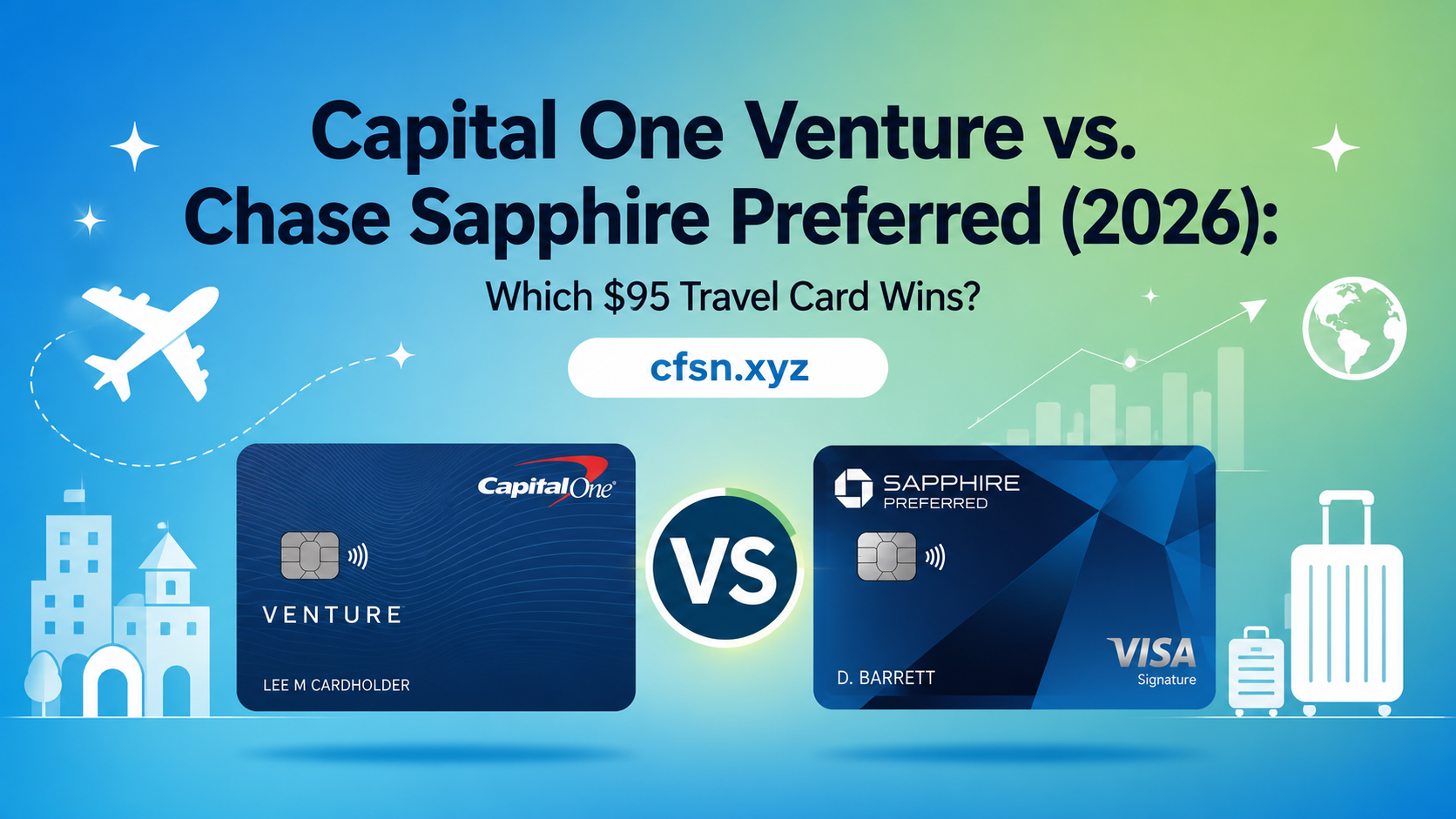
Meta description: Capital One Venture vs. Chase Sapphire Preferred in 2026 — we compare annual fees, welcome bonuses, earning rates, transfer partners, and travel protections to help you pick the right $95 travel credit card.
If you’ve narrowed your search for a mid-tier travel credit card down to two names, there’s a good chance those names are the Capital One Venture Rewards Credit Card and the Chase Sapphire Preferred® Card. Both charge a $95 annual fee. Both are marketed as the “starter” travel card that graduates into a long-term keeper. And both got meaningfully better in 2026 — Chase overhauled the Sapphire Preferred’s benefits in June 2026, while Capital One has quietly kept Venture’s flat-rate simplicity as its core selling point.
So which one actually deserves a spot in your wallet in 2026? The honest answer is: it depends on how you spend, how you like to redeem, and whether you value simplicity over optimization. This guide breaks down every angle — fees, bonuses, earning categories, transfer partners, insurance, lounge access, and real-world value — so you can make the call with confidence.
Quick Verdict: Capital One Venture vs. Chase Sapphire Preferred
| Category | Capital One Venture | Chase Sapphire Preferred |
|---|---|---|
| Annual fee | $95 | $95 |
| Foreign transaction fee | $0 | $0 |
| Welcome offer | 75,000 miles after $4,000 spend in 3 months | 100,000 points after $5,000 spend in 3 months (limited-time offer) |
| Base earning rate | 2X miles on everything | 1X point on everything |
| Bonus categories | 5X on Capital One Travel bookings, 5X Capital One Entertainment | 5X Chase Travel, 5X Lyft, 3X dining, 3X gas/EV charging, 3X vacation rentals, 3X select streaming/online groceries, 2X other travel |
| Annual travel credit | None built-in | $100 Chase Travel hotel credit |
| Global Entry/TSA PreCheck credit | Up to $120 every 4 years | Up to $120 every 4 years |
| Lounge access | 2 complimentary visits/year (Capital One + Plaza Premium) | None |
| Transfer partners | 15+ airline and hotel programs | 13+ airline and hotel programs |
| Trip cancellation/interruption coverage | Limited | Up to $10,000 per person / $20,000 per trip |
| Emergency medical evacuation coverage | Not standard | Up to $100,000 |
| Extra perks | Hertz Five Star status | Apple TV+ (1 year), DashPass subscription |
| Best for | Flat-rate simplicity, frequent flyers who want no-fuss earning | Category spenders who dine and travel often, and want deeper trip protection |
Now let’s dig into the details behind each of these categories.
Why These Two Cards Get Compared So Often
Capital One Venture and Chase Sapphire Preferred have been go-to recommendations in the travel card space for years, and it’s not a coincidence that they keep landing side by side in comparison articles. Both occupy the same pricing tier — a modest $95 annual fee that’s low enough for a casual traveler to justify, yet high enough to fund real benefits that a no-fee card simply can’t offer. Both are positioned as “gateway” travel cards: the product people graduate to after outgrowing a basic cash-back card, and the product many people hold onto for a decade rather than trading up to a $395-and-up premium card.
They also represent two different philosophies that show up again and again across the credit card industry. Capital One has built its entire consumer card lineup around predictable, flat-rate earning with minimal fine print. Chase, by contrast, has built an entire ecosystem — Ultimate Rewards points that pool across multiple Chase cards, a deep bench of airline and hotel transfer partners, and a rewards structure that reserves outsized value for cardholders willing to put in some strategy. Neither approach is inherently superior; they simply serve different kinds of spenders. Understanding that philosophical split is the fastest way to figure out which card actually fits your habits, rather than just chasing whichever one currently has the bigger headline bonus.
It’s also worth noting that both issuers treat these cards as entry points into larger card families. Capital One Venture sits below the $395-annual-fee Venture X in Capital One’s travel lineup, while Chase Sapphire Preferred sits below the more premium Chase Sapphire Reserve. If you eventually want lounge access beyond what Venture offers, or airport perks beyond what Sapphire Preferred offers, both issuers have a clear “next step” card waiting — but for now, we’re focused purely on the $95 tier where these two cards go head-to-head.
Annual Fee and Foreign Transaction Fees: A Dead Heat
There’s no daylight between these two cards on cost of entry. Both charge a $95 annual fee, and both waive foreign transaction fees entirely, which matters if you travel internationally — competing cards without this waiver typically tack on roughly 3% to every purchase made abroad. On a $3,000 international trip, that 3% fee would otherwise cost you about $90, so both cards are already paying for themselves before you’ve earned a single point or mile.
Neither card has a secret fee trap in the fine print, and neither one requires you to jump through hoops to avoid the annual fee (unlike some no-annual-fee cards that quietly raise APRs or restrict rewards). This category is a genuine tie — the differentiation happens entirely in how each card lets you earn and use its rewards.
Welcome Bonus: Chase Currently Has the Edge, With an Asterisk
As of mid-2026, the two welcome offers look like this:
- Capital One Venture: 75,000 bonus miles after spending $4,000 on purchases within the first 3 months of account opening. Capital One values this bonus at roughly $750 in travel when redeemed through Capital One Travel or as a statement credit against travel purchases.
- Chase Sapphire Preferred: 100,000 bonus points after spending $5,000 on purchases within the first 3 months of account opening. This is a limited-time offer tied to the card’s June 2026 refresh — Chase has only offered a six-figure Sapphire Preferred bonus three times in the card’s 17-year history, and third-party valuations have put it above $2,000 when the points are transferred to airline or hotel partners and redeemed strategically.
On paper, the Chase offer looks dramatically larger. A few caveats are worth flagging, though. First, Chase’s 100,000-point bonus is explicitly time-limited and could revert to a smaller offer (historically closer to 60,000 points) once the promotional period ends — so the number you see when you apply might be lower than what’s referenced here. Second, the $2,000-plus valuation assumes you transfer points to airline or hotel partners and book premium redemptions, which takes more research and flexibility than simply cashing out. Third, Chase requires a full $1,000 more in spending to trigger the bonus, which matters if your budget doesn’t stretch that far in three months.
Capital One’s bonus is smaller in raw point count but simpler to use at face value: miles redeem at a flat 1 cent each toward any travel purchase, so the 75,000-mile bonus is reliably worth $750 no matter how sophisticated your redemption strategy is.
Bottom line: if you can comfortably hit the higher spending threshold and you’re willing to learn a points-transfer strategy, Sapphire Preferred’s current bonus is the stronger short-term value. If you want a guaranteed, no-strategy-required payout, Venture’s bonus is smaller but rock-solid.
Everyday Earning Rates: Flat-Rate Simplicity vs. Category Optimization
This is where the two cards genuinely diverge in philosophy.
Capital One Venture’s earning structure
Venture is built around simplicity:
- 2X miles on every purchase, with no categories to track and no caps
- 5X miles on hotels, vacation rentals, and rental cars booked through Capital One Travel
- 5X miles on Capital One Entertainment purchases (concerts, sporting events, and similar experiences booked through the portal)
There’s no spreadsheet required. Whether you’re buying groceries, paying rent through a service that accepts cards, or booking a flight directly with an airline, you earn the same 2X rate. The only way to boost your earning is to route travel bookings through Capital One’s own portal.
Chase Sapphire Preferred’s earning structure (post-June 2026 refresh)
Sapphire Preferred rewards active planning and category-based spending:
- 5X points on travel booked through Chase Travel (flights, hotels, rental cars, vacation homes, cruises, activities, and tours)
- 5X points on Lyft rides (through September 30, 2027)
- 3X points on dining, including takeout and eligible delivery services
- 3X points on gas and EV charging (new as of June 2026)
- 3X points on vacation rentals booked directly through platforms like Airbnb and Vrbo (new as of June 2026)
- 3X points on select streaming services and online groceries
- 2X points on all other travel purchases not booked through Chase Travel
- 1X point on everything else
For someone who eats out regularly, commutes by rideshare, and books an occasional Airbnb, this structure can out-earn Venture’s flat 2X by a wide margin. A household that spends $500 a month on dining and groceries alone would earn 1,500 points a month from that spending on Sapphire Preferred, versus 1,000 miles on Venture for the same spending.
Who wins here depends entirely on your spending profile. If your spending is spread evenly across categories that don’t map to Chase’s bonus list — rent, utilities, insurance, big-box retail — Venture’s unconditional 2X will likely out-earn Sapphire Preferred’s 1X base rate. If a meaningful chunk of your budget goes toward dining, rideshare, gas, or vacation rentals, Sapphire Preferred’s bonus categories will pull ahead.
Annual Credits and Recurring Perks
This is one of the biggest differentiators after the June 2026 Sapphire Preferred refresh.
Chase Sapphire Preferred now bundles in:
- A $100 Chase Travel hotel credit each account anniversary year (doubled from $50 prior to the refresh), applied automatically to eligible hotel bookings made through the Chase Travel portal
- A complimentary one-year Apple TV+ subscription for cardholders who activate by December 31, 2026
- A complimentary DashPass subscription (minimum one year when activated by December 31, 2027), which removes delivery fees and reduces service fees on eligible DoorDash orders, plus a recurring $10 monthly promo credit on non-restaurant orders
- 5X points on Lyft rides through September 30, 2027
- 5X points on eligible Peloton equipment and accessories over $150, through December 31, 2027
Stack the $100 hotel credit with the Apple TV+ subscription (worth roughly $156 for a year) and the DashPass perks, and it’s easy to see how Chase argues the card “pays for itself” well beyond its $95 fee — provided you actually use these specific services.
Capital One Venture takes a different approach: instead of a grab-bag of lifestyle subscriptions, it offers two complimentary visits per year to Capital One Lounges and Plaza Premium Lounges. Given that single-visit day passes at airport lounges commonly run $50 or more, two visits alone can approach the value of the annual fee for travelers who fly often enough to use them. Venture also includes complimentary Hertz Five Star status, which offers faster rental car pickup and occasional vehicle upgrades — a small but genuinely useful perk for road-trippers.
The trade-off in plain terms: Sapphire Preferred’s bundle is worth more on paper if you subscribe to Apple TV+ and use DoorDash regularly, but much of that value evaporates if you don’t use those specific services. Venture’s lounge access has narrower appeal (you need to actually pass through airports with a participating lounge) but delivers real, tangible value to road warriors without requiring any extra sign-up or activation steps.
Global Entry, TSA PreCheck, and NEXUS Credits
Both cards are now evenly matched here. As part of its June 2026 update, Chase added a statement credit of up to $120 every four years toward Global Entry, TSA PreCheck, or NEXUS application fees — closing a gap that had long been a point of criticism against Sapphire Preferred, since competitors including Capital One Venture had offered a similar credit for years.
Capital One Venture continues to offer the same $120 credit every four years, fully covering the $120 Global Entry fee or the $78 TSA PreCheck fee (with room to spare).
Practically speaking, this is a wash. Frequent international travelers should apply for Global Entry (which includes TSA PreCheck) rather than TSA PreCheck alone, since it delivers more value for the same credit on either card.
Travel Protections and Insurance: Sapphire Preferred Pulls Ahead
If something goes wrong on a trip — a canceled flight, a delayed bag, a medical emergency far from home — this is the category that actually matters most, and it’s also where the two cards diverge the most sharply.
Chase Sapphire Preferred’s protections (post-refresh):
- Trip cancellation and interruption insurance: reimbursement up to $10,000 per covered traveler and $20,000 per trip for prepaid, non-refundable expenses if a trip is canceled or cut short due to covered reasons like illness or severe weather
- Baggage delay reimbursement: up to $100 a day for up to 5 days (up to $500 total) for essential purchases when checked luggage is delayed more than 6 hours
- Emergency evacuation and transportation coverage (new in 2026): up to $100,000 in coverage if a covered traveler is injured or becomes seriously ill 100+ miles from home and requires emergency evacuation
- Standard purchase protection and extended warranty coverage on eligible purchases made with the card
Capital One Venture’s protections:
- Travel accident insurance
- Rental car coverage for physical damage and theft on eligible rentals
- Lost luggage reimbursement for the actual cost of repairing or replacing checked or carry-on luggage and its contents
- 24-hour, toll-free travel assistance covering services like towing, gas delivery, jump-starts, and tire changes
- 24/7 access to emergency legal, medical, and transportation assistance while traveling (with the cardholder responsible for costs of any referred services)
- Extended warranties on eligible purchases
The difference is significant. Sapphire Preferred’s trip cancellation/interruption coverage and its new emergency evacuation benefit are considerably more robust than what Venture offers, and they don’t require any redemption strategy to access — you simply need to have paid for the trip with the card. For travelers who book non-refundable flights and hotels regularly, or who travel to remote destinations where medical evacuation is a realistic concern, Sapphire Preferred’s insurance suite alone can justify choosing it over Venture.
Redeeming Rewards: Flat-Value Simplicity vs. Transfer Partner Flexibility
How Capital One miles work
Capital One Venture miles are refreshingly simple:
- Redeem at a fixed rate of 1 cent per mile toward any travel purchase already charged to the card (the “Purchase Eraser” model), or book directly through Capital One Travel
- Transfer to 15+ airline and hotel loyalty programs at varying ratios (commonly 1:1, occasionally better) if you want to stretch your miles further for premium cabin or hotel redemptions
- Miles never expire as long as the account stays open
The flat 1-cent value is a genuine strength for people who don’t want to research transfer partner sweet spots. You’ll never get a bad deal, but you also won’t unlock the outsized value that comes from transferring points into, say, a premium international business-class award.
How Chase Ultimate Rewards points work
Sapphire Preferred points are more flexible but require more attention:
- Redeem directly for travel through the Chase Travel portal, where points are typically worth about 1.25 cents each for Sapphire Preferred cardholders — a built-in bonus over Venture’s flat rate
- Transfer to 13+ airline and hotel partners at a 1:1 ratio, including well-regarded programs where a single transfer can be worth well over 2 cents per point for the right redemption
- Redeem for cash back, gift cards, or shopping, though these options return less value per point than travel redemptions
The 1.25-cent baseline through Chase Travel already gives Sapphire Preferred a small structural edge over Venture’s flat 1-cent value, even before factoring in transfer partner potential. For cardholders willing to learn a handful of “sweet spot” transfers, Chase points can regularly be worth 1.5 to 2+ cents each — a ceiling Venture’s flat-rate system simply can’t match.
The trade-off: Chase’s system rewards research and flexibility with a higher ceiling. Capital One’s system rewards simplicity with a reliable floor. Neither approach is objectively better — it depends on how much time you’re willing to spend optimizing redemptions.
Lounge Access and Airport Perks
This category isn’t close. Capital One Venture includes two complimentary visits per year to Capital One Lounges and Plaza Premium Lounges — a real, no-activation-needed perk for travelers who pass through airports with participating locations (Capital One has been steadily expanding its own branded lounge network in major U.S. hubs).
Chase Sapphire Preferred does not include any lounge access. This is intentional positioning by Chase — lounge access is reserved for the pricier Chase Sapphire Reserve®, which carries a substantially higher annual fee. If lounge access matters to you and you don’t want to pay a premium-tier annual fee, Venture has a clear structural advantage here.
Credit Score and Approval Odds
Both cards target similar applicant profiles. Capital One typically looks for excellent credit, generally a FICO score of 740 or higher, though approval also weighs income and existing credit relationships. Chase Sapphire Preferred applicants are also generally expected to have good to excellent credit, and Chase applies its well-known 5/24 rule — if you’ve opened five or more new credit card accounts (from any issuer) in the past 24 months, you’re likely to be automatically denied regardless of your credit score. Capital One does not have a publicly codified rule equivalent to 5/24, though it does have its own velocity restrictions on how often you can be approved for new cards or earn a welcome bonus on the same product again.
If you’re an active credit card churner who opens new accounts frequently, check your 5/24 status before applying for Sapphire Preferred — it’s a common reason otherwise well-qualified applicants get denied.
Which Card Should You Actually Choose?
There’s no single right answer, but here’s how to think about it based on your travel and spending habits.
Choose Capital One Venture if:
- You want a genuinely simple card: one earning rate, no categories to track, and a mile that’s always worth 1 cent
- You fly often enough to use two free lounge visits a year and want that perk without paying for a premium card
- You rent cars frequently and want Hertz status baked in
- You’d rather not spend time researching transfer partner sweet spots
- Your spending doesn’t naturally concentrate in dining, gas, or rideshare categories
Choose Chase Sapphire Preferred if:
- You spend meaningfully on dining, gas/EV charging, rideshare, or vacation rentals and want to earn accelerated points on that spending automatically
- You want the strongest trip protection available at this price point, including the new emergency evacuation coverage
- You’re willing to learn Chase’s transfer partners to unlock outsized redemption value
- You’ll actually use the Apple TV+ subscription and DashPass perks, effectively lowering your real-world cost below $95
- You can meet the current $5,000 minimum spend to capture the elevated welcome bonus
Consider both, eventually
A number of experienced points-and-miles travelers end up holding both cards rather than choosing one. Because they come from different issuers with different reward currencies, there’s no overlap penalty, and each card is genuinely strongest in different categories: Sapphire Preferred for dining, travel, and rideshare; Venture for everything that falls outside a defined bonus category, plus its lounge access. If your budget supports two $95 annual fees, running them side by side can out-earn either card alone.
Frequently Asked Questions
Is Capital One Venture or Chase Sapphire Preferred better for beginners? Capital One Venture is generally easier for a first-time travel card holder because the flat 2X earning rate and 1-cent-per-mile redemption require no strategy. Chase Sapphire Preferred rewards a bit more research to get full value from its bonus categories and transfer partners.
Which card has the better welcome bonus right now? As of mid-2026, Chase Sapphire Preferred’s limited-time offer of 100,000 points after $5,000 in spending is larger in both raw point count and estimated dollar value than Capital One Venture’s 75,000-mile offer. Confirm current terms before applying, since Chase’s elevated offer is promotional and subject to change.
Do both cards charge foreign transaction fees? No. Neither Capital One Venture nor Chase Sapphire Preferred charges a foreign transaction fee, making both solid choices for international travel.
Which card offers airport lounge access? Only Capital One Venture includes complimentary lounge visits (two per year, at Capital One Lounges and Plaza Premium Lounges). Chase Sapphire Preferred does not include lounge access; that benefit is reserved for the pricier Chase Sapphire Reserve.
Which card has better travel insurance? Chase Sapphire Preferred offers more robust protection, including trip cancellation/interruption coverage up to $10,000 per person and $20,000 per trip, plus new emergency evacuation coverage up to $100,000. Capital One Venture’s protections are more modest, focused on travel accident insurance, rental car coverage, and lost luggage reimbursement.
Can I transfer points or miles from these cards to airline programs? Yes, both cards support transfers. Capital One Venture partners with 15+ airline and hotel loyalty programs, while Chase Sapphire Preferred partners with 13+ programs, generally at a 1:1 transfer ratio.
Is the $95 annual fee worth it for either card? For most travelers who use even a portion of the built-in credits and bonus categories, yes. Chase Sapphire Preferred’s $100 annual hotel credit alone can exceed the annual fee, and Capital One Venture’s two lounge visits can do the same for road warriors — before even counting the ongoing rewards earned on everyday spending.
A Real-World Spending Example
Numbers on a comparison chart only tell part of the story, so it helps to run a hypothetical month of spending through both cards.
Imagine a traveler who spends $400 on dining out, $200 on gas, $150 on a Lyft habit, $300 booking a flight directly with an airline (not through a portal), and $950 on everything else — groceries, utilities, subscriptions, and miscellaneous purchases. That’s $2,000 in total monthly spending.
On Capital One Venture, all $2,000 earns the flat 2X rate, for 4,000 miles, worth a reliable $40 at Venture’s 1-cent redemption value.
On Chase Sapphire Preferred, the same spending breaks down by category: $400 in dining earns 3X (1,200 points), $200 in gas earns 3X (600 points), $150 in Lyft earns 5X (750 points), $300 in airfare booked directly (not through Chase Travel) earns 2X (600 points), and the remaining $950 in uncategorized spending earns 1X (950 points). That totals 4,100 points — worth roughly $41 at Chase Travel’s 1.25-cent redemption rate, or potentially more through a well-timed transfer partner redemption.
In this particular scenario, the two cards land in a near dead heat on raw earning, with Sapphire Preferred pulling slightly ahead once its 1.25-cent Chase Travel redemption value is factored in. But shift the spending mix even slightly — say, more of that $950 in “everything else” and less in Sapphire Preferred’s bonus categories — and Venture’s flat 2X pulls ahead quickly, since Chase’s 1X base rate on uncategorized spending is where the card is weakest relative to Venture. This is exactly why there’s no universal winner: the card that earns more for you depends entirely on how your own budget is shaped, not on which card has the flashier list of bonus categories on paper.
Final Take
Capital One Venture and Chase Sapphire Preferred both deliver strong value for a $95 annual fee, but they’re built for different kinds of travelers. Venture is the card for someone who wants to earn consistently without thinking about it and who values lounge access more than a deep bench of travel insurance. Sapphire Preferred is the card for someone whose spending naturally lines up with its bonus categories, who wants stronger trip protection, and who doesn’t mind putting in a little effort to squeeze extra value out of point transfers.
Terms, bonus categories, and welcome offers on both cards can and do change — Chase’s June 2026 refresh is proof of how quickly a card’s value proposition can shift. Before applying for either card, check the issuer’s official page for the most current rates, fees, and offer terms.
This article is for informational purposes only and does not constitute financial advice. Card terms, rewards rates, and welcome offers are subject to change; always verify current details directly with Capital One or Chase before applying.