Introduction
For millions of traders and investors around the world, understanding what a market is doing right now, and what it might do next, starts with a chart. Long before algorithms and news headlines take over the conversation, price action itself tells a story, and reading that story well requires the right tools. Few platforms have shaped how modern traders read that story as significantly as TradingView.
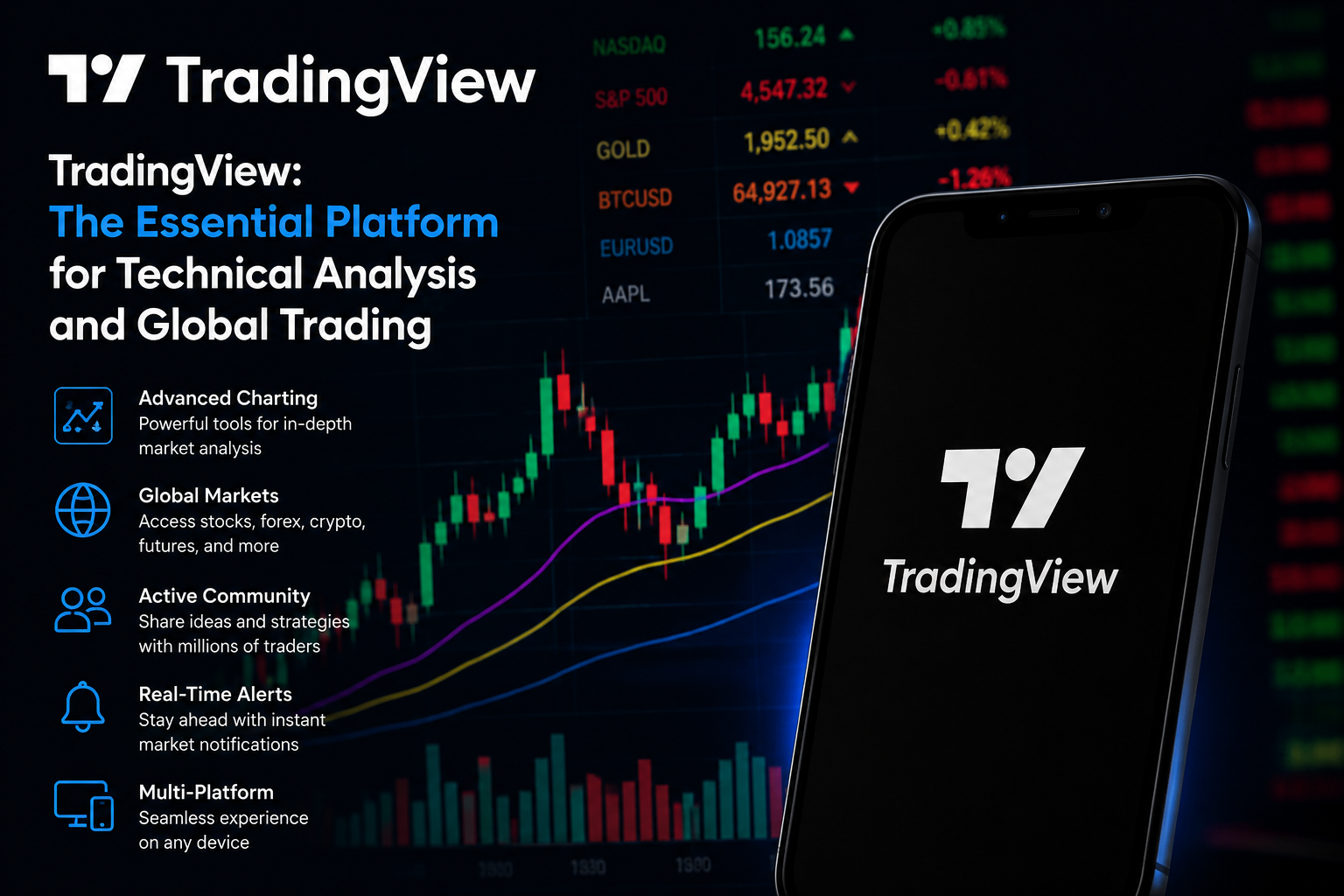
Launched in 2011 as a cloud-based charting platform, TradingView has grown into one of the most widely used tools in the entire financial industry, serving retail traders, professional analysts, and even brokers who integrate its charting technology directly into their own platforms. With coverage spanning stocks, forex, futures, bonds, cryptocurrencies, and more, combined with a massive library of technical indicators and a uniquely social approach to market analysis, TradingView has earned its reputation as an essential platform for technical analysis and global trading.
This article takes an in-depth look at what TradingView is, how it works, its most valuable features, and why it continues to be considered one of the best charting platforms available in 2026.
What Is TradingView?
TradingView is a cloud-based charting, market data, and social platform that gives traders and investors access to real-time and historical price data across a huge range of global markets. Because it is entirely web-based, users can access the full feature set of the platform directly through a browser, without needing to install dedicated desktop software, while still being able to use dedicated iOS, Android, and desktop applications if they prefer a native experience.
Unlike platforms that are narrowly focused on a single asset class or a single broker’s own trading infrastructure, TradingView positions itself as a universal charting and analysis layer that sits on top of the broader financial markets. It provides data and charting tools for equities, foreign exchange, futures, bonds, and cryptocurrencies, and it can be connected to a range of external brokers, allowing many users to move from analysis directly into trade execution without needing to switch between separate applications.
At its core, TradingView is built around three pillars: powerful and highly customizable charting tools, a vast and active community of traders sharing ideas and strategies, and a growing set of automation and workflow features designed to help traders move efficiently from analysis to action.
The Evolution of TradingView
Since its founding, TradingView has continuously expanded from a relatively simple charting tool into a much broader financial research and trading workspace. What began as a way to view clean, responsive price charts in a browser has grown to include an enormous library of technical indicators, a proprietary scripting language for building custom tools, and deep integrations with brokers that allow trades to be executed directly from the chart.
More recently, TradingView has placed significant emphasis on artificial intelligence, introducing features designed to help traders interpret market-moving events more quickly. This includes AI-generated summaries of corporate filings and other market catalysts, as well as an experimental AI charting assistant designed to help users construct charts, apply indicators, and interpret market conditions through natural conversation rather than manually configuring every setting. While some of these AI features remain in earlier stages of development, their introduction reflects a broader direction: TradingView is positioning itself not just as a charting tool, but as an increasingly intelligent research and workflow platform.
Alongside its AI expansion, the platform has continued to strengthen its coverage of alternative asset classes such as bonds and broader macroeconomic data, along with ongoing improvements to alerting, portfolio tracking, and direct broker connectivity. Together, these updates show a platform that has evolved well beyond its original identity as a simple charting tool.
Core Features of TradingView
1. Advanced, Customizable Charting
TradingView’s charting engine remains its most defining feature. The platform offers a highly responsive, drag-and-drop interface that allows users to build a workspace exactly the way they want it, arranging multiple charts, watchlists, and indicators across a single screen. Traders can quickly zoom in on price action, layer multiple indicators onto a single chart, and switch between different assets in just a few clicks, all without the interface feeling overly cluttered for less experienced users.
2. A Massive Library of Indicators and Drawing Tools
TradingView offers several hundred pre-built technical indicators, along with well over a hundred drawing tools, giving traders an extensive toolkit for analyzing price behavior from nearly any technical perspective. This includes widely used tools like moving averages, momentum oscillators, and volume-based indicators, as well as more specialized tools such as anchored VWAP, Renko charts, and point-and-figure charting, all available directly out of the box.
3. Pine Script for Custom Indicators and Strategies
One of TradingView’s most powerful features is Pine Script, its proprietary programming language designed specifically for building custom technical indicators and automated trading strategies. Pine Script allows traders with programming knowledge to design highly specific tools tailored to their own trading approach, and to backtest those strategies against historical data before ever risking real capital. This scripting capability has also fueled a large ecosystem of community-built indicators, many of which are shared publicly for other users to apply to their own charts.
4. Paper Trading for Risk-Free Practice
For traders who want to test a strategy or become familiar with the platform before committing real money, TradingView offers a paper trading feature that simulates live trading conditions using virtual funds. This allows users to practice executing trades, managing positions, and following a specific strategy in a realistic environment without financial risk, making it a valuable tool for both beginners and experienced traders testing a new approach.
5. Broker Integration and Direct Trade Execution
TradingView can be connected directly to a range of external brokers, allowing users to execute real trades from within the charting interface itself. This integration means traders can move seamlessly from identifying an opportunity on the chart to placing an order, without needing to switch to a separate trading platform, which can be a meaningful advantage in fast-moving markets where timing matters.
6. A Built-In Stock and Asset Screener
TradingView includes a powerful screener that allows users to filter stocks, cryptocurrencies, and other assets based on a wide range of technical and fundamental criteria. This makes it possible to systematically scan an entire market for assets matching a specific set of conditions, rather than manually checking individual charts one at a time, which is particularly useful for traders following a structured, criteria-based strategy.
7. Multi-Asset, Multi-Market Coverage
TradingView’s data coverage spans a huge range of markets, including global equities, forex pairs, futures contracts, bonds, and cryptocurrencies. This breadth allows a single user to research and monitor multiple asset classes from a unified interface, rather than needing separate platforms for stocks, crypto, and other instruments. The platform’s coverage also extends well beyond major Western markets, including significant coverage of exchanges and instruments across Asia and other regions.
8. A Vibrant Social and Idea-Sharing Community
Unlike most traditional charting platforms, TradingView incorporates a strong social element, allowing users to publish and share trading ideas, custom indicators, and market analysis with the broader community. This social layer allows traders to learn from one another, compare interpretations of the same chart, and discover new indicators or strategies developed by other members of the platform. As with any community-driven content, not every shared idea is equally credible, so users are encouraged to apply their own judgment when evaluating strategies shared by other members.
9. Flexible Alerts Across Devices
TradingView’s alert system allows a single, well-configured alert to monitor conditions across potentially hundreds of symbols within a watchlist simultaneously, notifying the user across email, browser, or mobile app the moment specified conditions are met. Alerts continue to function even when new symbols are added after the initial setup, giving traders a reliable way to stay informed about market-moving conditions without needing to constantly watch the screen.
10. Fundamental Data and News Integration
Beyond pure technical analysis, TradingView also provides access to fundamental data across major stock exchanges, along with an integrated news section that keeps users updated on developments that may affect the assets they are tracking. This combination of technical charting, fundamental data, and real-time news allows traders to build a more complete picture of a given asset without needing to constantly switch between separate research tools.
11. Expanding AI-Powered Tools
TradingView’s more recent updates have introduced AI-driven features designed to speed up research and interpretation. This includes AI-generated summaries of significant corporate events and regulatory filings, helping traders quickly understand the potential market impact of new information, as well as an evolving AI charting assistant intended to help users configure charts and interpret market conditions through natural language rather than manual configuration alone.
Why Traders Rely on TradingView
A Genuinely Global View of the Markets
Because TradingView aggregates data across such a wide range of asset classes and geographic markets, it allows traders to maintain a single, consistent view of global market activity rather than needing a patchwork of different tools for different regions or asset types. This is particularly valuable for traders who follow multiple markets simultaneously or who want to compare price action across related assets on different exchanges.
An Approachable Learning Curve for Newcomers
Despite its depth, TradingView has been consistently praised for how quickly new users can become comfortable with the platform. Built-in tutorials, an intuitive drag-and-drop interface, and a clean default layout mean that new traders do not need to read an extensive manual before they can begin building their first chart, while more advanced users can progressively unlock the platform’s deeper capabilities as their skills grow.
A Platform That Grows With the Trader
Because TradingView offers a free tier alongside several progressively more advanced paid tiers, new users can begin exploring the platform’s core functionality at no cost, then upgrade as their needs become more sophisticated, whether that means accessing more simultaneous chart layouts, a larger number of indicators per chart, or more advanced alerting capabilities. This tiered structure allows the platform to serve casual chart-watchers and professional analysts alike, without forcing either group into an ill-fitting pricing model.
Community-Driven Innovation
The scale of TradingView’s user base has created a uniquely large and active ecosystem of shared trading ideas, custom indicators, and public strategy scripts. This community-driven layer means that the platform’s capabilities are not solely defined by its own internal development team, but are constantly being extended by outside contributors building tools that solve specific, real-world trading problems.
How to Get Started With TradingView
- Create a Free Account. Sign up for TradingView’s free tier to begin exploring the platform’s core charting tools and market data.
- Explore the Default Interface. Spend some time familiarizing yourself with the drag-and-drop workspace, watchlists, and default chart layout before adding additional tools.
- Add Indicators and Drawing Tools. Begin layering in technical indicators and drawing tools relevant to your particular trading or investing approach.
- Build a Watchlist. Add the specific stocks, cryptocurrencies, or other assets you want to track regularly to a personalized watchlist.
- Set Up Alerts. Configure alerts based on specific price levels, indicator conditions, or other criteria relevant to your strategy, so you can be notified without needing to constantly monitor the chart.
- Try Paper Trading. Before committing real capital, use the paper trading feature to practice executing a strategy under realistic, simulated market conditions.
- Connect a Broker (Optional). If you want to execute real trades directly from the platform, connect a supported broker account to enable direct order placement from the chart.
- Upgrade as Needed. As your needs grow more advanced, consider upgrading to one of TradingView’s paid tiers to unlock additional indicators, chart layouts, and alert capacity.
TradingView’s Pricing Tiers
TradingView generally structures its subscription plans around four main tiers, each progressively unlocking a greater number of indicators per chart, additional simultaneous chart layouts, a larger number of active alerts, and other advanced capabilities. The free tier provides access to core charting functionality, making it possible for a new user to explore the platform meaningfully before deciding whether a paid upgrade is worthwhile. As with any subscription-based platform, exact pricing and the specific features included in each tier can change over time, so traders should always verify current details directly on TradingView’s official website before subscribing.
Who Is TradingView Built For?
Active Traders Focused on Technical Analysis
TradingView is most strongly associated with active traders who rely heavily on technical analysis, particularly within stocks and cryptocurrencies, though its coverage extends well beyond those two asset classes. Its combination of extensive charting tools, custom scripting, and direct broker connectivity makes it especially well suited to traders who want to move quickly from analysis to execution.
Long-Term, Fundamentals-Focused Investors
While TradingView is primarily built with active, technically focused traders in mind, longer-term investors can still make effective use of the platform’s free charting tools to help identify reasonable entry and exit points for a long-term position, even if they are not the platform’s primary target audience.
Professional Analysts and Institutions
Because of its multi-asset coverage, customizable workspace, and Pine Script scripting capabilities, TradingView is also used by professional analysts who need to monitor multiple markets simultaneously and build highly specific custom tools tailored to their own research process.
Strategy Developers and Quantitative Traders
Pine Script’s ability to backtest custom strategies against historical data makes TradingView a valuable tool for traders interested in systematic or rules-based approaches, allowing them to evaluate how a given strategy would have performed historically before committing real capital to it.
Limitations to Keep in Mind
While TradingView offers an extensive set of capabilities, it is worth understanding a few limitations before relying on it as a complete trading solution:
Real-time data costs. While the platform’s free tier provides substantial functionality, access to certain real-time data feeds, particularly for specific exchanges, may require additional paid data subscriptions, which can add to the overall cost for active traders who rely on multiple markets.
Not a full brokerage on its own. While TradingView allows direct trade execution through connected brokers, it is fundamentally a charting and analysis platform rather than a brokerage itself, meaning actual account funding, custody, and regulatory relationships remain with the connected broker rather than with TradingView directly.
Variable quality of community content. Because TradingView’s social features allow any user to publish trading ideas and custom indicators, the quality and reliability of shared content can vary considerably, and not every publicly shared strategy is well-tested or credible.
Early-stage AI features. Some of TradingView’s newer AI-powered tools remain in earlier stages of development and may not yet offer the same reliability as the platform’s more established charting and analysis features.
Customer support experience. Some users have noted that customer support responsiveness has been an area of criticism, which is worth factoring in for traders who anticipate needing frequent direct assistance from the platform.
TradingView vs. Broker-Specific Charting Tools
Many brokers offer their own built-in charting tools, but these are typically limited to the specific markets and instruments that broker supports, and often lack the depth of indicators, custom scripting, and social features found on TradingView. By using TradingView as a broker-agnostic charting layer, and connecting it to a supported broker when ready to trade, users can access a consistently powerful analysis experience regardless of which specific broker they ultimately choose to execute trades through. This flexibility is one of the key reasons TradingView has become a near-universal reference point across the trading community, even among traders who do not use it for direct trade execution at all.
Common Use Cases for TradingView
Day Trading and Short-Term Technical Analysis
For day traders, TradingView’s real-time charting, extensive indicator library, and fast alerting system make it possible to react quickly to short-term price movements. The ability to layer multiple timeframes and indicators onto a single chart helps active traders identify entry and exit points with a level of precision that would be difficult to achieve using a broker’s more basic built-in charting tools.
Swing Trading Across Multiple Assets
Swing traders, who typically hold positions for several days or weeks rather than minutes or hours, benefit from TradingView’s ability to monitor multiple watchlists and asset classes simultaneously. The platform’s screener functionality is particularly useful for this style of trading, allowing users to systematically identify assets that meet specific technical criteria for a potential swing trade, rather than manually reviewing charts one at a time.
Long-Term Portfolio Monitoring
Even investors who are not actively trading on a short-term basis often use TradingView simply to monitor the overall health of a long-term portfolio. Custom watchlists, fundamental data, and integrated news coverage allow long-term investors to stay informed about developments affecting their holdings, without needing a dedicated technical trading background.
Strategy Development and Backtesting
For traders interested in systematic or rules-based approaches, Pine Script offers a genuine strategy development environment. Traders can codify a specific set of entry and exit rules, then test that strategy against years of historical data before ever risking real capital, helping to separate strategies with genuine statistical merit from those that simply look appealing on a chart in hindsight.
Cross-Market Comparison and Correlation Analysis
Because TradingView aggregates data across so many different asset classes and global markets, it is particularly well suited to traders and analysts who want to study relationships between different markets, such as how a currency pair might correlate with a particular commodity, or how a specific stock might move relative to a broader sector index.
Making the Most of TradingView’s Community Features
TradingView’s social layer is often underused by newer traders who focus solely on the charting tools themselves. Learning to engage with the community effectively can meaningfully expand what a trader gets out of the platform.
Follow analysts whose track record you trust. Rather than treating every shared idea equally, it is worth following specific contributors over time to assess whether their historical analysis has proven accurate, rather than reacting to any single published idea in isolation.
Study, don’t copy, shared strategies. Publicly shared Pine Script strategies and custom indicators can be valuable learning tools, but should generally be studied and understood, or independently backtested, rather than applied blindly to real trading decisions.
Use published ideas as a starting point for your own analysis. Community-shared chart analysis can highlight technical setups or levels a trader might not have noticed independently, but the most effective use of this content is as a prompt for further independent research rather than as a final trading signal.
Contribute your own analysis over time. Traders who regularly publish their own ideas often report that the discipline of clearly explaining their reasoning to a public audience helps sharpen their own analytical process, independent of any feedback they receive from the community.
Quick Comparison: TradingView at a Glance
| Category | Details |
|---|---|
| Founded | 2011 |
| Platform type | Cloud-based charting, market data, and social trading platform |
| Access | Web browser, plus dedicated iOS, Android, and desktop apps |
| Asset coverage | Stocks, forex, futures, bonds, and cryptocurrencies across more than 100 countries |
| Core tools | Advanced charting, hundreds of indicators, over 100 drawing tools, Pine Script |
| Automation | Custom strategy backtesting, flexible cross-symbol alerts |
| Practice tools | Built-in paper trading with simulated funds |
| Trade execution | Direct integration with a range of external brokers |
| Pricing | Free tier plus four progressively advanced paid tiers |
| Best suited for | Active technical traders, strategy developers, multi-asset analysts |
| Less suited for | Traders who need account custody or brokerage services built directly into the platform itself |
Frequently Asked Questions
Is TradingView free to use? Yes. TradingView offers a free tier that provides access to core charting tools and market data, with several paid tiers available for traders who want additional indicators, chart layouts, and alert capacity.
Can I trade directly from TradingView? Yes. TradingView supports direct broker integrations that allow users to execute real trades from within the charting interface, moving seamlessly from analysis to execution without switching platforms.
What is Pine Script? Pine Script is TradingView’s proprietary scripting language, used to build custom technical indicators and automated trading strategies, including the ability to backtest those strategies against historical market data.
Does TradingView cover cryptocurrencies? Yes. TradingView provides charting and market data for a wide range of cryptocurrencies, alongside its coverage of stocks, forex, futures, and bonds.
Is TradingView suitable for beginners? Yes. Despite its depth, TradingView is generally considered approachable for beginners thanks to its clean default interface, built-in tutorials, and free tier, though its deeper features are primarily designed with active, technically focused traders in mind.
Does TradingView offer paper trading? Yes. TradingView includes a paper trading feature that allows users to practice trading strategies using simulated funds before committing real capital.
Is community-shared content on TradingView reliable? Not always. While TradingView’s community features offer valuable opportunities to learn from other traders, the quality of shared ideas and strategies varies, and users should apply their own judgment before relying on any publicly shared analysis or strategy.
The Broader Role of TradingView in Modern Trading Culture
Beyond its technical capabilities, TradingView has played a notable role in shaping how an entire generation of traders learns and communicates about the markets. Before platforms like this existed, technical analysis was often something learned in isolation, through books, paid courses, or one-on-one mentorship. TradingView’s public idea-sharing features have turned that process into something far more visible and collaborative, allowing newer traders to observe how more experienced analysts approach a chart in real time, and to compare their own interpretations against a broad and active community.
This cultural shift has also changed how quickly new indicators, strategies, and analytical techniques spread throughout the trading community. A useful custom indicator built by one trader using Pine Script can be published, discovered, and adopted by thousands of other users within a short period of time, accelerating the pace at which new analytical approaches are tested and refined. While this openness naturally comes with the previously mentioned caveat that not all shared content is equally reliable, it has undeniably lowered the barrier for traders to learn from one another at a scale that would have been difficult to imagine in earlier eras of retail trading.
Conclusion
TradingView has earned its position as one of the most essential platforms in modern trading by combining powerful, highly customizable charting tools with a uniquely social approach to market analysis and a rapidly expanding set of workflow and automation features. From its extensive library of indicators and custom Pine Script capabilities to its direct broker integrations and growing AI-powered tools, the platform offers a level of depth that appeals to casual chart-watchers and professional analysts alike.
While it is not without limitations, including additional costs for certain real-time data feeds and variability in the quality of community-shared content, TradingView’s continued evolution shows a clear commitment to remaining at the center of how traders around the world read, interpret, and act on market data. For anyone serious about technical analysis, whether trading stocks, forex, futures, bonds, or cryptocurrencies, TradingView remains one of the clearest examples of a platform that has become genuinely indispensable to the global trading community.
Ultimately, the value of any charting platform comes down to how effectively it helps a trader turn raw price data into a clear, actionable understanding of the market. TradingView’s combination of depth, flexibility, and community insight gives traders at every level of experience the tools they need to build that understanding for themselves, whether they are placing their very first trade or refining a strategy they have used for years.
This article is for informational purposes only and does not constitute financial or investment advice. Trading and investing involve risk, including the potential loss of capital, and readers should conduct their own independent research before making any financial decisions.