Introduction
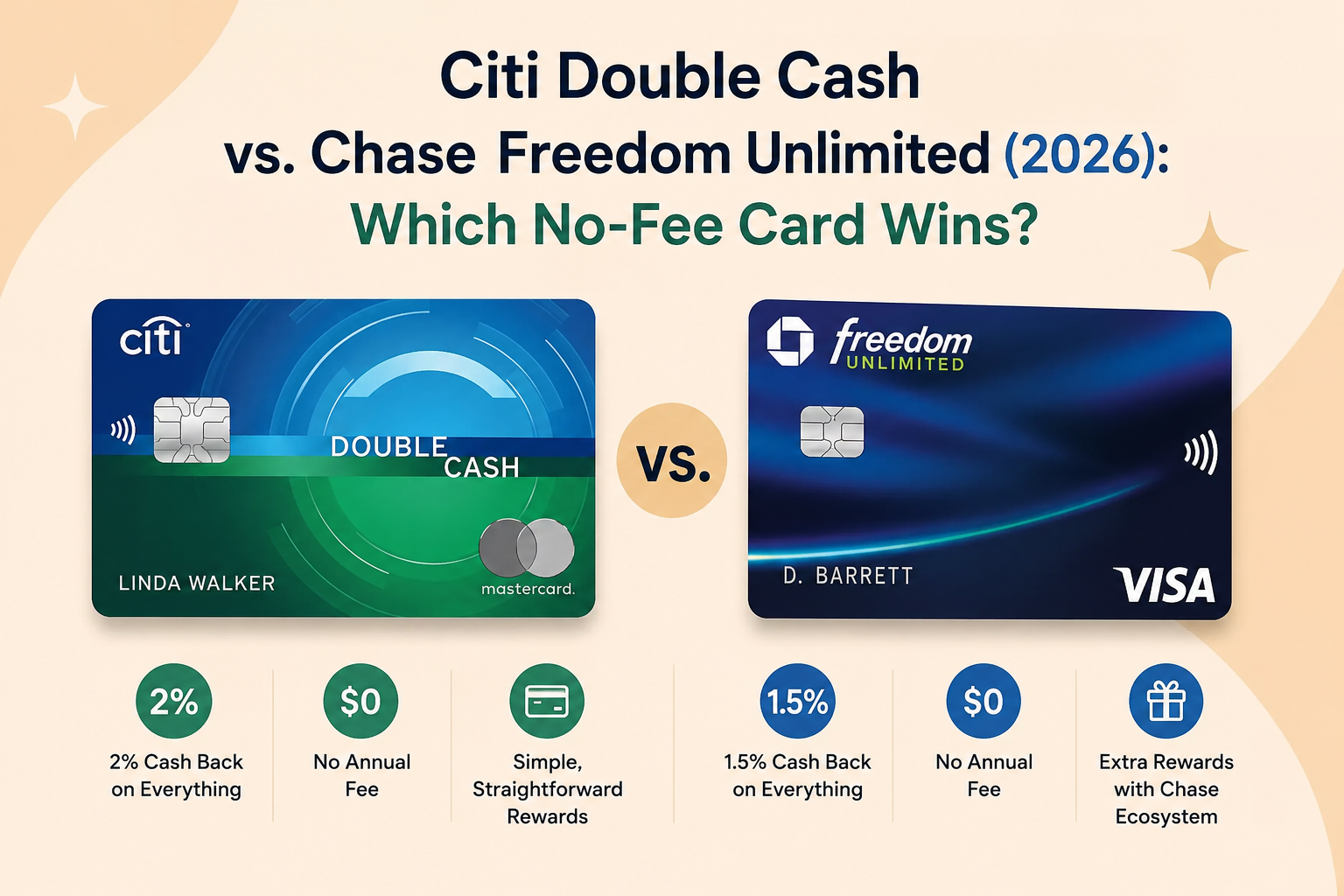
When it comes to no-annual-fee cash back credit cards, two names consistently rise to the top of nearly every comparison list: the Citi Double Cash Card and the Chase Freedom Unlimited. Both cards have earned a reputation as some of the best all-around rewards cards available to everyday consumers, and both manage to deliver strong value without charging a cent in annual fees.
But despite their similar reputations, these two cards are built around genuinely different rewards philosophies. The Citi Double Cash rewards simplicity above all else, offering a flat cash back rate on every single purchase with no categories to track. The Chase Freedom Unlimited, on the other hand, layers bonus categories on top of a solid base rate, rewarding cardholders who spend more heavily in specific areas like dining, drugstores, and travel booked through Chase.
So which card actually wins in 2026? The honest answer is that it depends heavily on your spending habits, but this guide will walk through every important factor, including rewards rates, welcome bonuses, redemption flexibility, fees, and overall value, to help you decide which card deserves a spot in your wallet.
Citi Double Cash: Overview
The Citi Double Cash Card has long been considered one of the gold standards of flat-rate cash back cards. Its central selling point is refreshingly simple: cardholders earn 2% cash back on every purchase, structured as 1% when a purchase is made and an additional 1% when that purchase is paid off. This “buy and pay” structure means the full 2% is only realized once the cardholder actually pays their statement balance, which is an important detail to understand, though it rarely changes the practical value of the card for anyone who pays their bill regularly.
Because there are no bonus categories to activate or track, the Double Cash appeals strongly to consumers who simply want a dependable, no-fuss card that rewards every purchase equally, regardless of where that purchase is made. Rewards accumulate as Citi ThankYou Points, which can be redeemed as a statement credit, direct deposit, or check, and which can become significantly more valuable if paired with certain other Citi cards that unlock the ability to transfer points to airline and hotel partners.
Chase Freedom Unlimited: Overview
The Chase Freedom Unlimited takes a different approach, combining a strong base cash back rate with a set of always-on bonus categories rather than a single flat rate across the board. Cardholders earn an unlimited 1.5% cash back on general purchases, but that rate jumps significantly higher in several everyday categories: 5% cash back on travel purchased through Chase Travel, and 3% cash back on both dining (including takeout and eligible delivery) and drugstore purchases. Unlike some other Chase cards that require quarterly activation of rotating 5% categories, these enhanced rates on the Freedom Unlimited apply automatically, with no activation required.
Like the Double Cash, rewards are earned in a points-based system, in this case Chase Ultimate Rewards points, which can be redeemed for cash back at a straightforward 1-cent-per-point rate. However, the Freedom Unlimited’s real potential is unlocked when it is paired with a premium Chase card that allows for full point transferability, turning what would otherwise be simple cash back into a more flexible travel rewards currency.
Rewards Rate Breakdown
Citi Double Cash Rewards Structure
- 2% cash back on every purchase (1% at the time of purchase, 1% when the balance is paid)
- No bonus categories, no spending caps, no activation required
- Rewards apply identically whether spending on groceries, dining, travel, or anything else
Chase Freedom Unlimited Rewards Structure
- 5% cash back on travel purchased through Chase Travel
- 3% cash back on dining at restaurants, including takeout and eligible delivery services
- 3% cash back on drugstore purchases
- 1.5% unlimited cash back on all other purchases
- No activation required for the elevated categories, and no quarterly spending caps on the bonus categories
Head-to-Head Comparison
For pure, category-free spending, the math clearly favors the Citi Double Cash: 2% back on everything beats the Freedom Unlimited’s 1.5% base rate on non-bonus purchases. However, the moment a cardholder’s spending shifts into dining, drugstores, or travel booked through Chase, the picture changes dramatically. At 3% back on dining and drugstores, and 5% back on Chase-booked travel, the Freedom Unlimited can outearn the Double Cash quite easily for cardholders whose monthly budgets lean heavily into those categories.
In practice, the better card often comes down to a simple question: does your spending look mostly like a flat, evenly distributed mix of purchases, or does it cluster heavily around dining out, drugstore purchases, and travel? If your spending is broad and unpredictable, the Double Cash’s flat 2% rate is difficult to beat without carefully tracking categories. If a meaningful share of your monthly budget goes toward restaurants, pharmacies, or Chase-booked trips, the Freedom Unlimited can pull ahead.
Welcome Bonuses
Welcome bonuses can meaningfully shift the calculus in the first year of card ownership, and both of these cards have offered competitive sign-up incentives.
The Citi Double Cash has offered new cardholders a bonus in the range of $200 in cash back, typically earned after meeting a moderate minimum spending requirement within the first several months of account opening. This bonus is fulfilled as ThankYou Points, redeemable for the equivalent cash value.
The Chase Freedom Unlimited has similarly offered a welcome bonus in the range of $200 after meeting a relatively low minimum spending threshold within the first three months of account opening, making it one of the more attainable welcome bonuses among no-annual-fee cards.
Because welcome bonus offers change periodically and can vary by promotional period, prospective applicants should always check the current, official offer directly through each issuer before applying, since the specific bonus amount and spending requirement are subject to change.
Annual Fees and Ongoing Costs
Both cards charge no annual fee, which is central to their appeal as long-term, no-cost cash back tools. Neither card requires cardholders to pay anything simply to hold and use the account, meaning that any cash back earned represents pure value with no offsetting cost to recoup.
Where the two cards diverge is in foreign transaction fees. The Citi Double Cash charges a foreign transaction fee on purchases made outside the United States, which is an important consideration for anyone who travels internationally or frequently shops on overseas websites. The Chase Freedom Unlimited, by contrast, does not charge a foreign transaction fee, making it the more travel-friendly option of the two for cardholders who spend money abroad.
Introductory APR Offers
Both cards have historically included introductory 0% APR periods, though the specific terms and duration can vary and should always be confirmed directly with the issuer before applying.
The Citi Double Cash has typically offered an introductory 0% APR period specifically on balance transfers, often lasting around 18 months, which can make it a strong option for consumers looking to pay down existing high-interest debt. It is worth noting that this introductory rate has generally applied to balance transfers rather than new purchases, meaning cardholders should plan to pay new purchases in full each month to avoid interest charges.
The Chase Freedom Unlimited has typically offered an introductory 0% APR period on both purchases and balance transfers for a set introductory window, often in the range of 15 months, giving new cardholders more flexibility to finance a large purchase interest-free during that period, in addition to any balance transfer benefits.
After the introductory period ends on either card, a variable APR applies, based on creditworthiness and prevailing interest rates. Because ongoing APRs can be relatively high on both cards, as is standard for rewards credit cards generally, cardholders are generally best served by paying their balance in full each month whenever possible.
Redemption Options
Citi Double Cash Redemption
Rewards on the Citi Double Cash accumulate as Citi ThankYou Points and can be redeemed in a variety of ways, including a statement credit, direct deposit, or a mailed check. There is generally no minimum redemption amount required if crediting an eligible Citi checking account, while other redemption methods may require a small minimum balance to accumulate first. For cardholders who also hold a premium Citi rewards card that supports point transfers, ThankYou Points earned on the Double Cash can potentially be converted into airline or hotel transfer partner points, unlocking additional value beyond straightforward cash back.
Chase Freedom Unlimited Redemption
Rewards on the Chase Freedom Unlimited accumulate as Chase Ultimate Rewards points and can be redeemed for a statement credit, direct deposit into an eligible account, travel booked through Chase Travel, gift cards, or purchases through Amazon.com. Points are generally worth 1 cent each when redeemed for cash back. As with the Citi ecosystem, the real upside comes when a Freedom Unlimited cardholder also holds a premium Chase card that supports full Ultimate Rewards point transferability, such as a Chase Sapphire-tier card, which can convert those same points into a considerably more valuable travel rewards currency when transferred to airline or hotel partners.
The “Trifecta” Strategy: Getting More From Either Card
Both the Citi Double Cash and the Chase Freedom Unlimited become significantly more powerful when combined with other cards from the same issuer’s ecosystem, a strategy sometimes referred to informally as building a card “trifecta.”
For Chase cardholders, pairing the Freedom Unlimited with a premium card like the Chase Sapphire Preferred or Chase Sapphire Reserve allows Ultimate Rewards points earned on everyday spending through the Freedom Unlimited to be pooled together with points from the premium card, then transferred to Chase’s airline and hotel partners at a potentially higher redemption value than straight cash back. Some cardholders further combine this with the Chase Freedom Flex, which offers additional rotating 5% categories that require quarterly activation, to maximize bonus category coverage across an even wider range of spending.
For Citi cardholders, a similar strategy exists by pairing the Double Cash with a premium Citi card that supports transferring ThankYou Points to airline and hotel partners, allowing the straightforward 2% earned on everyday spending through the Double Cash to potentially be converted into higher-value travel redemptions rather than simple cash back.
For cardholders who have no interest in building out a broader points strategy and simply want a dependable cash back card, both the Double Cash and Freedom Unlimited work perfectly well as standalone cards, with cash back redemption remaining simple and straightforward on their own.
Which Card Is Better for Different Types of Spenders?
The Simplicity-First Spender
If you want a single card that earns a strong, dependable rate on every purchase without needing to think about categories, the Citi Double Cash is difficult to beat. Its flat 2% rate means there is no need to remember which category applies to a given purchase, and no risk of missing out on a higher rate simply because a purchase falls outside a specific bonus category.
The Dining and Drugstore Regular
If a significant portion of your monthly spending goes toward restaurants or pharmacies, the Chase Freedom Unlimited’s 3% rate in both categories can meaningfully outearn the Double Cash’s flat 2%, particularly for cardholders who eat out frequently or regularly fill prescriptions and purchase household items at drugstores.
The Chase Travel Booker
Cardholders who regularly book flights, hotels, or car rentals directly through the Chase Travel portal stand to gain the most from the Freedom Unlimited’s 5% travel rate, which significantly outpaces what the Double Cash offers on the same purchases.
The International Spender
For anyone who frequently makes purchases abroad or shops on international websites, the Chase Freedom Unlimited’s lack of a foreign transaction fee gives it a clear advantage over the Citi Double Cash, which does charge a fee on international purchases.
The Debt Consolidator
For cardholders primarily focused on paying down existing high-interest credit card debt through a balance transfer, both cards have historically offered competitive introductory 0% APR windows on balance transfers, making either a reasonable option, though exact terms should always be confirmed at the time of application since promotional offers change.
The Points-Strategy Builder
For cardholders who already hold, or plan to eventually hold, a premium travel rewards card from either Citi or Chase, the card that matches your existing or planned ecosystem generally makes the most sense, since it allows earned points to be pooled and potentially transferred to travel partners for outsized value, rather than simply redeemed for cash.
Pros and Cons
Citi Double Cash
Pros:
- Simple, flat 2% cash back on every purchase with no categories to track
- No annual fee
- Competitive introductory 0% APR on balance transfers
- Flexible cash back redemption options
- Potential to unlock travel value when paired with a premium Citi card
Cons:
- Charges a foreign transaction fee
- The “1% when you buy, 1% when you pay” structure can be slightly confusing for new cardholders
- No bonus categories, meaning heavy spenders in specific categories may leave value on the table compared to a category-based card
Chase Freedom Unlimited
Pros:
- Strong bonus categories (5% on Chase Travel, 3% on dining and drugstores) with no activation required
- No annual fee
- No foreign transaction fee
- Competitive introductory 0% APR on both purchases and balance transfers
- Strong potential to unlock significant travel value when paired with a premium Chase card
Cons:
- Base rate of 1.5% on non-bonus purchases is lower than the Double Cash’s flat 2%
- Full value requires spending that aligns with the card’s specific bonus categories
- The best long-term value generally requires pairing with a separate premium card to fully unlock travel-transfer potential
A Closer Look: How the Citi Double Cash “Buy and Pay” Structure Actually Works
One detail that trips up a surprising number of new Citi Double Cash cardholders is the mechanics behind its 2% rate. Rather than earning a flat 2% the instant a purchase posts to the account, the card splits the reward into two separate halves. The first 1% is earned immediately when a purchase is made. The second 1% is only earned once that specific purchase is paid off, which in practice generally means once the statement balance covering that purchase is paid.
For the overwhelming majority of cardholders who pay their bill in full every month, this distinction rarely matters in any meaningful way, since the full 2% is realized on a predictable, ongoing basis. However, it is worth understanding for two reasons. First, if a cardholder carries a balance or makes only partial payments, the timing of when the second 1% posts can be delayed. Second, if a purchase is returned or refunded before it has been paid off, the rewards associated with that purchase are typically reversed as well. None of this changes the card’s fundamental value proposition, but understanding the mechanism helps explain why the card is sometimes described as slightly more complex than a truly simple flat-rate card, despite ultimately functioning like one for well-managed accounts.
A Closer Look: How Chase Freedom Unlimited’s Bonus Categories Work in Practice
The Chase Freedom Unlimited’s bonus categories are notable for how little friction they require compared to some competing cards. Rather than needing to opt in or activate anything each quarter, the 5% rate on Chase Travel purchases and the 3% rates on dining and drugstore purchases apply automatically to every eligible transaction, all year round, with no spending cap that would cause the rate to drop after a certain threshold.
This is a meaningful advantage compared to cards that rely on rotating categories requiring quarterly activation, since it removes the risk of a cardholder forgetting to activate a category and unintentionally earning a lower rate on qualifying purchases. It is worth noting, however, that “dining” and “drugstore” categories are defined by how a merchant is coded by the payment network, which occasionally leads to edge cases where a purchase a cardholder expects to qualify for a bonus rate does not, simply due to how that specific merchant happens to be categorized. Reviewing recent statements periodically can help confirm that bonus category purchases are being credited as expected.
Building a Long-Term Strategy Around Either Card
Starting With the Right Card for Your Current Spending
For someone just beginning to build a rewards credit card strategy, the right starting point usually comes down to an honest look at recent spending. Pulling up a few months of bank or existing credit card statements and roughly categorizing spending into groups such as dining, drugstores, travel, groceries, and general purchases can make it much easier to estimate which card would actually earn more in practice, rather than relying on assumptions about spending habits that may not match reality.
Layering in a Second Card Over Time
Many experienced rewards optimizers eventually end up holding both card types, precisely because they are complementary rather than redundant. Using the Freedom Unlimited specifically for its bonus categories, while defaulting to the Double Cash for everything else, effectively creates a system where almost every purchase earns either 2%, 3%, or 5% back, depending on where it falls, with very little effort required to maintain that system once it is set up.
Considering a Premium Card Down the Road
For cardholders who find themselves consistently earning meaningful amounts of cash back and who also travel with any regularity, it may eventually make sense to consider adding a premium travel rewards card from whichever ecosystem, Citi or Chase, the cardholder already favors. Doing so can unlock the ability to transfer previously “stuck” cash-back-equivalent points into airline miles or hotel points, often at a meaningfully higher redemption value than straightforward cash back, though this additional step generally only makes sense for cardholders who already travel enough to make use of transfer partner redemptions effectively.
Credit Score Considerations
Both the Citi Double Cash and the Chase Freedom Unlimited are generally positioned toward applicants with good to excellent credit, and approval odds, credit limits, and the specific APR assigned to an approved applicant will vary based on individual creditworthiness. Applicants with limited or damaged credit history may find it more difficult to be approved for either card, and may want to consider building credit through a secured card or a card specifically designed for building credit history before applying for either of these particular rewards cards.
It’s also worth noting that Chase has specific application policies, sometimes referred to informally within the rewards community as the “5/24 rule,” that can affect approval odds for applicants who have opened a large number of new credit card accounts across all issuers within a recent period, regardless of their credit score. Applicants interested in Chase cards specifically, including the Freedom Unlimited, may want to research current application policies before applying if they have recently opened several new credit accounts.
Frequently Asked Questions
Which card earns more cash back overall? It depends on your spending pattern. The Citi Double Cash earns more on purchases outside of the Freedom Unlimited’s bonus categories, since its flat 2% rate beats the Freedom Unlimited’s 1.5% base rate. However, the Freedom Unlimited earns more on dining, drugstore purchases, and travel booked through Chase, where its 3% and 5% rates outpace the Double Cash’s flat rate.
Do either of these cards charge an annual fee? No. Both the Citi Double Cash and the Chase Freedom Unlimited charge no annual fee.
Which card is better for international travel? The Chase Freedom Unlimited is generally the better choice for international spending, since it does not charge a foreign transaction fee, while the Citi Double Cash does.
Can I use these cards together? Yes. Some cardholders choose to hold both cards simultaneously, using the Citi Double Cash for general spending outside of Chase Freedom Unlimited’s bonus categories, and the Freedom Unlimited specifically for dining, drugstore purchases, and Chase-booked travel, effectively maximizing rewards across a broader range of spending.
Do either card require activating bonus categories each quarter? No. Unlike some other cash back cards that require quarterly activation of rotating bonus categories, both the Citi Double Cash’s flat rate and the Chase Freedom Unlimited’s elevated categories apply automatically without any activation step.
Which card has a better welcome bonus? Both cards have offered similar welcome bonuses in recent periods, generally in the range of $200 after meeting a moderate minimum spending requirement. Because these offers change periodically, it is worth checking each issuer’s current, official offer before applying.
Which card is easier to redeem rewards with? Both cards offer straightforward redemption for cash back, including statement credit and direct deposit options. The Chase Freedom Unlimited additionally allows redemption for gift cards and purchases through Amazon.com, while the Citi Double Cash offers a mailed check option in addition to statement credit and direct deposit.
Quick Comparison Table
| Category | Citi Double Cash | Chase Freedom Unlimited |
|---|---|---|
| Annual fee | $0 | $0 |
| Base rewards rate | 2% on all purchases (1% + 1%) | 1.5% on non-bonus purchases |
| Dining | 2% | 3% |
| Drugstores | 2% | 3% |
| Travel via issuer’s portal | 2% | 5% |
| Foreign transaction fee | Yes | No |
| Intro APR on purchases | Not typically offered | Yes, for a set introductory period |
| Intro APR on balance transfers | Yes, for a set introductory period | Yes, for a set introductory period |
| Rewards currency | Citi ThankYou Points | Chase Ultimate Rewards points |
| Best for | Flat-rate, category-free spenders | Dining, drugstore, and Chase Travel spenders |
Verdict: Which No-Fee Card Wins in 2026?
There is no single, universal winner between the Citi Double Cash and the Chase Freedom Unlimited, because the two cards are built around fundamentally different rewards philosophies. The Double Cash wins decisively for anyone who wants maximum simplicity and a strong, dependable flat rate across all spending, with no categories to think about. The Freedom Unlimited wins for anyone whose spending naturally concentrates in dining, drugstores, or travel booked through Chase, where its bonus rates can meaningfully outearn a flat 2%.
For many consumers, the most effective strategy is not choosing one over the other at all, but rather holding both cards and directing spending strategically: using the Freedom Unlimited for its bonus categories, and the Double Cash for everything else. This combined approach allows a cardholder to capture the best possible rate across nearly all of their spending, without needing to rely on a single card to do everything well.
Ultimately, the “better” card comes down to your own spending habits, your appetite for tracking categories, and whether you are interested in building toward a broader points-transfer strategy with a premium travel card down the road. Both the Citi Double Cash and the Chase Freedom Unlimited remain two of the strongest no-annual-fee cash back cards available in 2026, and either one is a genuinely solid choice on its own.
If you can only choose one, take an honest look at where your money actually goes each month rather than where you assume it goes. A quick review of a few recent statements will usually make the right choice obvious. And if you find that your spending is split fairly evenly between everyday purchases and the Freedom Unlimited’s bonus categories, remember that applying for both cards and using each one strategically is a perfectly reasonable path that many savvy cardholders ultimately choose.
This article is for informational purposes only and does not constitute financial advice. Credit card terms, rewards rates, fees, and welcome bonus offers are subject to change and can vary based on creditworthiness and promotional periods. Always review the current, official terms and conditions directly from the issuer before applying for any credit card.