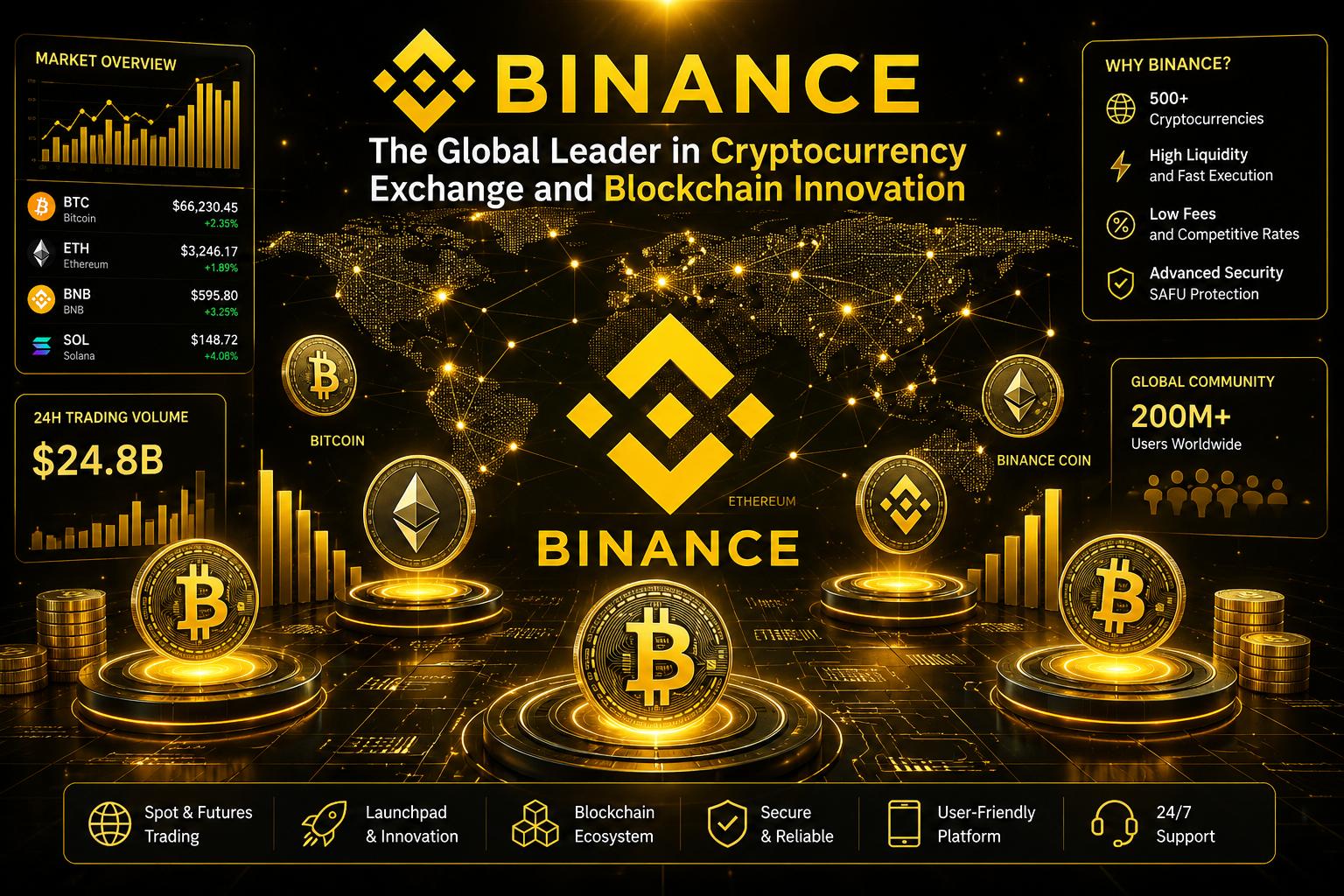
Introduction: The Exchange That Redefined Scale in Crypto
Few companies in the history of finance have grown as fast, as globally, or as controversially as Binance. Launched in 2017, Binance rose within a matter of years from a relatively unknown startup to the largest cryptocurrency exchange on the planet, processing trillions of dollars in trading volume and serving hundreds of millions of registered users across nearly every corner of the globe. Its influence extends far beyond simple spot trading — Binance has built an entire ecosystem spanning its own blockchain network, a widely used native token, venture investment arms, educational initiatives, and an expanding suite of traditional financial products.
At the same time, Binance’s story is inseparable from the regulatory turbulence that has followed its meteoric rise. The exchange has weathered intense scrutiny from financial regulators around the world, a landmark legal settlement with U.S. authorities, and a leadership transition that reshaped how the company operates. Understanding Binance today means understanding both halves of this story: the extraordinary scale and innovation that made it the dominant force in crypto trading, and the hard-won lessons about compliance and accountability that have reshaped its operations in recent years.
This article explores how Binance became the global leader in cryptocurrency exchange and blockchain innovation, the ecosystem it has built, the challenges it has faced, and where the platform appears to be heading next. It is a story that touches nearly every major theme running through the modern cryptocurrency industry — explosive technological growth, the tension between rapid global expansion and regulatory oversight, the slow but steady convergence of digital and traditional finance, and the ongoing question of how much trust a single platform can be expected to hold when it sits at the center of so much of the world’s crypto activity.
The Origins: Built for Speed in a Fast-Moving Market
Binance was founded in 2017 by a small team of engineers with deep backgrounds in high-frequency trading systems and exchange infrastructure. From day one, the platform was engineered around a singular priority: raw trading performance. At a time when many existing cryptocurrency exchanges struggled with slow matching engines, frequent downtime during periods of high volatility, and clunky user interfaces, Binance was built to handle massive trading volume with speed and reliability, quickly earning a reputation among traders as one of the most technically capable platforms in the industry.
This technical foundation, combined with an aggressive strategy of listing new cryptocurrencies faster than most competitors, allowed Binance to capture significant trading volume almost immediately after launch. Within roughly six months of going live, Binance had already become one of the largest cryptocurrency exchanges in the world by trading volume — a growth trajectory almost unmatched in the history of financial services.
A Global-First, Borderless Strategy
Unlike many exchanges that started with a single national headquarters and expanded outward, Binance was designed from the outset to operate as a globally distributed platform, without being anchored to any single jurisdiction. This borderless approach allowed the company to scale rapidly across dozens of countries, adapting to regional regulatory environments as it grew rather than being constrained by a single national regulatory framework from day one.
While this strategy fueled extraordinarily fast growth in the exchange’s early years, it also became one of the central sources of regulatory tension that Binance would later have to resolve, as regulators in major markets increasingly pushed the platform toward clearer jurisdictional accountability and formal licensing. In hindsight, this early tension between speed and structure would go on to define much of the next chapter in Binance’s history, as the company gradually shifted from an ethos of maximum flexibility toward one built around formal accountability in the specific markets where it chose to operate.
Building the Binance Ecosystem
What distinguishes Binance from a simple cryptocurrency exchange is the breadth of the ecosystem it has built around its core trading platform.
BNB: The Native Token at the Center of the Ecosystem
Central to Binance’s ecosystem is BNB, the platform’s native cryptocurrency, originally launched to offer users trading fee discounts on the exchange. Over time, BNB’s utility expanded dramatically beyond simple fee discounts, becoming the core token used across Binance’s broader blockchain ecosystem — powering transaction fees on Binance’s own blockchain networks, supporting token launches, and serving as a foundational asset within the exchange’s DeFi and Web3 initiatives. BNB has consistently ranked among the largest cryptocurrencies in the world by market capitalization, reflecting the scale of the ecosystem built around it.
Binance Smart Chain and BNB Chain
Recognizing the limitations of relying entirely on other blockchain networks for its ecosystem, Binance developed its own blockchain infrastructure, originally launched as Binance Smart Chain and later rebranded more broadly as BNB Chain. This network was designed to offer significantly lower transaction fees and faster confirmation times than Ethereum, quickly attracting a large community of developers building decentralized applications, decentralized exchanges, and new token projects on top of it.
BNB Chain’s growth had a significant ripple effect across the broader crypto industry, demonstrating that alternative blockchain networks optimized for speed and low cost could attract substantial developer activity and user adoption, intensifying competition among layer-1 blockchain networks more broadly.
Binance Launchpad and Token Listings
Binance built a significant reputation around its Launchpad platform, which allows new blockchain projects to raise funds and distribute tokens directly to Binance users before those tokens become tradable on the broader exchange. Several projects launched through Binance Launchpad went on to become significant success stories within the crypto industry, reinforcing Binance’s role not just as a trading venue, but as a genuine kingmaker within the broader landscape of new blockchain projects.
Binance Academy and Research
To support its broader mission of expanding cryptocurrency adoption, Binance built out extensive educational resources through Binance Academy, offering free content designed to help newcomers understand blockchain technology, trading concepts, and digital asset security. This educational investment reflects a recognition, shared across much of the crypto industry, that long-term adoption depends heavily on improving financial and technical literacy among new users entering an often confusing and rapidly evolving space.
Binance Labs and Venture Investment
Beyond its exchange operations, Binance has built a significant venture capital arm investing directly in early-stage blockchain projects and startups. This investment activity has allowed Binance to support the broader development of blockchain infrastructure and applications well beyond its own platform, functioning simultaneously as an exchange, a blockchain network operator, and a major venture investor within the same connected ecosystem.
Scale: Understanding Binance’s Global Dominance
Binance’s scale within the cryptocurrency industry is difficult to overstate. The platform has grown into the largest cryptocurrency exchange in the world by both registered users and trading volume, with hundreds of millions of accounts spanning nearly every region of the globe. On especially active trading days, Binance alone can account for a substantial share of global spot and derivatives trading volume across the entire cryptocurrency market — a level of market concentration virtually unmatched by any single financial venue in traditional markets.
Trading Volume and Market Share
Binance regularly processes tens of billions of dollars in daily spot trading volume, spread across thousands of individual trading pairs. When derivatives trading is included, Binance’s overall share of global cryptocurrency trading activity becomes even more pronounced, with the platform historically capturing a leading share of both Bitcoin and Ethereum trading volume worldwide on any given day.
User Growth
Binance’s user base has grown at a remarkable pace, expanding from a few million early crypto adopters shortly after launch to several hundred million registered users within less than a decade. This growth has been particularly notable in emerging markets, where Binance has often served as one of the primary gateways through which new populations first gain access to cryptocurrency and broader digital financial services.
Institutional Adoption
While Binance built its early reputation primarily around retail trading, the platform has increasingly attracted institutional participants as well, including hedge funds, market makers, and corporate treasury desks. Binance has expanded its institutional product suite considerably, including prime brokerage-style services, off-exchange settlement solutions that allow institutional clients to trade without moving assets away from independent custodians, and deep liquidity across both spot and derivatives markets — all aimed at meeting the more demanding operational and security requirements of large institutional trading desks.
Navigating Regulatory Challenges: A Defining Chapter
No honest account of Binance’s history can ignore the significant regulatory challenges the company has faced, which represent one of the most consequential chapters in the broader story of cryptocurrency regulation.
The Path to a Landmark Settlement
As Binance grew rapidly across multiple jurisdictions, it drew increasing scrutiny from regulators concerned about compliance with anti-money laundering requirements, sanctions rules, and licensing obligations in various countries. This scrutiny eventually culminated in a landmark legal settlement with U.S. authorities, under which Binance agreed to pay a substantial financial penalty and accepted a range of compliance-related commitments. As part of that resolution, the company’s founder and long-time chief executive stepped down from his leadership role, marking a significant turning point in the company’s history and governance structure.
A New Era of Leadership and Compliance
Following this settlement, Binance underwent one of the most significant corporate transformations in the history of the cryptocurrency industry, moving from a company defined largely by rapid, borderless growth to one increasingly focused on building formal compliance infrastructure, regional licensing, and closer relationships with regulators in major markets. Under new leadership, Binance has pursued formal regulatory authorization in a growing number of jurisdictions, including securing comprehensive licensing under a major Middle Eastern regulatory framework — a notable milestone representing one of the most rigorous approvals any global crypto exchange has achieved.
Rebuilding Trust Through Transparency
In the years following its regulatory settlement, Binance has placed significant emphasis on rebuilding user and institutional trust through greater transparency. This has included publishing regular proof-of-reserves reports intended to demonstrate that user assets held on the platform are appropriately backed, expanding its Secure Asset Fund for Users — an emergency reserve fund designed to help reimburse users in the event of a security incident — and investing heavily in compliance staffing and monitoring systems across its global operations.
This shift illustrates a broader pattern that has played out across the cryptocurrency industry more generally: exchanges that survive major regulatory reckonings tend to be those willing to fundamentally restructure their compliance posture, rather than treating enforcement action as an isolated cost of doing business.
The Broader Regulatory Landscape
Binance’s regulatory journey has also mirrored, and in some ways helped shape, the broader evolution of cryptocurrency regulation worldwide. As more countries have introduced formal licensing regimes for digital asset businesses, Binance has pursued authorization across an expanding list of jurisdictions, reflecting both the increasing maturity of global crypto regulation and the company’s own strategic shift toward operating within clearly defined legal frameworks rather than operating in less-regulated gray areas.
Security: Protecting Users at Unprecedented Scale
Given the sheer scale of assets held on the platform, security has remained a central and continuous priority for Binance throughout its history.
Cold Storage and Asset Protection
Binance stores the significant majority of user funds in cold storage — offline wallets disconnected from the internet and therefore far more resistant to hacking attempts than “hot,” internet-connected wallets used for active trading liquidity. This layered storage approach is a standard best practice among major exchanges, but the scale at which Binance must implement it, given the size of its user base and total assets held, makes its security infrastructure particularly consequential to the broader stability of the crypto market.
The Secure Asset Fund for Users (SAFU)
Binance established its Secure Asset Fund for Users specifically to provide a financial backstop in the event of a security breach or other incident resulting in user losses. This fund has grown substantially over time and has, on occasion, been used to help make affected users whole following security incidents, reflecting a broader industry recognition that user trust depends not just on preventing incidents entirely, but on having credible mechanisms in place to respond when they do occur.
Proof of Reserves
In response to broader industry concerns about exchange solvency — concerns significantly heightened following the collapse of other major exchanges in recent years — Binance began publishing regular proof-of-reserves reports using cryptographic verification methods intended to demonstrate that customer assets are appropriately backed on a roughly one-to-one basis. While such reports have inherent limitations and do not capture every dimension of an exchange’s financial health, they represent an important step toward greater transparency in an industry that has historically operated with limited public financial disclosure.
Continuous Security Investment
Binance has continued investing in advanced security systems, including artificial-intelligence-driven monitoring designed to detect suspicious account activity and potential fraud in real time. As cyber threats targeting cryptocurrency platforms have grown increasingly sophisticated, this continuous investment in both preventive and responsive security infrastructure has become an essential, non-negotiable part of operating an exchange at Binance’s scale.
Expanding Beyond Crypto: The Push Into Traditional Finance
In recent years, Binance has expanded its ambitions well beyond its original core of cryptocurrency trading, pursuing a broader vision of becoming a comprehensive global financial platform.
Tokenized Stocks and Traditional Securities
Binance has introduced products allowing users to gain exposure to traditional equities and exchange-traded funds directly through its platform, including tokenized securities that trade around the clock rather than being limited to traditional market hours. This expansion reflects a growing trend across the crypto industry toward blending traditional financial instruments with blockchain-based infrastructure, offering users continuous market access that traditional brokerages, bound by conventional trading hours, generally cannot match.
Building a “Financial Super App”
Binance’s broader strategic ambition appears to extend toward becoming an all-encompassing financial platform — combining cryptocurrency trading, traditional securities, savings and earning products, payment services, and more within a single unified application. This ambition reflects a recognition that long-term growth in the crypto industry increasingly depends on breaking down the barriers between traditional and digital finance, rather than treating them as entirely separate categories of financial activity.
Institutional Infrastructure Development
To support this broader vision, Binance has continued building out institutional-grade infrastructure, including partnerships with independent custody providers that allow institutional clients to trade on Binance while keeping their underlying assets secured with regulated third-party custodians — an arrangement designed to address institutional concerns about counterparty risk that have persisted since the broader crypto industry’s various high-profile collapses.
Binance’s Role in Shaping the Broader Crypto Industry
Beyond its own platform, Binance’s influence has rippled across the cryptocurrency industry as a whole in several important ways.
Setting Competitive Benchmarks
Binance’s scale and product breadth have effectively set the competitive benchmark that other major exchanges — including Coinbase, Kraken, and OKX — must measure themselves against, whether in terms of trading fees, product diversity, listing speed for new tokens, or geographic reach. This competitive pressure has generally pushed the broader exchange industry toward faster innovation and, particularly in recent years, toward greater regulatory compliance as competitors seek to differentiate themselves on trust and legitimacy.
Advancing Blockchain Infrastructure
Through BNB Chain and its broader ecosystem investments, Binance has played a significant role in advancing the development of alternative blockchain infrastructure beyond Ethereum, contributing to a broader multi-chain future in which different blockchain networks compete and specialize based on cost, speed, and specific use cases rather than a single network dominating all blockchain activity.
Expanding Global Access to Crypto
Perhaps most significantly, Binance has played an outsized role in expanding cryptocurrency access to populations and regions historically underserved by traditional financial services. In many emerging markets, Binance has served as a primary entry point through which new users gain access not just to cryptocurrency trading, but to broader digital financial tools, including savings products and payment capabilities that may be more accessible or more attractive than traditional banking alternatives in certain regions.
Looking Ahead: What’s Next for Binance
Several key trends appear likely to define Binance’s continued evolution in the years ahead.
Continued regulatory expansion is likely to remain a top priority, as Binance pursues formal licensing across additional jurisdictions in pursuit of long-term legitimacy and reduced regulatory risk, building on its post-settlement strategic shift toward compliance-first operations.
Deeper integration between crypto and traditional finance appears likely to accelerate, as Binance continues expanding its tokenized securities and traditional asset offerings, potentially blurring the line between cryptocurrency exchanges and conventional brokerages even further.
Institutional infrastructure investment will likely continue growing, as Binance competes for institutional trading volume against both crypto-native competitors and increasingly crypto-curious traditional financial institutions.
Ecosystem expansion around BNB Chain seems likely to persist, as Binance continues supporting developer activity and new applications built on its blockchain infrastructure, reinforcing the broader ecosystem beyond the core exchange product.
Ambitions toward becoming a global financial super app suggest Binance’s long-term strategic identity may increasingly diverge from that of a pure cryptocurrency exchange, evolving instead toward a broader, digitally native financial services platform serving billions of potential users worldwide.
Whatever specific direction these developments take, Binance’s underlying strategic identity — extraordinary scale, rapid product innovation, and an increasingly serious commitment to regulatory legitimacy following its past challenges — appears likely to remain central to its next chapter.
Binance’s Derivatives and Advanced Trading Business
While spot trading first brought Binance to prominence, its derivatives business — including futures and options contracts tied to cryptocurrency prices — has become an equally significant, and in many respects even more dominant, part of the platform’s overall trading activity.
Futures and Perpetual Contracts
Binance offers a wide range of futures products, including perpetual contracts that allow traders to speculate on cryptocurrency price movements with leverage, without an expiration date. These products have become enormously popular among both retail and professional traders, and Binance’s derivatives volume regularly represents a substantial share of the entire global crypto derivatives market, often exceeding the trading activity seen on dedicated derivatives-focused platforms.
Risk Management Infrastructure
Operating a derivatives business at this scale requires substantial risk management infrastructure, including systems designed to manage liquidations, insurance funds intended to cover losses during periods of extreme volatility, and continuously updated risk parameters for different trading pairs. Binance has invested heavily in this infrastructure, recognizing that the reliability of its risk systems directly affects both trader confidence and the platform’s own financial stability during periods of significant market stress.
Appealing to Professional and Institutional Traders
Binance’s advanced trading tools — including API access for automated trading strategies, deep order book liquidity, and a wide selection of trading pairs — have made the platform particularly attractive to professional traders, quantitative trading firms, and institutional desks seeking efficient execution at scale. This professional-grade infrastructure operates alongside Binance’s more beginner-friendly “Lite” mode, allowing the platform to serve dramatically different types of users without forcing either group into an experience poorly suited to their needs.
How Binance Compares to Its Major Competitors
Understanding Binance’s position in the market also requires understanding how it compares to its closest competitors, each of which has pursued a somewhat different strategic path.
Where Coinbase has built its reputation primarily around U.S. regulatory compliance, public company transparency, and a beginner-friendly retail experience, Binance has historically competed on sheer scale, product breadth, and aggressive global expansion — a strategy that fueled faster growth but also invited greater regulatory friction along the way. Other competitors, such as Kraken and OKX, have carved out their own niches, whether through long-standing reputations for security and regulatory caution or through deep institutional relationships in specific regions.
In the current market environment, competition among these major platforms increasingly centers on institutional trust and infrastructure rather than simply trading fees or the number of listed tokens. As Binance has rebuilt its compliance posture following its regulatory settlement, it has increasingly competed directly with more conservative, compliance-first competitors for the same institutional clients — a dynamic that would have seemed unlikely during the exchange’s earlier, faster-growing but less regulated years.
Frequently Asked Questions
Is Binance the largest cryptocurrency exchange in the world? Yes. By registered users and total trading volume, Binance is widely recognized as the largest cryptocurrency exchange globally, processing a substantial share of worldwide spot and derivatives trading activity.
What is BNB and why is it important? BNB is Binance’s native cryptocurrency, originally created to provide trading fee discounts on the exchange. It has since become a central utility token across the broader Binance ecosystem, including BNB Chain, token launches, and various DeFi applications.
Is Binance available in the United States? The main global Binance exchange is not available to U.S. residents. Instead, U.S. users can access a separate, independently regulated platform, Binance.US, which operates under its own compliance framework.
What happened with Binance’s regulatory settlement? Binance reached a landmark settlement with U.S. authorities involving a substantial financial penalty and a series of compliance commitments. As part of the resolution, the company’s founder stepped down from his executive role, and Binance has since undergone significant changes to its leadership and compliance infrastructure.
How does Binance protect user funds? Binance stores the majority of user assets in offline cold storage, publishes periodic proof-of-reserves reports, and maintains a dedicated emergency reserve fund known as SAFU designed to help reimburse users in the event of a security incident.
Does Binance offer more than just cryptocurrency trading? Yes. Binance has expanded well beyond spot crypto trading to include derivatives, staking, its own blockchain network, tokenized stocks and ETFs, educational resources, and venture investment activities, positioning itself as a broad digital financial ecosystem rather than a single-purpose exchange.
How does Binance’s derivatives business compare to its spot trading business? Binance’s derivatives volume, including futures and perpetual contracts, regularly represents a substantial share of the exchange’s overall trading activity and often exceeds volumes seen on platforms that specialize exclusively in derivatives, reflecting the platform’s broad appeal to both retail and professional traders.
Conclusion
Binance’s story is, in many ways, the story of the cryptocurrency industry itself: extraordinary, rapid growth built on genuine technological and product innovation, followed by a difficult but ultimately necessary reckoning with regulatory accountability, and now an ongoing effort to build durable legitimacy without losing the scale and agility that made the platform dominant in the first place.
Few companies have shaped the practical experience of buying, trading, and holding cryptocurrency as significantly as Binance has for hundreds of millions of users worldwide. Its blockchain infrastructure, native token ecosystem, and expanding suite of financial products have pushed the boundaries of what a cryptocurrency exchange can become, while its regulatory journey has offered the broader industry an important lesson about the long-term costs of prioritizing growth over compliance — and the real possibility of rebuilding trust through sustained transparency and structural change.
What makes Binance’s trajectory particularly instructive is the scale at which its lessons have played out. Because so much of the global cryptocurrency market has historically flowed through a single platform, the consequences of both its early, less regulated growth strategy and its later compliance-focused transformation have rippled across the entire industry, influencing how competitors, regulators, and institutional participants alike think about what responsible operation at massive scale actually requires.
As Binance continues expanding into traditional finance, deepening its institutional infrastructure, and pursuing formal regulatory legitimacy across an increasingly global footprint, its next chapter will likely say as much about the broader future of digital finance as its first decade said about the raw, disruptive potential of cryptocurrency itself. For an industry still working to prove that speed, scale, and trust can coexist, Binance’s ongoing transformation remains one of the most closely watched case studies in modern financial history.